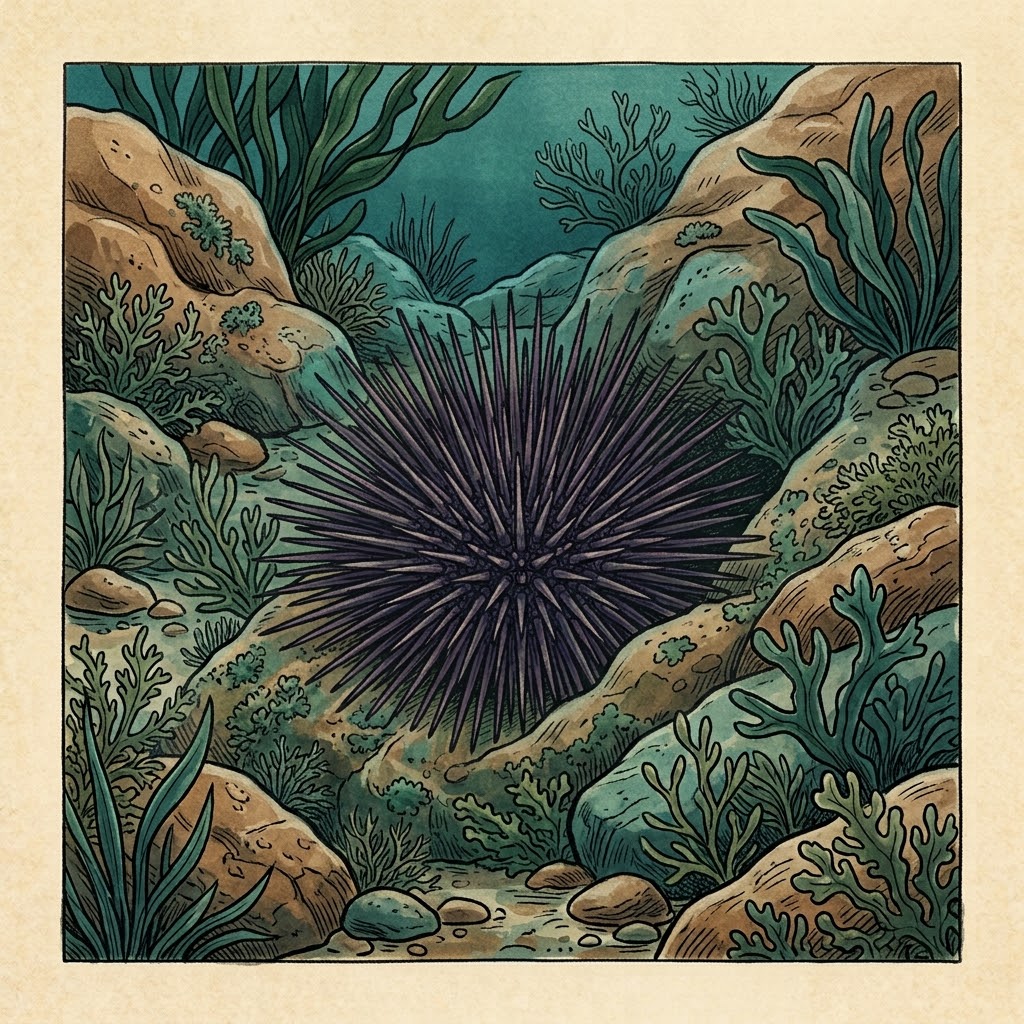
Echinoderm · Mediterranean
Paracentrotus lividus
● Stock under pressure · shortened season
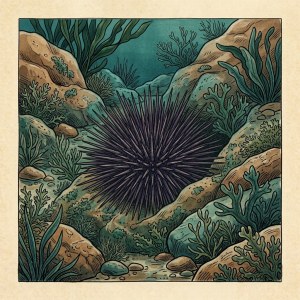
Snorkel anywhere along the Mediterranean and you will see them among the rocks: little balls covered in purple spines. Step on one and you will never forget it. But inside lies a delicacy: five orange star-shaped strips of roe, the corail, which tastes of the sea itself.
| Habitat | Rocky seabeds and seagrass meadows, from the surface to about 20 metres deep |
| Size | Shell up to 7 cm across, without spines |
| Season on the plate | Midwinter, from mid-December to the end of February |
Card I of IV
Ecological profile
| Identification | Round shell covered in long, sharp spines, usually purple, sometimes brown or olive green; often with bits of shell or seagrass on its back as camouflage |
| Don’t confuse with | The black sea urchin, with matt black spines, which has hardly any edible roe |
| Diet | Algae and seagrass, which it scrapes off the rocks with its five teeth |
Where can you find them?
Difficulty: ●●●●● Very easy
With a snorkel mask you will see them on almost any rocky coast, often in just half a metre of water.
| Provence | The Côte Bleue and the Calanques near Marseille |
| Also good | The rocky coasts of the Côte d’Azur and Corsica |
| Tip | Wear water shoes: the spines snap off easily in your foot |
Did you know a sea urchin walks on hundreds of tiny tube feet between its spines? Its mouth on the underside, with five teeth in an intricate jaw, is called ‘Aristotle’s lantern’.
Card II of IV
Behaviour & seasons
The sea urchin is the lawnmower of the rocks. It creeps slowly over the seabed, grazing algae and seagrass. By day it often sits in a hollow or crevice, sometimes a hollow it has worn into the rock itself with its teeth and spines. In winter the roe glands grow, and in spring and early summer males and females release their eggs and sperm into the water at the same time.
| December – February | Roe full and orange: the eating season |
| March – June | Spawning season; harvesting closed |
| Summer | Roe empty; the larvae drift with the plankton |
| Autumn | Roe builds up again |
When to eat them?
| Jan | Feb | Mar | Apr | May | Jun | Jul | Aug | Sep | Oct | Nov | Dec |
| season | closed · spawning and recovery | from mid-Dec. | |||||||||
■ Plenty fresh ■ Fair supply ■ Better to skip
Card III of IV
From sea to plate
Along the Provençal coast the sea urchin has become clearly rarer in recent years, through harvesting and a warmer sea. That is why, since 2023, the season in the Bouches-du-Rhône, the Var and the Alpes-Maritimes has been cut back to roughly mid-December to the end of February. There is a minimum size of 5 cm across without spines, and recreational gatherers may only take a limited number per day. So buy sea urchins only in season, from a licensed fisher or fishmonger.
These are general seasonal and preparation guidelines, not official fishing rules or a food safety guarantee. Check local regulations and reliable sources.
Card IV of IV
Recipe & tradition
Oursins nature (raw sea urchins)
| Sea urchins | A dozen fresh sea urchins, ideally caught the same day |
| Opening | Cut around the mouth on the flat underside with scissors or a special tool and lift off the cap |
| Cleaning | Rinse briefly in seawater, so only the five orange strips of roe remain |
| Serve with | A teaspoon, baguette with butter and a cool white wine from Cassis |
On Sundays in January and February the quays of Carry-le-Rouet and other villages on the Côte Bleue fill with tables: it is time for the oursinades. Fishers open the sea urchins on the spot, and people eat them with a little spoon, a piece of bread and a glass of white wine in the winter sun by the sea. With the shorter season and smaller stock, though, there are fewer fishers than there used to be.
These are general seasonal and preparation guidelines, not official fishing rules or a food safety guarantee. Check local regulations and reliable sources.
Frequently asked questions
Questions about the purple sea urchin
Which part of a sea urchin do you eat?
Only the five orange strips of roe inside, the corail. The rest is thrown away.
When is sea urchin season?
On the Provençal coast it now runs from about mid-December to the end of February. Always check the current rules for each département.
What should you do if you step on a sea urchin?
Carefully remove any protruding spines with tweezers and disinfect the wound. If they are deep or the spot becomes inflamed, see a doctor.
Habitat · France