Mammal · Baltic coast & wetlands
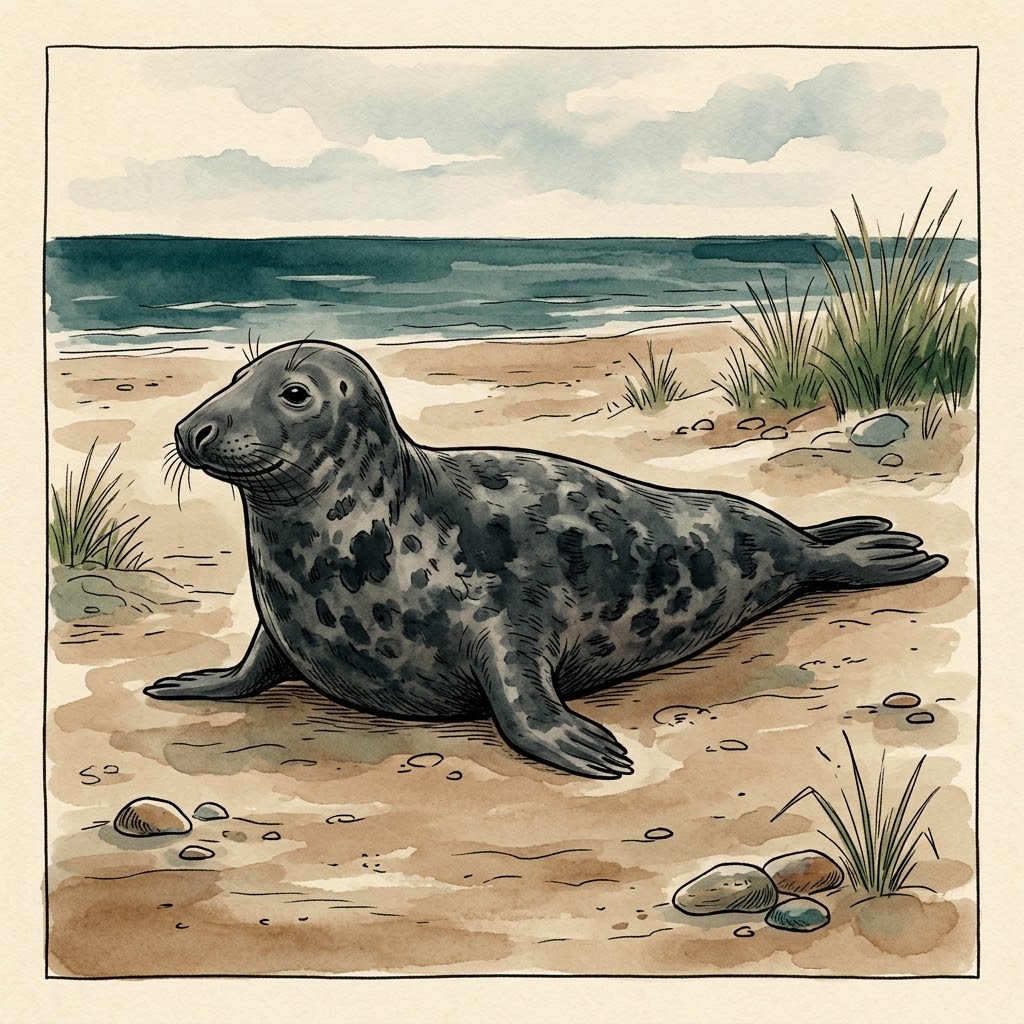
Halichoerus grypus
● IUCN: Least Concern · strictly protected
Germany’s largest predator does not live in the forest, but by the sea. The grey seal was long persecuted as a ‘fishing pest’ and disappeared from the German coast. Now it is coming back: on Heligoland, hundreds of white pups are born every winter.
| Habitat | Sandy beaches, sandbanks and rocky coasts of the North Sea and Baltic |
| Weight | Female approx. 150–200 kg, male up to approx. 300 kg |
| Active | Day and night; rests on the beach between hunting trips |
Card I of IV
Ecological profile
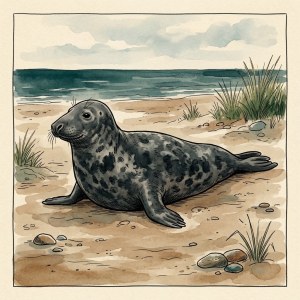
| Identification | Large seal with a long, straight ‘Roman’ nose, parallel nostrils and a dark, blotchy grey coat |
| Difference from harbour seal | Larger and heavier, with a pointed, elongated head; the harbour seal has a round head and V-shaped nostrils |
| Diet | Mainly fish, such as cod, flatfish and herring |
Where can you see them?
Difficulty: ●●●●● Easy
On Heligoland you see them almost always. On the Baltic they are still rare, but numbers are growing.
| North Sea | The Düne of Heligoland, and sandbanks near Amrum and the East Frisian Islands |
| Baltic | The Greifswalder Oie and the Großer Stubber sandbank in the Greifswald Bay |
| Tip | Always keep plenty of distance, especially from mothers with pups. On the Düne, rangers show you the safe paths |
Did you know grey seal milk is more than half fat? That is why the pups gain up to two kilos a day.
Card II of IV
Behaviour & seasons
In winter, when other animals take it easy, the beach is busy. Mothers give birth to a single pup with a thick, white baby coat. The pups cannot swim yet and lie alone on the beach for days while the mother hunts at sea. That is normal: they have not been abandoned.
| November – January | Pupping and mating season on the North Sea, with most births in December |
| After about four weeks | The pups lose their white coat and go into the water |
| Spring | Moulting; the animals spend a lot of time on the sandbanks |
| Rest of the year | Hunting at sea and resting on the beach |
When is the best time to see them?
| Jan | Feb | Mar | Apr | May | Jun | Jul | Aug | Sep | Oct | Nov | Dec |
| winter · pups | spring · moult | summer | autumn | pups | |||||||
■ Good chance ■ Fair chance ■ Difficult
Card III of IV
Role in the ecosystem
As the largest predator, the grey seal sits at the top of the food chain in coastal waters. Near Heligoland, grey seals have in recent years even been seen attacking and eating harbour seals. Its return shows that the sea is doing better, but it also sparks debate with fishermen.
Found a pup? A white pup lying alone on the beach is usually not in trouble: the mother is hunting nearby. Keep your distance, do not touch it and keep dogs on a lead. If in doubt, report it to a seal sanctuary or the local nature warden.
Card IV of IV
Stories & culture
From ‘fishing pest’ to Heligoland star
Around 1900 some hundred thousand grey seals lived in the Baltic. They were hunted everywhere as competitors of the fishermen: between 1886 and 1927 more than 350,000 were killed in the Baltic. In 1920 the last one was shot on the coast of Western Pomerania. After protection they slowly returned. In 1993 the first pup was born on Heligoland’s Düne; today there are more than a thousand every winter.
Frequently asked questions
Questions about the grey seal
Where can you see grey seals in Germany?
Most easily on Heligoland’s Düne. On the Baltic they rest mainly on the Greifswalder Oie and the Großer Stubber sandbank.
When are the pups born?
On the North Sea from November to January, with most births in December. After about four weeks the pups lose their white coat and go into the water.
How do you recognise a grey seal?
By its long, straight nose and parallel nostrils. The harbour seal is smaller, with a round head and V-shaped nostrils.
What should you do if you see a pup alone?
Keep your distance and do not touch it. The mother is usually hunting nearby. If in doubt, report it to a seal sanctuary or the local nature warden.
Habitat · Germany