Bird · Coast & North Sea
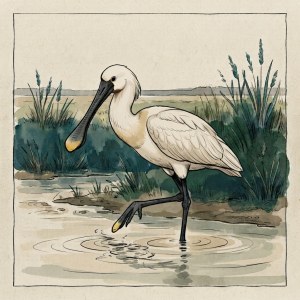
Platalea leucorodia
● IUCN: Least Concern · protected
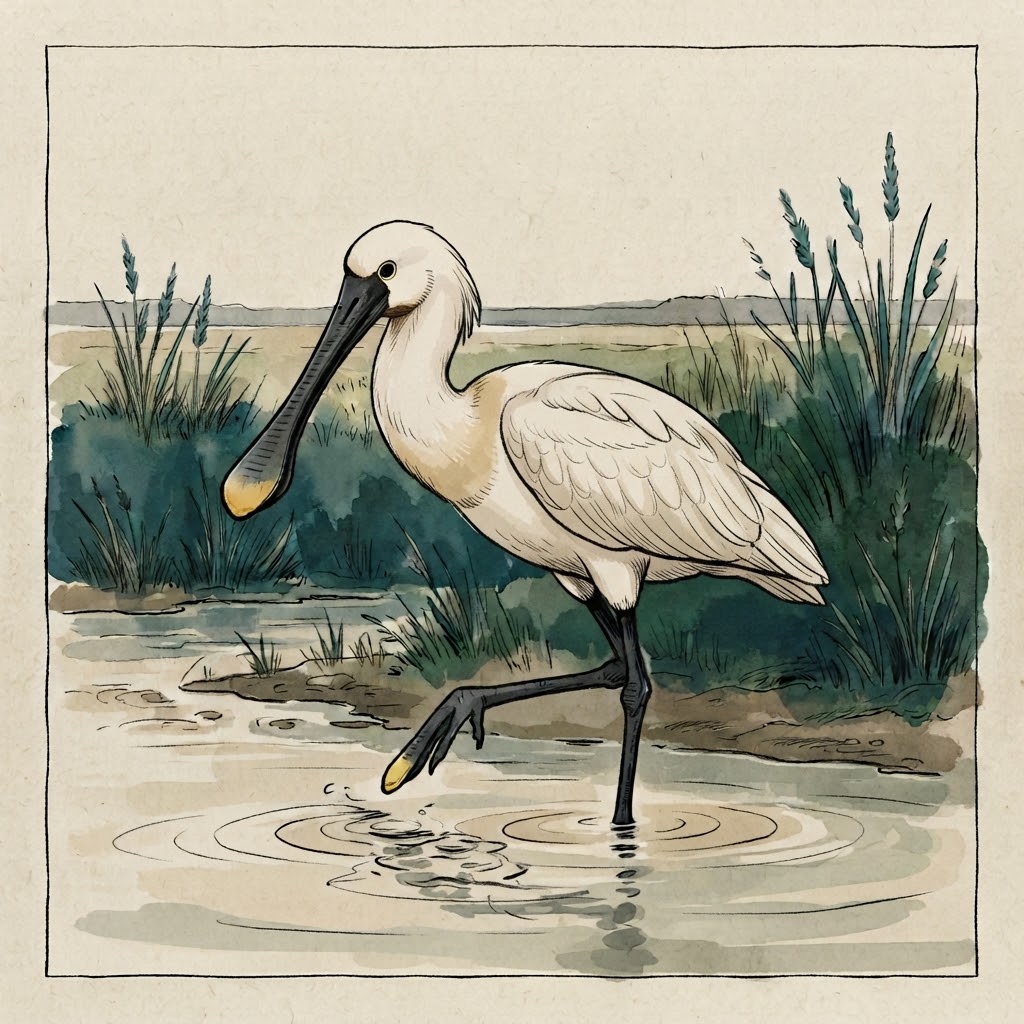
A snow-white bird that swings its bill through the shallow water like a scythe, back and forth, back and forth. That bill ends in a flat spoon, which gives the spoonbill its name. Once nearly gone, it is now a familiar sight again in coastal nature.
| Habitat | Shallow water, mudflats, salt marshes and freshwater marshes |
| Length | 80–93 cm, wingspan up to 1.35 m |
| Weight | About 1.1–2 kg |
Card I of IV
Ecological profile
| Identification | All white, long black bill ending in a flat, yellow-tipped spoon; in the breeding season a crest and a yellowish-brown breast band; flies with neck outstretched |
| Not to be confused with | The great egret, which has a pointed bill and flies with its neck drawn in |
| Diet | Small fish, shrimps and other crustaceans, insect larvae |
Where can you find them?
| Belgium | From spring to late summer in coastal reserves such as the Zwin and the IJzer estuary, and in the polders |
| Netherlands | Large breeding colonies on the Wadden Islands and in the Delta region |
| Tip | Look around channels and pools at low tide: spoonbills often feed in small groups |
Did you know the spoonbill hunts by touch? As soon as something touches the sensitive inside of the spoon, the bill snaps shut in a flash. That way it can find food even in murky water and at night.
Card II of IV
Behaviour & seasons
Spoonbills breed in colonies, on the ground in dune valleys and salt marshes or in bushes and low trees. They sometimes fly dozens of kilometres between their nest and their feeding grounds. In late summer most birds head south: some winter in France and Spain, many continue to West Africa, to the Banc d’Arguin in Mauritania and the deltas of Senegal. More and more spoonbills, however, stay in our region in mild winters.
| March – April | Return to the breeding colonies |
| April – July | Breeding; 3–4 eggs, the young fledge after ±7 weeks |
| August – October | Migration south |
| Winter | Southern Europe and West Africa; a few stay here |
Card III of IV
Role in the ecosystem
The spoonbill depends on shallow, food-rich water full of small fish and shrimps. That makes it a good indicator of healthy salt marshes, mudflats and marshes. In the 1960s the Dutch population collapsed to about 150 pairs, mainly because of agricultural pesticides that built up in the birds through their food. After those substances were banned, and thanks to nature restoration, the population grew back to thousands of pairs.
What helps? Peace in the breeding colonies, clean and shallow water, and protection of the wintering grounds in West Africa. A spoonbill needs two ‘home countries’.
Card IV of IV
Stories & culture
The spoonbill played a part in the birth of nature conservation in the Netherlands. Around 1900, the Naardermeer, home to one of the country’s last spoonbill colonies, was to be drained and used as a rubbish dump for Amsterdam. Nature lovers bought the lake in 1906 and founded Natuurmonumenten to do so. The Naardermeer thus became the first private nature reserve in the Netherlands.
Frequently asked questions
Questions about the spoonbill
Where can you see spoonbills in Belgium?
From spring to late summer in coastal reserves such as the Zwin and the IJzer estuary, and in wet polder areas.
Why does the spoonbill have such a strange bill?
It sweeps the flat spoon through the water and feels for prey. When a small fish or shrimp touches the inside, the bill snaps shut immediately.
Where do spoonbills spend the winter?
Mainly in France, Spain and West Africa, including Mauritania and Senegal. A small number stay in the Low Countries in mild winters.
Habitat · Belgium