Crustacean · Coast & North Sea
Cancer pagurus
● Common in the North Sea · minimum landing size
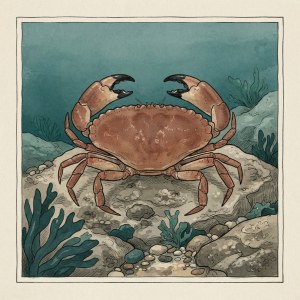
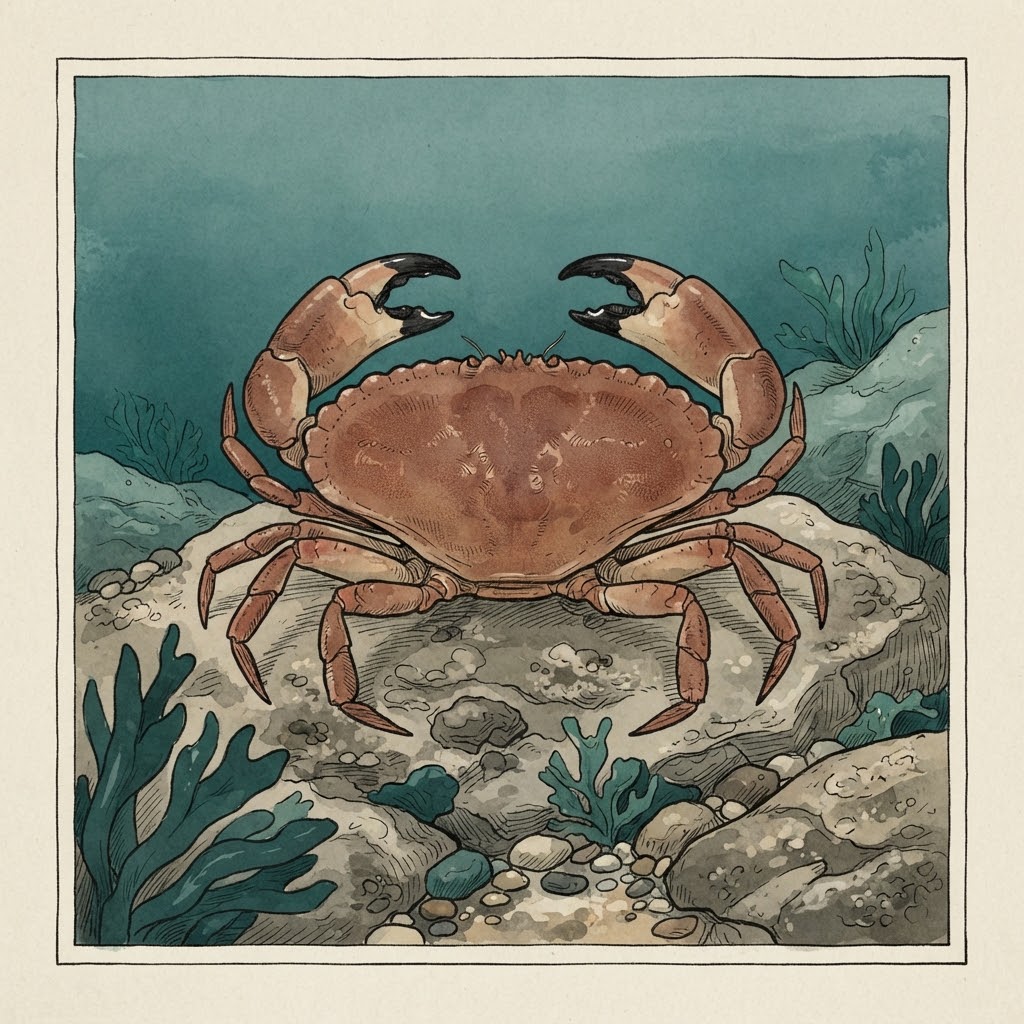
A sturdy, reddish-brown crab with a shell that looks like a pie with a crimped edge, and heavy claws with black tips. The edible crab is the largest crab on our coast and loves hard bottoms: rocks, stones and shipwrecks.
| Habitat | Rocky and stony bottoms, wrecks and dyke foundations, to ±100 m deep |
| Shell width | Usually 15–20 cm, sometimes up to 25 cm |
| Weight | Adults usually 1–3 kg |
Card I of IV
Ecological profile
| Identification | Oval, reddish-brown shell with a crimped ‘pie-crust’ edge at the front; heavy claws with black tips |
| Male or female | Males have larger claws and a narrow, pointed tail flap; females a broad, rounded one |
| Diet | Shellfish, crustaceans, worms and carrion; it cracks mussels and snails with its claws |
Where can you find them?
| Belgium | Around shipwrecks, offshore wind farms and harbour piers in the North Sea |
| Netherlands | In the Eastern Scheldt, along dykes and around wrecks off the coast |
| Tip | Empty shells from moulting sometimes wash up; they are light and empty inside |
Did you know the foundations of offshore wind turbines form new ‘reefs’? Crabs, lobsters and fish flock to them, because the stones offer shelter and food.
Card II of IV
Behaviour & seasons
By day the edible crab hides in crevices or buries itself; at night it goes out. To grow, it has to shed its hard shell. Just after moulting it is soft and vulnerable, and hides until the new shell has hardened. A female can carry millions of eggs under her tail flap for months, until the larvae hatch in spring and drift away with the current.
| Summer – autumn | Moulting and mating |
| Winter | Females carry the eggs under the tail flap |
| Spring – summer | Larvae hatch and drift with the current |
| All year | Hidden by day, active at night |
Card III of IV
From wild to plate
Edible crabs are caught with pots. A minimum landing size applies, and in some areas females carrying eggs may not be landed. Buy them from the fishmonger, preferably ready-cooked, or fresh from a trader who knows where they come from. A good crab feels heavy for its size: a light crab has just moulted and holds little meat. The white meat is in the claws and legs, the flavourful brown meat under the shell.
These are general seasonal and preparation guidelines, not official hunting seasons or a food safety guarantee. Check local regulations and reliable sources.
Card IV of IV
Recipe & tradition
Tourteau mayonnaise
| Crab | A whole edible crab, cooked and cooled |
| Mayonnaise | Homemade from egg yolk, mustard, oil and a squeeze of lemon juice |
| Tools | Nutcracker or small hammer and a crab pick |
| To serve | Brown bread and butter, lemon and a fresh salad |
In France the edible crab is called tourteau, and on the coasts of Brittany and Normandy tourteau mayonnaise is a fixed classic. The crab comes to the table whole and everyone cracks their own claws and legs. It is not a quick dish but a convivial ritual, also found on the menus of Belgian seaside brasseries.
These are general seasonal and preparation guidelines, not official hunting seasons or a food safety guarantee. Check local regulations and reliable sources.
Frequently asked questions
Questions about the edible crab
How do you recognise an edible crab?
By its oval, reddish-brown shell with a crimped edge at the front and its heavy claws with black tips.
How can you tell if a crab has plenty of meat?
A good crab feels heavy for its size. A light crab has usually just moulted and is not yet ‘full’.
Where does the edible crab live in Belgium?
On hard bottoms in the North Sea: around shipwrecks, harbour piers and the foundations of offshore wind farms.
Habitat · Belgium