Mollusc · Coast & North Sea
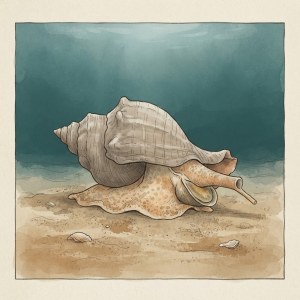
Buccinum undatum
● Common in the North Sea · locally vulnerable
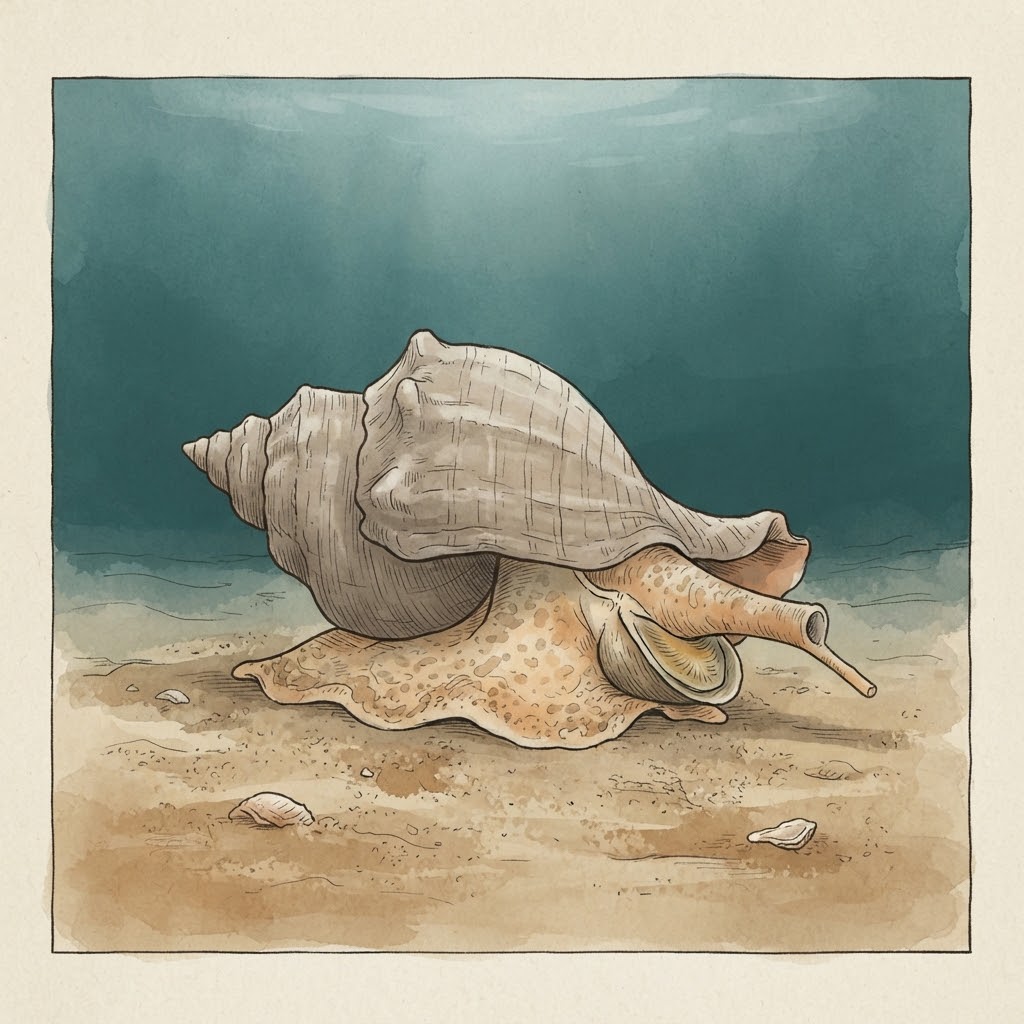
The largest sea snail in the North Sea creeps slowly across the seabed, with a long ‘snorkel’ raised to sniff the water. If it smells a dead fish, it gets there faster than you might expect. On the beach you will often find its empty shells, and its strange, spongy egg masses.
| Habitat | Sand, gravel and mud bottoms, from the low-tide line to ±1,200 m deep |
| Shell length | Usually 6–10 cm, sometimes up to 12 cm |
| Age | Can live for more than ten years |
Card I of IV
Ecological profile
| Identification | Thick, pointed spiral shell with wavy ribs, cream to yellowish brown; large opening closed by a horny lid |
| Egg masses | Light, spongy clusters of hundreds of empty egg capsules, often washed up after a storm |
| Diet | Dead fish and other remains, worms and shellfish |
Where can you find them?
| Belgium | On the North Sea floor; empty shells and egg masses wash up on the beach |
| Netherlands | In the North Sea and the Eastern Scheldt; strongly declined in the Wadden Sea |
| Tip | After a strong north-westerly storm, search the tideline for shells and egg masses |
Did you know sailors once used the light egg masses of the whelk to wash themselves? That is why they are still called sea wash balls in English.
Card II of IV
Behaviour & seasons
The whelk ‘smells’ with its siphon, a tube it raises like a snorkel. This lets it find carrion from far away. It opens live shellfish by wedging the edge of its own shell between their valves. In the cold months the females lay their egg capsules in clusters on stones and shells. After a few months a handful of fully formed little snails crawl out of each capsule: the whelk has no free-swimming larval stage.
| Autumn – winter | Mating and laying egg masses |
| Spring | Young snails crawl out of the capsules |
| After storms | Empty egg masses and shells wash up |
| All year | Active on the seabed, searching for carrion |
Card III of IV
From wild to plate
Whelks are caught with baited pots and also come up as bycatch in nets. Because they grow slowly, mature late and hardly disperse, local stocks are easily overfished. Minimum sizes therefore apply. Buy whelks from a fishmonger who knows where they come from. In Belgium you mostly find them cooked at stalls on the coast and in Brussels, and fresh at the fishmonger. Cook whelks briefly, as overcooking makes the meat tough.
These are general seasonal and preparation guidelines, not official hunting seasons or a food safety guarantee. Check local regulations and reliable sources.
Card IV of IV
Recipe & tradition
Caricoles
| Shellfish | Whelks, well rinsed |
| Broth | Water with celery, onion, bay leaf, thyme, salt and plenty of pepper or a pinch of cayenne |
| Method | Cook briefly in the spiced broth until the meat is done but still tender |
| To serve | Piping hot in a small bowl with a splash of broth, and a pick to get the meat out of the shell |
In Brussels, caricoles are a real street tradition. Since the nineteenth century, street vendors have sold the whelks hot from a cart, in a small bowl of spicy broth. They were once a fixture around the bird market and at the funfair. Today only a few stalls remain, but whoever finds one gets a taste of old Brussels.
These are general seasonal and preparation guidelines, not official hunting seasons or a food safety guarantee. Check local regulations and reliable sources.
Frequently asked questions
Questions about the common whelk
What are those spongy balls on the beach?
They are usually empty egg masses of the whelk: clusters of hundreds of small egg capsules from which the young snails have already crawled out.
What are caricoles?
A Brussels street snack: whelks cooked in a spicy broth with celery and pepper and sold hot in a small bowl.
Why did the whelk disappear from the Wadden Sea?
Mainly because of pollution with TBT, a toxic substance from ship paint that disrupted reproduction, and because of fishing. TBT has since been banned.
Habitat · Belgium