Mammal · Brooks & rivers
Lutra lutra
● IUCN: Near Threatened · strictly protected
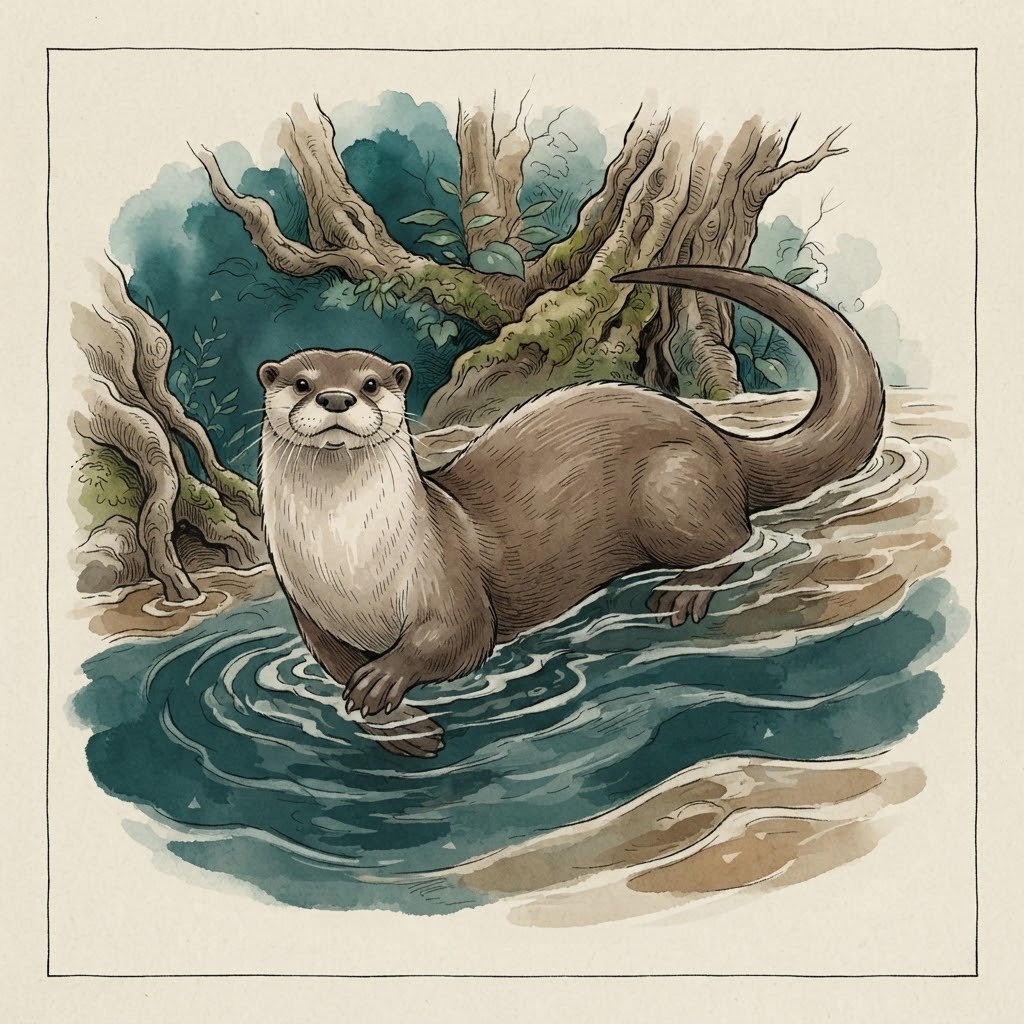
A long, supple body that glides through the water like a wave, a flat head with small ears and a thick tail for a rudder. The otter almost disappeared from the Low Countries, but it is slowly swimming back.
| Habitat | Clean rivers, streams and marshes with vegetated banks |
| Length | 60–90 cm, plus a 35–45 cm tail |
| Weight | About 6–10 kg |
Card I of IV
Ecological profile
| Identification | Long, streamlined and brown, with a pale throat, flat head, small ears, webbed feet and a thick, tapering tail |
| Signs | Droppings (spraints) on stones and stumps by the water, containing fish scales and with a sweetish smell |
| Diet | Mainly fish, plus crayfish, frogs and sometimes waterbirds |
Where can you find them?
| Belgium | Very rare; slowly returning along rivers in the Ardennes and in Limburg |
| Netherlands | Reintroduced in De Weerribben in 2002 and since spread to more parts of the country |
| Tip | Seeing one is a lucky moment; look instead for tracks and spraints along the bank |
Did you know an otter has no thick layer of blubber like a seal? It stays warm thanks to an extremely dense coat that traps a layer of air, keeping the cold water away from its skin.
Card II of IV
Behaviour & seasons
Otters are mainly active at night and at dusk and sometimes travel many kilometres a night along the water. A male has a large territory that overlaps those of several females. By day they rest in a den in the bank, the ‘holt’, or among tree roots and reeds. Otters have no fixed breeding season: cubs can be born at any time of year.
| All year | Mating and births can happen in any season |
| After ±2 months | Two to three cubs in a well-hidden holt |
| After ±3 months | The cubs learn to swim and fish from their mother |
| After ±1 year | Young otters leave and look for a territory of their own |
Card III of IV
Role in the ecosystem
The otter sits at the top of the food web in our rivers. It mainly takes abundant and slow fish, and its presence shows that a river is clean and holds enough fish. In the twentieth century it disappeared almost everywhere because of hunting, pollution with toxic substances such as PCBs, and the straightening of rivers. Today traffic is its biggest threat: many otters are killed crossing roads.
What helps? Wildlife underpasses beneath roads and dry ledges under bridges, so otters don’t have to cross the road. And natural, vegetated banks where they can hide.
Card IV of IV
Stories & culture
Few animals have inspired so many writers. In Tarka the Otter (1927) Henry Williamson followed the life of an otter along the rivers of Devon, and in Ring of Bright Water Gavin Maxwell described his life with a tame otter on the Scottish coast. Both books helped turn the otter from a ‘fish thief’ into a beloved symbol of living rivers.
Frequently asked questions
Questions about the otter
Are there otters in Belgium?
Yes, but they are very rare. The otter is slowly returning along rivers in the Ardennes and in Limburg, often coming from the Netherlands, Germany and Luxembourg.
What does an otter eat?
Mainly fish, plus crayfish, frogs and sometimes waterbirds.
What is the biggest threat to the otter?
At the moment, traffic. It also needs clean water, enough fish and quiet, vegetated banks.