Mammal · Brooks & rivers
Castor fiber
● IUCN: Least Concern · protected
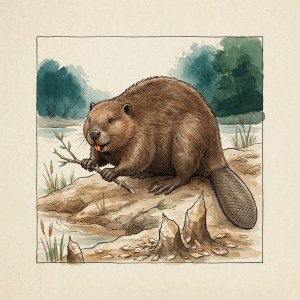
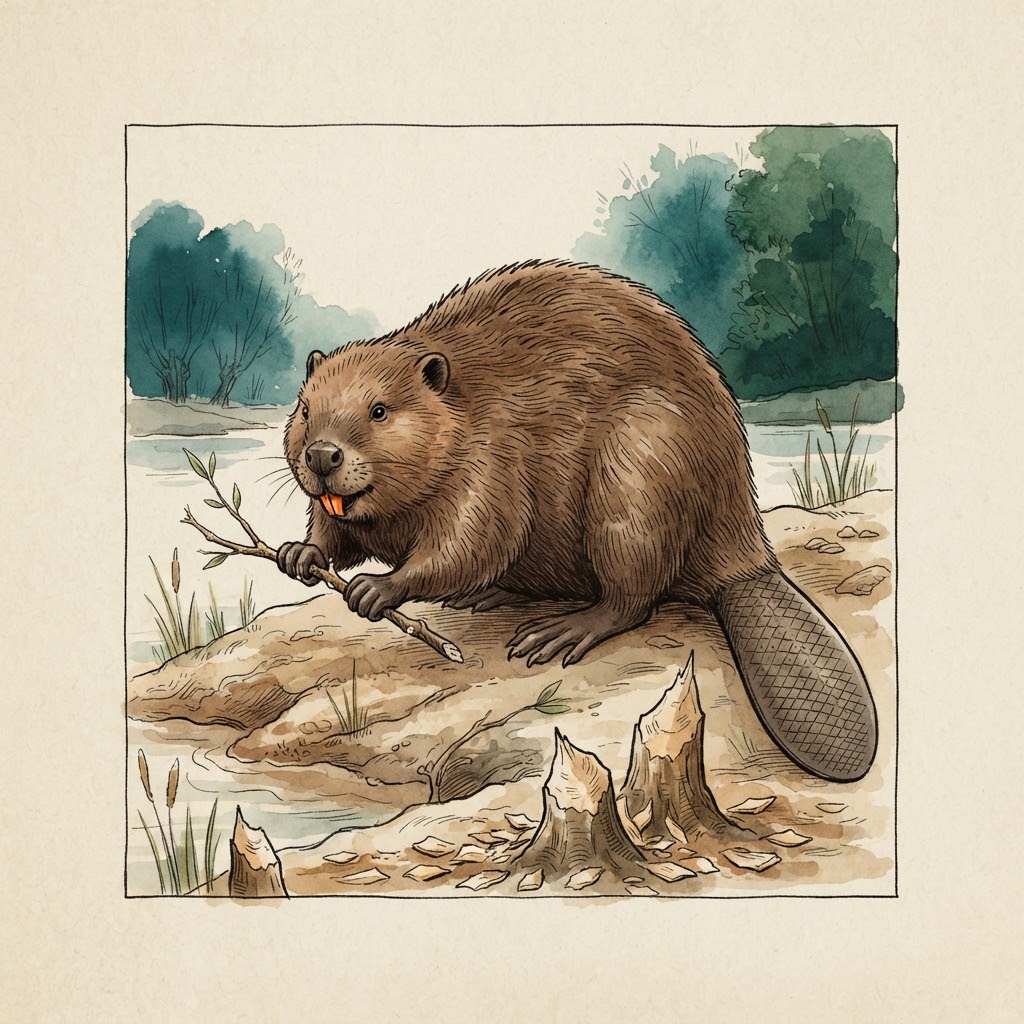
The largest rodent in Europe and a true master builder. The beaver fells trees, builds dams and lodges, and in doing so reshapes entire stream valleys. A century ago it had vanished from the Low Countries; now it is back.
| Habitat | Rivers, streams and marshes with willows and poplars |
| Weight | 15–30 kg |
| Active | At dusk and at night |
Card I of IV
Ecological profile
| Identification | Thick brown fur, broad flat scaly tail, orange gnawing teeth |
| Diet | Entirely plant-based: bark, twigs, water plants and herbs |
| Home | A lodge of branches and mud, with the entrance under water |
Where can you find them?
| Belgium | Ardennes rivers and streams, and increasingly in Flanders |
| Netherlands | The Biesbosch, the Gelderse Poort and along the Meuse and Rhine |
| Signs | Trees gnawed into an hourglass shape, with wood chips around them |
Did you know a beaver’s teeth are orange because of iron in the enamel? That makes them extra hard, and they keep growing throughout its life.
Card II of IV
Behaviour & seasons
Beavers live in families: a pair that often stays together for life, with the young of the past two years. If the water is too shallow, they build a dam to raise the level so the entrance to their lodge stays under water. When in danger, they slap their tail hard on the water as a warning.
| January – March | Mating season |
| May – June | Two to four kits in the lodge |
| Autumn | Collecting branches as an underwater winter store |
Card III of IV
Role in the ecosystem
The beaver is an ecosystem engineer: its dams create pools and marshes that benefit dragonflies, frogs, fish and kingfishers. Its dams also hold water back in dry summers and slow down floods. After centuries of hunting, the beaver had disappeared from the Netherlands and Belgium by around 1900. Since its reintroduction in the Biesbosch in 1988 and similar projects in Belgium, it is widespread again.
Card IV of IV
Stories & culture
For centuries the beaver was hunted for three things: its dense fur for hats, the scent substance castoreum used in perfume and medicine, and its meat. A striking story: because the beaver has a scaly tail and lives in water, the medieval Church regarded it as a fish. So beaver could be eaten during Lent, when meat was forbidden. That, too, contributed to its disappearance.
Frequently asked questions
Questions about the beaver
Does a beaver eat fish?
No, the beaver is a complete herbivore. It eats bark, twigs, water plants and herbs.
Where can you see beavers?
In the Netherlands in the Biesbosch and along the Meuse and Rhine; in Belgium along the Ardennes rivers. Go and look at dusk and watch for gnaw marks on trees.
Why does a beaver build a dam?
To raise the water level, so the entrance to its lodge stays under water and it is safe from predators.