Fish · Fish ponds
Cyprinus carpio
● IUCN: Vulnerable (wild form)
No fish is as woven into European history as the carp. Medieval monks farmed it in their ponds, and in Germany it is still on the Christmas menu. Yet the true wild carp of the Danube has become rare.
| Habitat | Warm, quiet ponds, lakes and slow rivers |
| Length | Usually 40–80 cm, sometimes much larger |
| Season on the plate | September to April (the months with an ‘r’) |
Card I of IV
Ecological profile
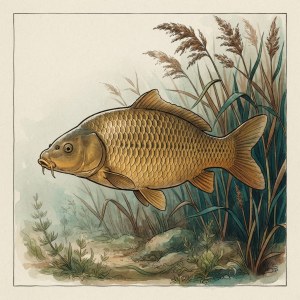
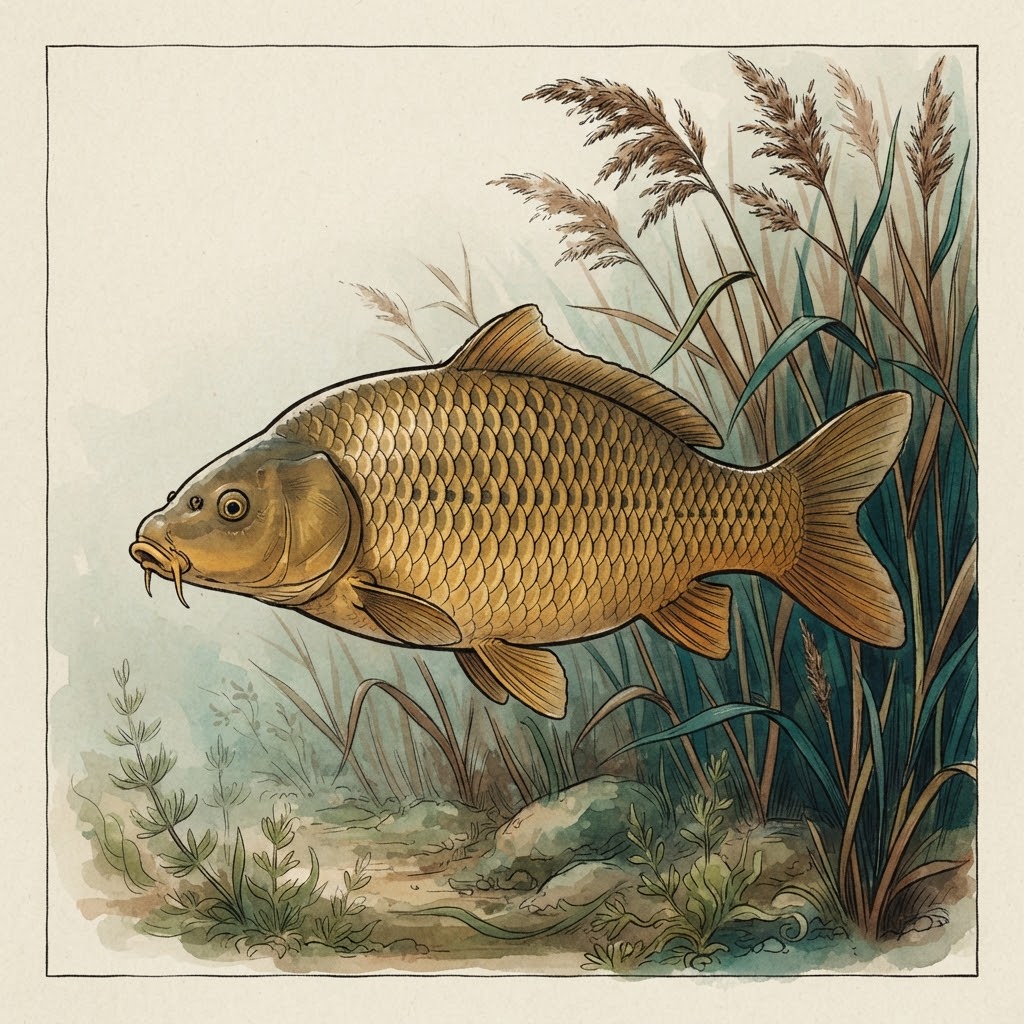
| Identification | High back, large golden-brown scales and four barbels around the mouth |
| Forms | Common carp (fully scaled) and mirror carp (a few large scales) |
| Diet | Roots in the bottom for midge larvae, small snails, worms and plant remains |
Where can you find them?
| Germany | The pond landscapes of Franconia (Aischgrund), the Upper Palatinate and Lusatia |
| Netherlands | In almost all lakes, ponds and canals |
| Tip | On warm summer days you often see carp basking just below the surface |
Did you know the orange and white koi of Japanese ponds are the same species? Over centuries they were bred for their colours.
Card II of IV
Behaviour & seasons
Carp love warmth. In summer they are active and grow fast; in winter they lie almost motionless on the bottom of deep spots. In the German pond regions, farming has followed that rhythm for centuries: in autumn the ponds are drained and the carp harvested, just in time for the season.
| May – June | Spawning among water plants in shallow, warm water |
| Summer | Active and growing |
| September – October | Ponds are drained and harvested; carp season begins |
| Winter | Resting on the bottom |
Card III of IV
From wild to plate
Carp from good farm ponds has white, firm flesh with a mild, slightly sweet flavour. The traditional rule: only eat carp in months with an ‘r’. In the cold water of autumn and winter the flesh is at its finest. The Aischgründer Spiegelkarpfen from Franconia even has a protected European designation of origin. Watch out for the fine Y-shaped bones when eating; many farmers score them in advance so they dissolve during frying.
These are general seasonal and preparation guidelines, not official hunting seasons or a food safety guarantee. Check local regulations and reliable sources.
Card IV of IV
Recipe & tradition
Karpfen blau (blue carp)
| Fish | Fresh carp, handled gently so the slime layer stays intact |
| Method | Pour hot vinegar over it, then poach gently in a stock with carrot, onion, bay leaf and peppercorns |
| Result | The skin turns steel blue |
| Serve with | Melted butter, horseradish and boiled potatoes |
In Franconia people prefer their carp gebacken: halved, dusted with flour and fried crisp, with potato salad.
Carp farming in Germany began in the Middle Ages at monasteries. Monks were not allowed to eat meat on the many fast days, but fish was permitted, and carp were easy to keep in ponds. That is how the pond landscapes of Franconia and the Upper Palatinate came about.
Many German families still eat Weihnachtskarpfen on Christmas Eve or New Year’s Eve. A well-known custom: put a carp scale in your wallet, and it will be full of money all the coming year.
These are general seasonal and preparation guidelines, not official hunting seasons or a food safety guarantee. Check local regulations and reliable sources.
Frequently asked questions
Questions about the carp
Why do Germans eat carp at Christmas?
The tradition goes back to the fasting periods, when fish could be eaten but meat could not. Carp from monastery ponds thus became a fixed festive dish.
What is Karpfen blau?
Carp doused with hot vinegar and then poached in stock, which turns the skin blue. It is served with butter and horseradish.
Is the carp an endangered fish?
The wild carp of the Danube and other large rivers is listed as Vulnerable on the IUCN Red List. Farmed carp, on the other hand, is widespread.