Amphibian · Ardennes
Salamandra salamandra
● Critically endangered in NL and BE
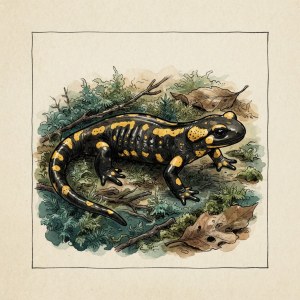
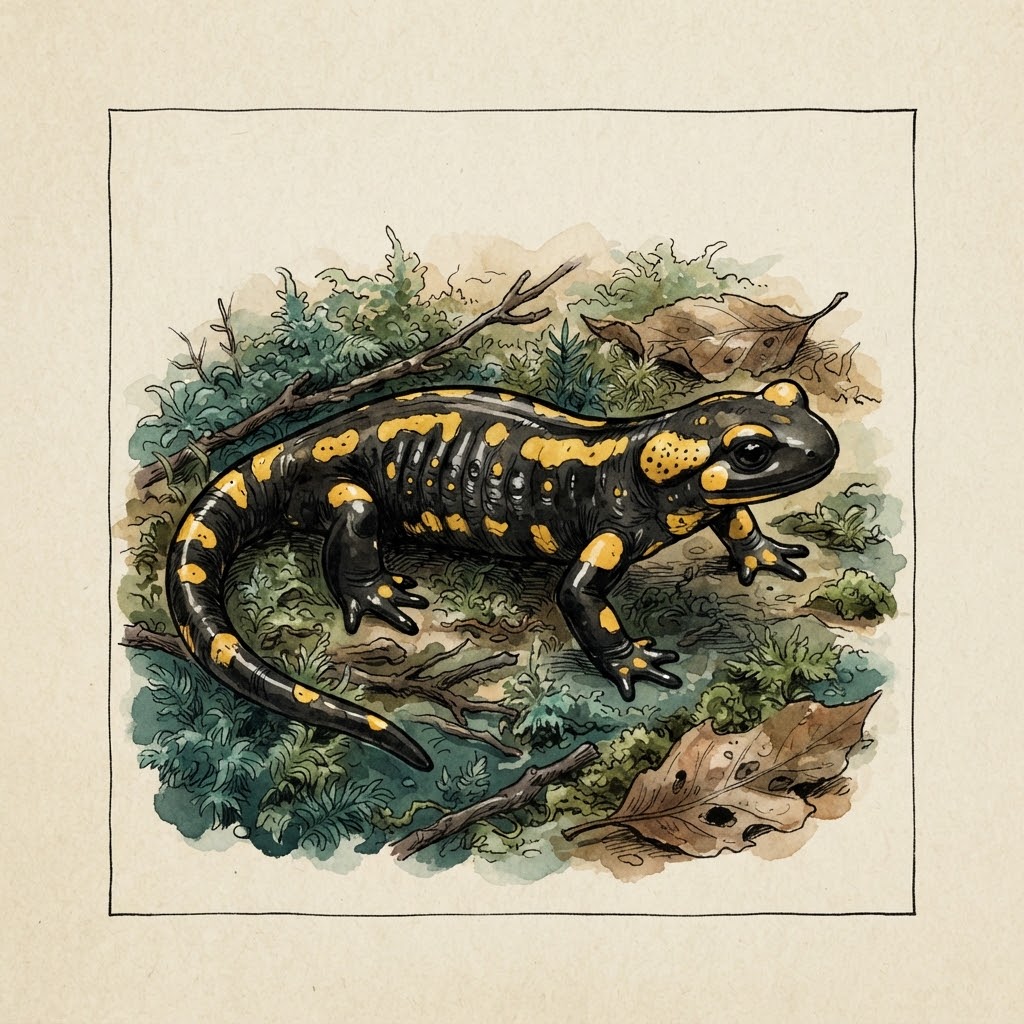
Glossy black with bright yellow spots: the fire salamander is one of the most beautiful amphibians in Europe. Its colours are a warning, because its skin secretes a toxic slime.
| Habitat | Damp deciduous forests with clear spring-fed streams |
| Length | 15–20 cm |
| Active | On nights after rain |
Card I of IV
Ecological profile
| Identification | Stocky, glossy black body with yellow (sometimes orange) spots or stripes |
| Diet | Slugs, earthworms, spiders and insects |
| Lifespan | Often more than twenty years |
Where can you find them?
| Belgium | Damp stream valleys in the Ardennes and Wallonia |
| Netherlands | Formerly in South Limburg; now almost gone there |
| Tip | Stay on the paths and never touch salamanders; that way you do not spread disease |
Card II of IV
Behaviour & seasons
Unlike frogs, the fire salamander does not lay eggs. In spring the female gives birth to ready-made larvae in a cool, clear spring-fed stream. There they grow into small salamanders, which then move off into the forest. By day they hide under tree stumps, stones and moss.
| March – May | Larvae are deposited in spring-fed streams |
| Summer | Larvae leave the water as small salamanders |
| Winter | Hibernation in burrows and crevices in the ground |
Card III of IV
Role in the ecosystem
The fire salamander clears up slugs and insects in the forest leaf litter. Its biggest threat is a fungus from Asia, Batrachochytrium salamandrivorans (Bsal), which has been spreading since around 2010 in South Limburg and later in Belgium and Germany. In the Netherlands it wiped out most of the fire salamanders.
Want to help? After a walk in salamander country, clean your shoes thoroughly before visiting another nature area. That stops the fungus from spreading further.
Card IV of IV
Stories & culture
Since antiquity people believed the salamander could live in fire and even put it out. People probably saw salamanders crawling out of burning wood in which they had hidden. That is how the myth arose that gave it its name. In the Middle Ages the salamander became a symbol of steadfastness; King Francis I of France chose it as his emblem.
Frequently asked questions
Questions about the fire salamander
Is a fire salamander poisonous?
Its skin secretes a toxic slime that deters predators. It is not dangerous to people, but do not touch salamanders, also for their own protection.
Why has the fire salamander become so rare?
Because of a fungal disease from Asia that has killed large numbers of salamanders in South Limburg, Belgium and Germany since around 2010.
How did the fire salamander get its name?
From an old legend that it could live in fire, probably because salamanders crawled out of burning wood in which they had been sheltering.
Habitat · Belgium