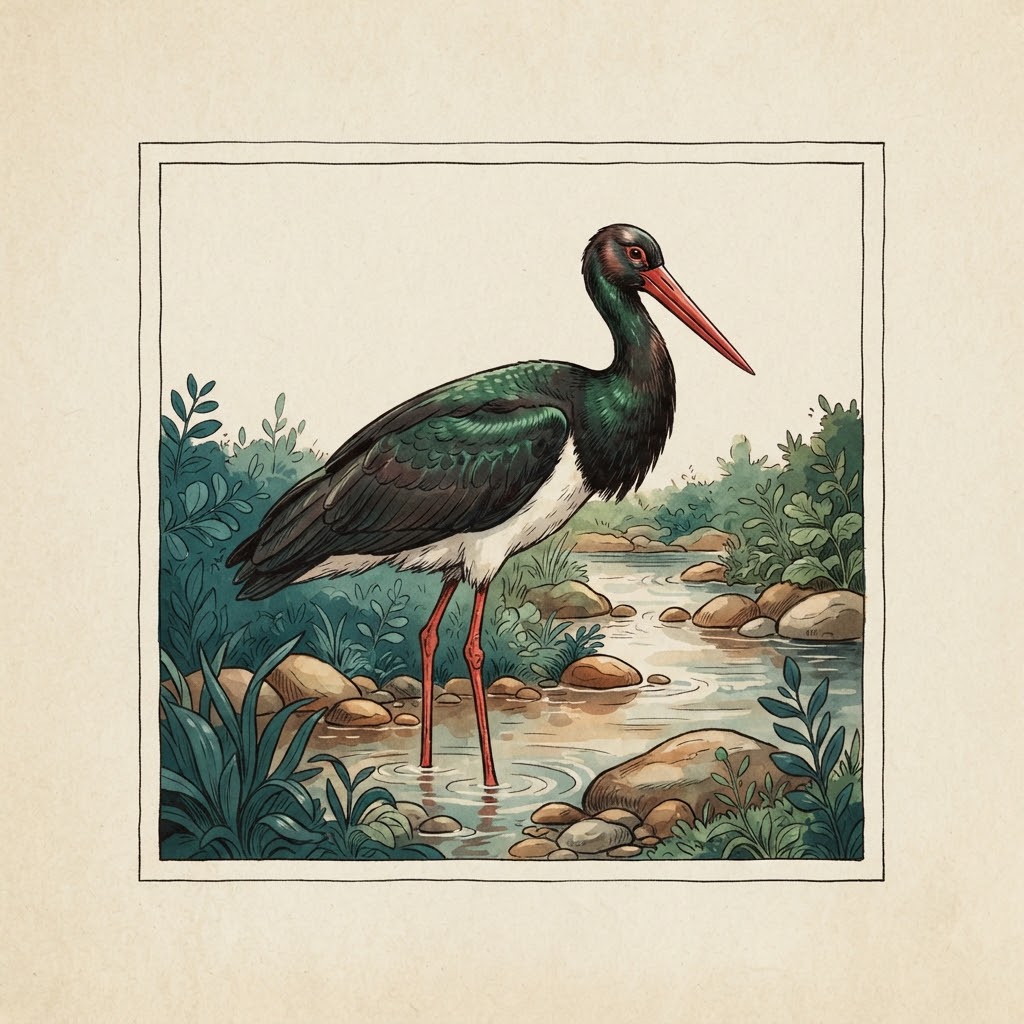
Bird · Ardennes
Ciconia nigra
● IUCN: Least Concern · protected
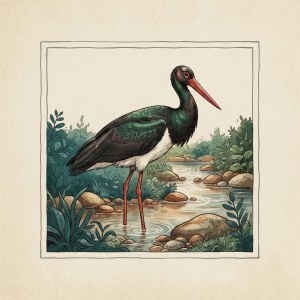
The shy cousin of the familiar white stork. Where the white stork nests on roofs and poles near people, the black stork seeks the quiet of old forests and clear streams.
| Habitat | Quiet old forests with streams and pools |
| Length | About 1 metre, wingspan up to 2 metres |
| Present | March to September |
Card I of IV
Ecological profile
| Identification | Black plumage with a green and purple sheen, white belly, red bill and legs |
| Diet | Fish, frogs, salamanders and aquatic insects from streams and pools |
| Nest | A large stick nest high in an old tree, deep in the forest |
Where can you find them?
| Belgium | The wooded valleys of the Ardennes and the Famenne |
| Netherlands | Mainly as a passage migrant in spring and autumn |
| Tip | In summer you sometimes see them circling high above the forests on warm thermals |
Did you know the black stork had completely disappeared from the Ardennes a few decades ago? It has bred there again since the 1980s, now that the forests are quieter and the streams cleaner.
Card II of IV
Behaviour & seasons
The black stork is a migratory bird. It winters in Africa, south of the Sahara, and returns to its breeding grounds in spring. Disturbance around the nest is disastrous: a pair that feels threatened may abandon its nest.
| March – April | Return from Africa |
| April – July | Breeding season: three to five young |
| August – September | Departure for Africa |
Card III of IV
Role in the ecosystem
The black stork is an indicator of healthy forests. It needs three things: old, thick trees for its nest, peace and quiet in the breeding season, and clean streams full of fish and amphibians. So where it breeds, the forest is in good condition.
Card IV of IV
Stories & culture
The white stork is famous as the bringer of babies and a bringer of luck on the roof. The black stork never got such a role in folk belief: it lived too hidden a life. That is exactly why, for nature lovers in Belgium, it is a coveted sighting, the secret of the deep Ardennes forests.
Frequently asked questions
Questions about the black stork
How does it differ from the white stork?
The black stork is mostly black with a white belly, lives shyly in old forests and nests in trees. The white stork, by contrast, nests close to people.
Where does the black stork spend the winter?
In Africa, south of the Sahara. It is in Europe from March to September.
Does the black stork breed in the Netherlands?
Very rarely. In the Netherlands you mainly see it on migration. In Belgium it breeds in the Ardennes.
Habitat · Belgium