Mammal · Forest & heath
Dama dama
● IUCN: Least Concern
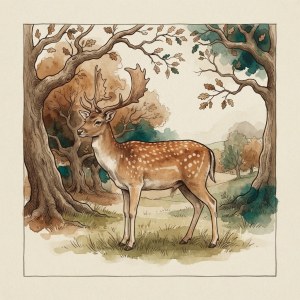
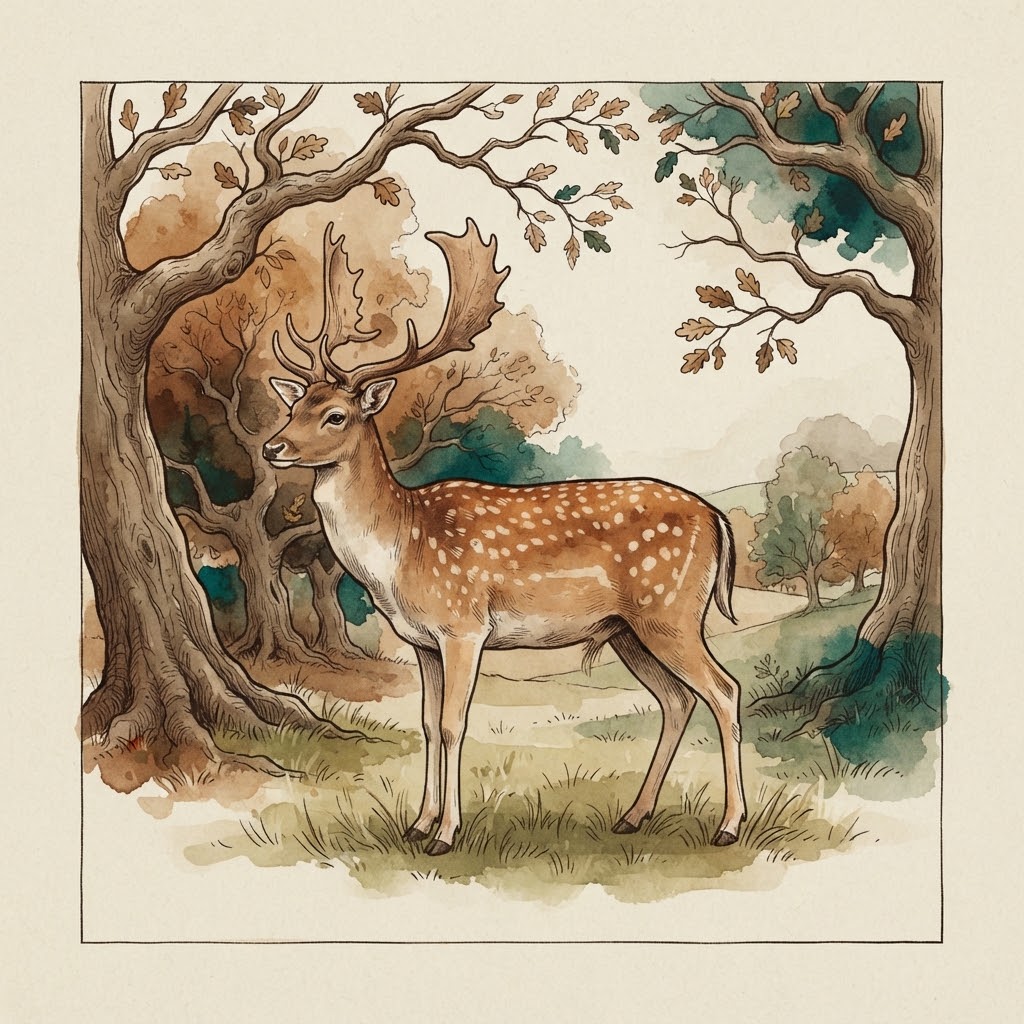
A deer with antlers like a shovel and a summer coat full of white spots. The fallow deer is not an original inhabitant of north-west Europe: the Romans and later the medieval nobility brought it in for their hunting parks.
| Habitat | Open deciduous woodland, parkland and heath |
| Weight | Doe 35–50 kg, buck up to about 90 kg |
| Active | At dusk, often also during the day |
Card I of IV
Ecological profile
| Identification | Reddish-brown with white spots in summer, greyer in winter; long tail with a black stripe; bucks with broad, shovel-shaped antlers |
| Diet | Grasses, herbs, leaves, acorns and chestnuts |
| Size | Between roe deer and red deer |
Where can you find them?
| Germany | Widespread, especially in the north and east, such as Mecklenburg and Brandenburg |
| Netherlands | The Amsterdam Water Supply Dunes and other dune areas |
| Tip | In the dunes, fallow deer are often so used to walkers that you can see them up close |
Did you know fallow deer do not roar like red deer? In the rut the buck makes a deep, rattling groan that sounds like a heavy snore.
Card II of IV
Behaviour & seasons
Fallow deer live in groups, often separated by sex. In the rut, bucks sometimes gather at a fixed spot where they compete for the favour of the does. Their rut falls a little later than that of the red deer.
| April – May | Bucks cast their antlers |
| June – July | Birth of a single spotted fawn |
| October – November | Rut |
Card III of IV
From wild to plate
Fallow deer meat is fine-grained, tender and mild in flavour: a little firmer than roe deer, but softer than red deer. In Germany, Damwild is one of the most eaten types of game, and in autumn and winter you will find it at the game dealer and on game menus.
These are general seasonal and preparation guidelines, not official hunting seasons or a food safety guarantee. Check local regulations and reliable sources.
Card IV of IV
Recipe & tradition
Fallow deer medallions with lingonberries and spätzle
| Meat | Fallow deer saddle cut into thick medallions |
| Method | Fry briefly and hot in butter with juniper and thyme, serve pink |
| Sauce | Game stock with red wine, reduced |
| Serve with | Spätzle, red cabbage and lingonberry compote (Preiselbeeren) |
Game with Preiselbeeren, lingonberries, is a fixed combination in Germany and Austria. A spoonful of the fresh, slightly bitter compote belongs with almost every game dish. Together with homemade spätzle from southern Germany, it makes a classic autumn plate.
These are general seasonal and preparation guidelines, not official hunting seasons or a food safety guarantee. Check local regulations and reliable sources.
Frequently asked questions
Questions about the fallow deer
What is the difference between a fallow deer and a red deer?
The fallow deer is smaller, has white spots in summer and the buck carries broad, shovel-shaped antlers. The red deer is larger and has branching antlers.
Is the fallow deer a native species?
No. It originally comes from the eastern Mediterranean and was brought to north-west Europe by the Romans and the medieval nobility.
When is the fallow deer rut?
In October and November, a little later than that of the red deer.
Habitat · Germany