Mammal · Forest & heath
Lynx lynx
● IUCN: Least Concern · rare in Germany
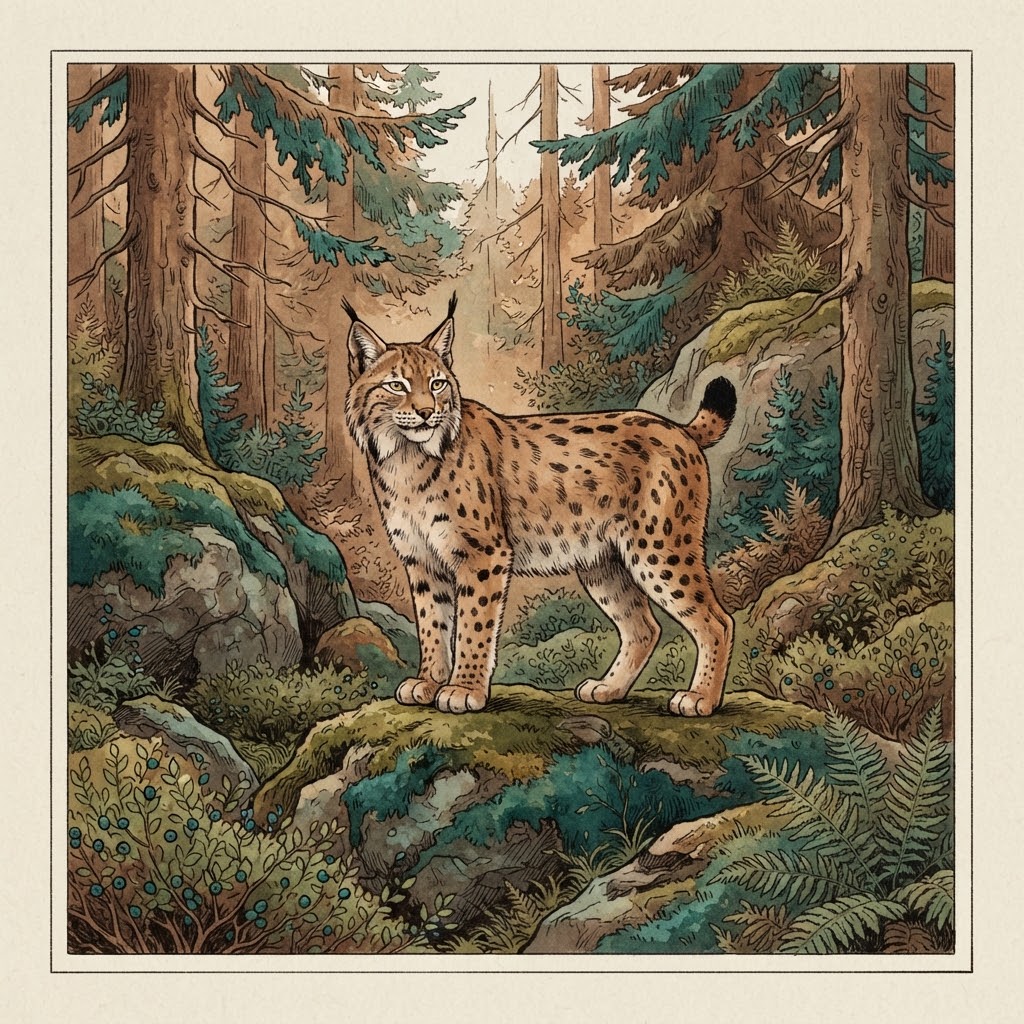
The largest cat in Europe, and one of the most invisible. The lynx slips silently through the forest, and even people who live in its territory almost never see it. Recognisable by its black ear tufts and short tail.
| Habitat | Large, quiet forests in low mountain ranges |
| Weight | 15–30 kg |
| Active | At dusk and at night |
Card I of IV
Ecological profile
| Identification | Long legs, large furry paws, black ear tufts, facial ruff and a short tail with a black tip |
| Diet | Mainly roe deer, plus hares, foxes and young deer |
| Hunting | Stalks its prey and ambushes it with a short sprint |
Where can you find them?
| Germany | The Bavarian Forest, the Harz and the Palatinate Forest |
| Tip | In the Bavarian Forest National Park you can see lynx in a large outdoor enclosure |
Did you know the lynx’s large, furry paws work like snowshoes? They stop it from sinking into deep snow.
Card II of IV
Behaviour & seasons
The lynx is a loner with an enormous territory, often more than 100 square kilometres. After a successful hunt it hides its prey under leaves and returns to it to feed for several nights in a row.
| February – March | Mating season; you may sometimes hear their call |
| May – June | Two to three kittens in a hidden den |
| Autumn | The young travel with their mother and learn to hunt |
Card III of IV
Role in the ecosystem
As a hunter of roe deer, the lynx keeps the numbers and behaviour of herbivores in balance. In Germany it was wiped out in the nineteenth century. Around 2000 lynx were released in the Harz, and it also returned to the Bavarian Forest from the Czech Republic. Traffic and illegal persecution are still the biggest threats.
Card IV of IV
Stories & culture
Expressions such as ‘lynx-eyed’ and the German Luchsaugen refer to sharp eyesight. They go back to the Greek hero Lynceus, one of the Argonauts, who could see so sharply that he could look through walls and into the earth. His name became linked with the lynx, the cat that seems to see everything while staying invisible itself.
Frequently asked questions
Questions about the lynx
Where does the lynx live in Germany?
Mainly in the Bavarian Forest, the Harz and the Palatinate Forest.
Is the lynx dangerous to people?
No. The lynx is extremely shy and avoids people. Attacks on people are virtually unknown in Europe.
Is the lynx found in the Netherlands?
No, there are no lynx living in the Netherlands. The nearest populations are in the German low mountain ranges.
Habitat · Germany