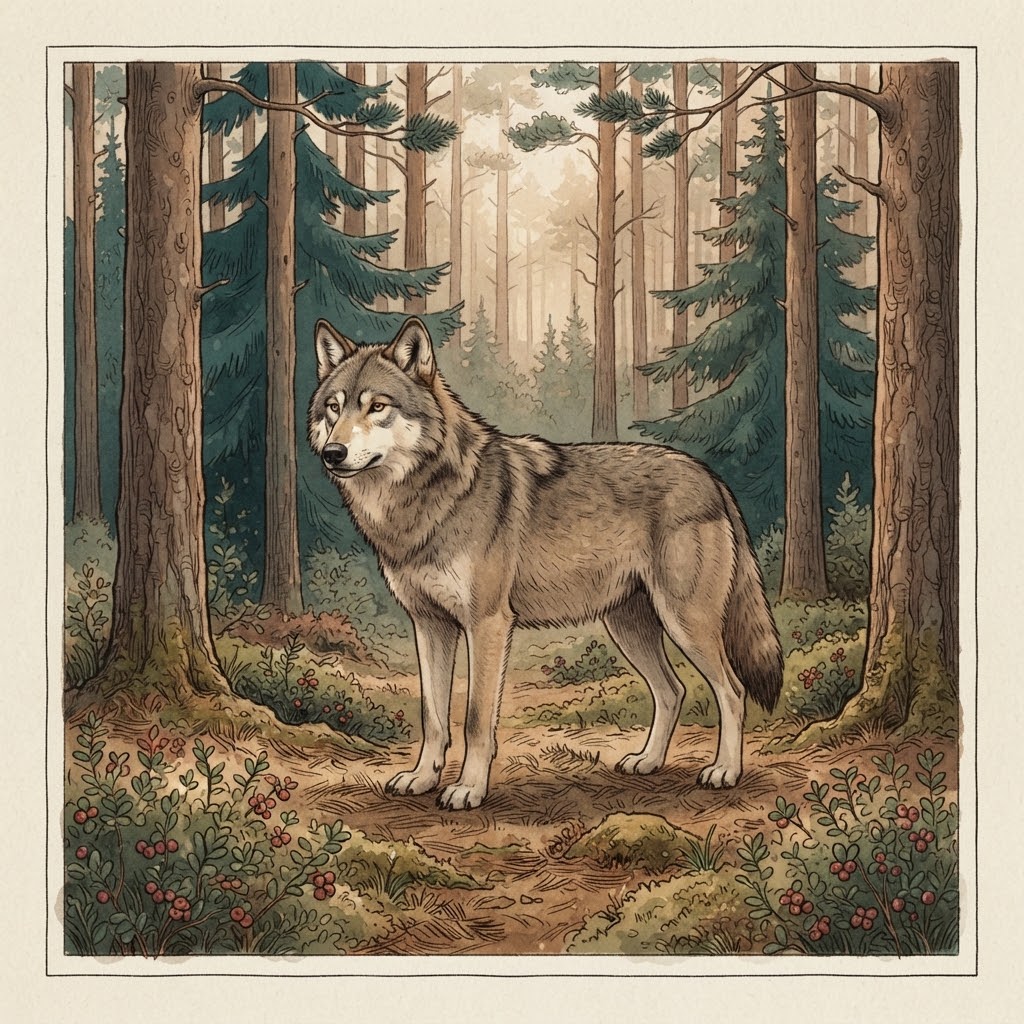
Mammal · Forest & heath
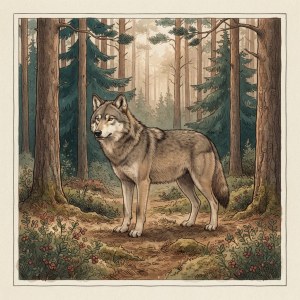
Canis lupus
● IUCN: Least Concern · protected
For more than a century the wolf was gone from western Europe. Since 2000 it has been back in Germany, and from there it moved on to the Netherlands and Belgium. No animal stirs up as many emotions as the wolf.
| Habitat | Large forest and heathland areas, but highly adaptable |
| Weight | 30–50 kg |
| Active | Mainly at dusk and at night |
Card I of IV
Ecological profile
| Identification | Grey-brown coat, pale muzzle and throat, upright triangular ears, hanging tail with a dark tip |
| Difference from a dog | Longer legs, narrower chest and a straight back; often walks in a straight line |
| Diet | Mainly roe deer, red deer, wild boar and mouflon |
Where can you find them?
| Germany | Mainly in the north and east, such as Lusatia, Brandenburg and Lower Saxony |
| Netherlands | Including the Veluwe and Drenthe |
| If you meet one | Stand still, make yourself big, talk loudly and back away calmly; keep your dog on a lead |
Card II of IV
Behaviour & seasons
Wolves live in a pack: a parent pair with their young of the past one or two years. A pack has a large territory, often more than 200 square kilometres. At some point young wolves leave to find a territory of their own, sometimes hundreds of kilometres away. That is how wolves from Germany also reached the Netherlands.
| January – March | Mating season |
| April – May | Four to six pups in a den |
| Summer – autumn | The pups learn to hunt with the pack |
| Spring | Young wolves leave to find their own territory |
Card III of IV
Role in the ecosystem
As a top predator, the wolf influences the entire forest. Deer and wild boar become more watchful and spread out more, which lets young trees grow better in some places. Wolves often take sick, weak or young animals, and their leftovers feed foxes, ravens, beetles and white-tailed eagles. At the same time its return causes tension, especially among sheep farmers: good fencing and guard dogs help prevent damage.
Card IV of IV
Stories & culture
In the fairy tales of the Brothers Grimm, collected in Germany, the wolf is the great villain: he tricks Little Red Riding Hood and eats the seven little goats. That image of the ‘big bad wolf’ shaped how people thought about him for centuries. Yet in other stories the wolf stands for care and strength, as in the Roman legend of the she-wolf who suckled Romulus and Remus. Its return makes us look afresh at an animal we mostly knew from stories.
Frequently asked questions
Questions about the wolf
Is the wolf dangerous to people?
Wolves are naturally shy and avoid people. If you meet one, stand still, make yourself big, talk loudly and back away calmly. Never feed wolves.
Since when has the wolf been back?
In Germany since 2000, in Lusatia. It then spread further, and for a few years now there have also been resident packs in the Netherlands.
What does a wolf eat?
Mainly roe deer, red deer, wild boar and mouflon. Sometimes also sheep if they are not well protected.
Habitat · Germany