Fish · Brooks & rivers
Salmo salar
● IUCN: Near Threatened · protected in the Meuse
Born in the gravel of an Ardennes tributary, grown up in the ocean off Greenland, and years later back in exactly the same river. The Atlantic salmon makes one of the most impressive journeys in the animal world, and after almost a century of absence it is slowly returning to the Meuse.
| Habitat | Clear, cool rivers with gravel beds; as an adult the North Atlantic Ocean |
| Length | Usually 50–100 cm |
| Weight | Usually 2–10 kg |
Card I of IV
Ecological profile
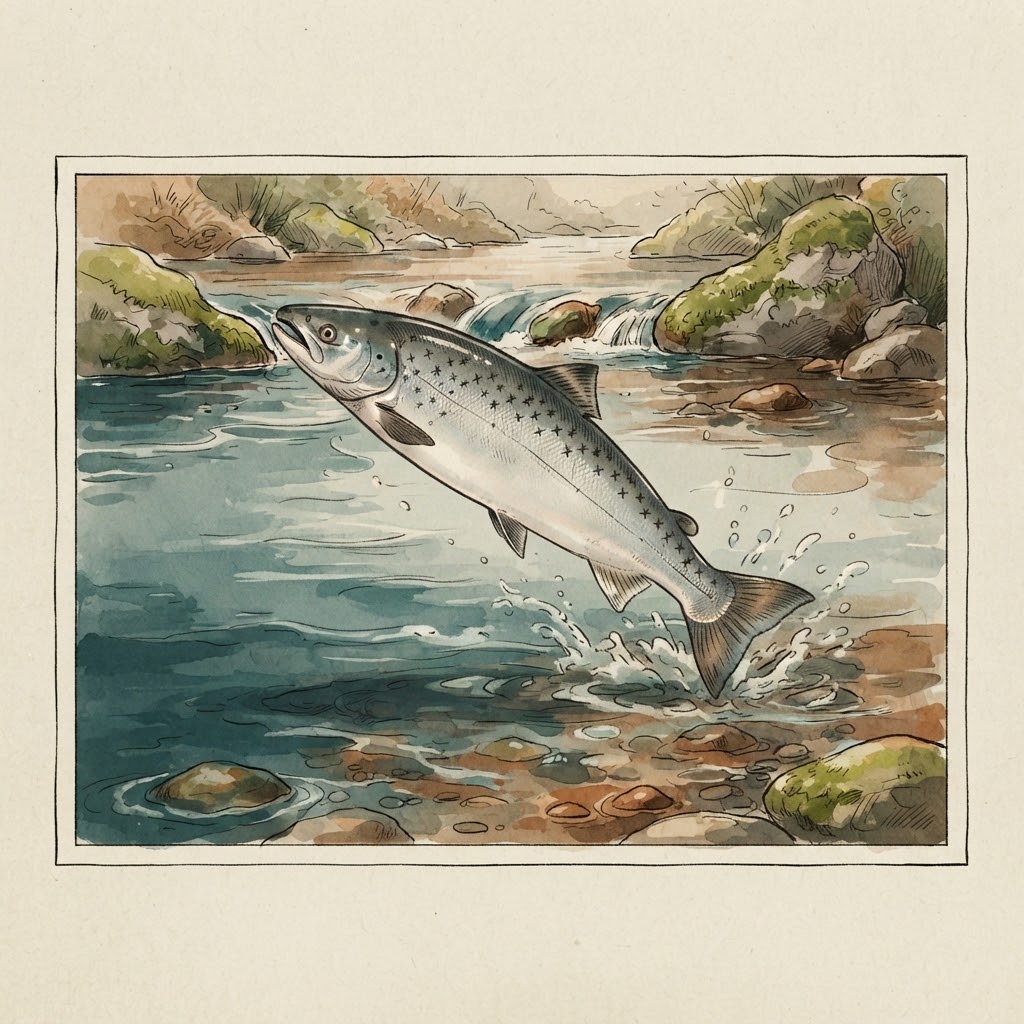
| Identification | Silvery, with small black X-shaped spots above the lateral line, a small adipose fin and a slightly forked tail |
| Difference from sea trout | Slimmer tail stock and a slightly forked tail; the sea trout has more, rounder spots, also below the lateral line |
| Diet | In the river insect larvae; at sea fish such as herring and sand eels, and shrimp-like crustaceans |
Where can you find them?
| Belgium | The Meuse and Ardennes tributaries such as the Ourthe and the Amblève, thanks to a reintroduction project |
| Netherlands | Passing through the large rivers on the way to spawning grounds upstream |
| Tip | At some fish passes and weirs you can see migrating fish leap in autumn |
Did you know a salmon finds its home river by the smell of the water? After years at sea it can ‘smell’ which river and which side stream is home.
Card II of IV
Behaviour & seasons
The young salmon grows up in the river for one to three years. Then it turns silvery and swims to sea as a ‘smolt’. In the North Atlantic it feeds and grows for one to three years, around the Faroe Islands and West Greenland among other places. It then swims back to its home river, leaps rapids and weirs, and lays its eggs in the gravel in autumn. Many salmon die after spawning, but some survive and return to sea.
| Spring | Young fish emerge from the gravel; smolts migrate to sea |
| Summer – autumn | Adult salmon run up the river |
| November – December | Spawning on gravel beds in the upper reaches |
| Winter | The eggs develop in the cold gravel |
Card III of IV
From wild to plate
Salmon from the Meuse and the Rhine was once everyday food in the Low Countries. Pollution, weirs and locks made it disappear in the first half of the twentieth century. Since the late 1980s Wallonia has worked on its return through the Saumon Meuse project, and wild salmon in the Meuse is protected. Salmon in the shops is therefore almost always farmed salmon from Norway, Scotland, Ireland or the Faroe Islands. ‘Wild salmon’ in the shops usually comes from Alaska: those are Pacific salmon species, a different animal from the Atlantic salmon.
These are general seasonal and preparation guidelines, not official hunting seasons or a food safety guarantee. Check local regulations and reliable sources.
Card IV of IV
Recipe & tradition
Salmon with sorrel
| Fish | Skinless salmon fillet, cut into thin slices |
| Sauce | Reduced fish stock and white wine with cream, fresh sorrel stirred in at the end |
| Method | Cook the slices very briefly in a hot pan so they stay translucent inside |
| To serve | Sauce on the plate, salmon on top |
Saumon à l’oseille became famous in the 1960s at the Troisgros brothers’ restaurant in Roanne, France, and is seen as one of the dishes that heralded nouvelle cuisine. The fresh, sour leaves of sorrel cut beautifully through the rich salmon. A simple idea that shows how well a fish and a seasonal plant can complement each other.
These are general seasonal and preparation guidelines, not official hunting seasons or a food safety guarantee. Check local regulations and reliable sources.
Frequently asked questions
Questions about the Atlantic salmon
Are there salmon in the Meuse again?
Yes, in small numbers. Thanks to the Walloon reintroduction project and fish passes at weirs, adult salmon are returning to the Meuse and its Ardennes tributaries.
Is salmon from the shop wild or farmed?
Atlantic salmon in the shops is almost always farmed. When ‘wild salmon’ is sold, it is usually a Pacific salmon species from Alaska.
How does a salmon find its home river?
Mainly by its sense of smell: it recognises the unique scent of the water it grew up in.