Bird · Fens & heath
Lyrurus tetrix
● IUCN: Least Concern · critically endangered in Belgium
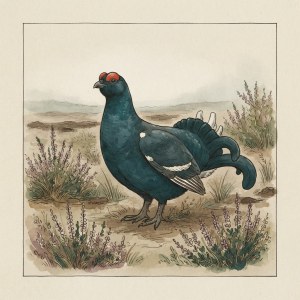
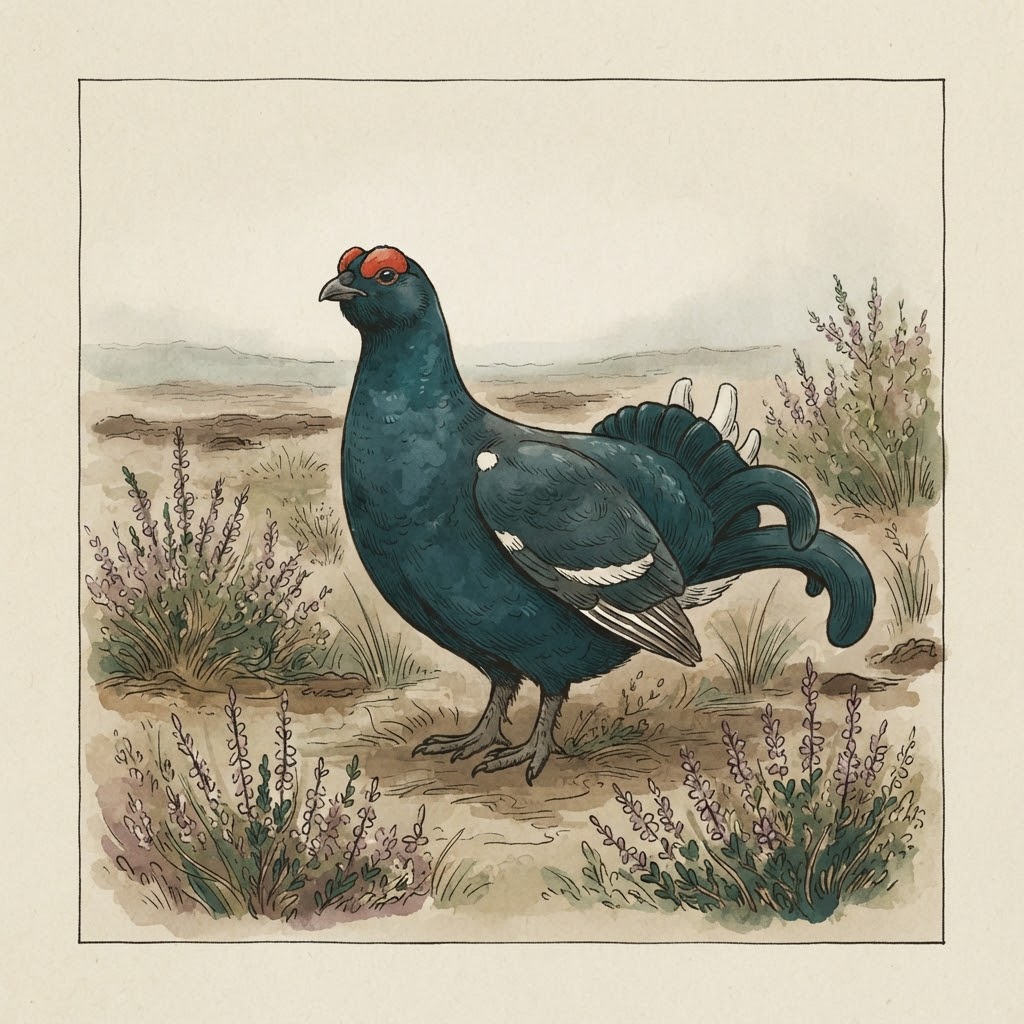
A glossy black cock with a lyre-shaped tail, fiery red eyebrows and snow-white undertail feathers. In spring the males dance, hiss and coo at sunrise on the bog. In Belgium the black grouse survives only in the High Fens, as one of the country’s rarest birds.
| Habitat | Open raised bog and heath with scattered birch, pine and bilberry |
| Length | Male ±55 cm, female ±42 cm |
| Weight | Male ±1.2 kg, female ±0.9 kg |
Card I of IV
Ecological profile
| Identification | Male blue-black with a lyre-shaped tail, white wing bar, white undertail and red ‘roses’ above the eyes; female brown and barred with a slightly forked tail |
| Diet | Buds and catkins of birch, bilberry, heather and seeds; chicks eat mainly insects |
| Family | Grouse, like the capercaillie and the hazel grouse |
Where can you find them?
| Belgium | Only in the High Fens, in small numbers |
| Netherlands | A small, very vulnerable population on the Sallandse Heuvelrug |
| Tip | Stay on the boardwalks: large parts of the fens are closed in spring to give the birds peace |
Did you know black grouse dig a hollow in the snow to sleep in during harsh winters? Snow insulates so well that it is much warmer inside than in the freezing air above.
Card II of IV
Behaviour & seasons
In spring the males gather before sunrise at a fixed display ground, the ‘lek’, in the open bog. With fanned tails, puffed-up necks and drooping wings they turn and leap around each other, giving a long, bubbling coo interspersed with a hissing ‘tchu-wee’. The females come to watch and choose the strongest males. After that the female nests alone, in a hollow among heather or bilberry.
| April – May | Lekking at sunrise on the display ground |
| May – June | The female lays 6–10 eggs and incubates for ±25 days |
| Summer | Chicks search for insects in heather and bilberry |
| Winter | Birch buds, and sleeping in the snow |
Card III of IV
Role in the ecosystem
The black grouse is a barometer of healthy, varied heath and bog: it needs open spaces to display, rough cover to nest in and plenty of insects for its chicks. Land reclamation, spruce plantations, acidification, disturbance and a lack of insects made it disappear from almost all of Belgium and the Netherlands. Since 2017, black grouse from Sweden have been released in the High Fens to strengthen the last, inbred population.
What helps? Bog restoration, felling spruce plantations, peace during the breeding season, and you: stay on the paths and keep dogs on a lead. A single disturbance at the lek can cost a whole morning’s display.
Card IV of IV
Stories & culture
The black grouse’s display has always fascinated people. In the Alps it is sometimes said that the Schuhplattler, the Bavarian and Tyrolean folk dance with leaping and slapping of thighs and shoe soles, was copied from the dancing blackcocks. And the curled black tail feathers, Spielhahnfedern in German, have long adorned the hats of Alpine people.
Frequently asked questions
Questions about the black grouse
Where can you see black grouse in Belgium?
Only in the High Fens, in small numbers. Large parts of the bog are closed to give the birds peace; with some luck you can see or hear them from the boardwalks.
What is a black grouse lek?
In April and May the males gather at sunrise at a fixed spot, where they dance, leap and coo with fanned tails to impress the females.
Why has the black grouse become so rare?
Because of the loss of heath and raised bog, afforestation, acidification, disturbance and too few insects for the chicks.
Habitat · Belgium