Reptile · Fens & heath
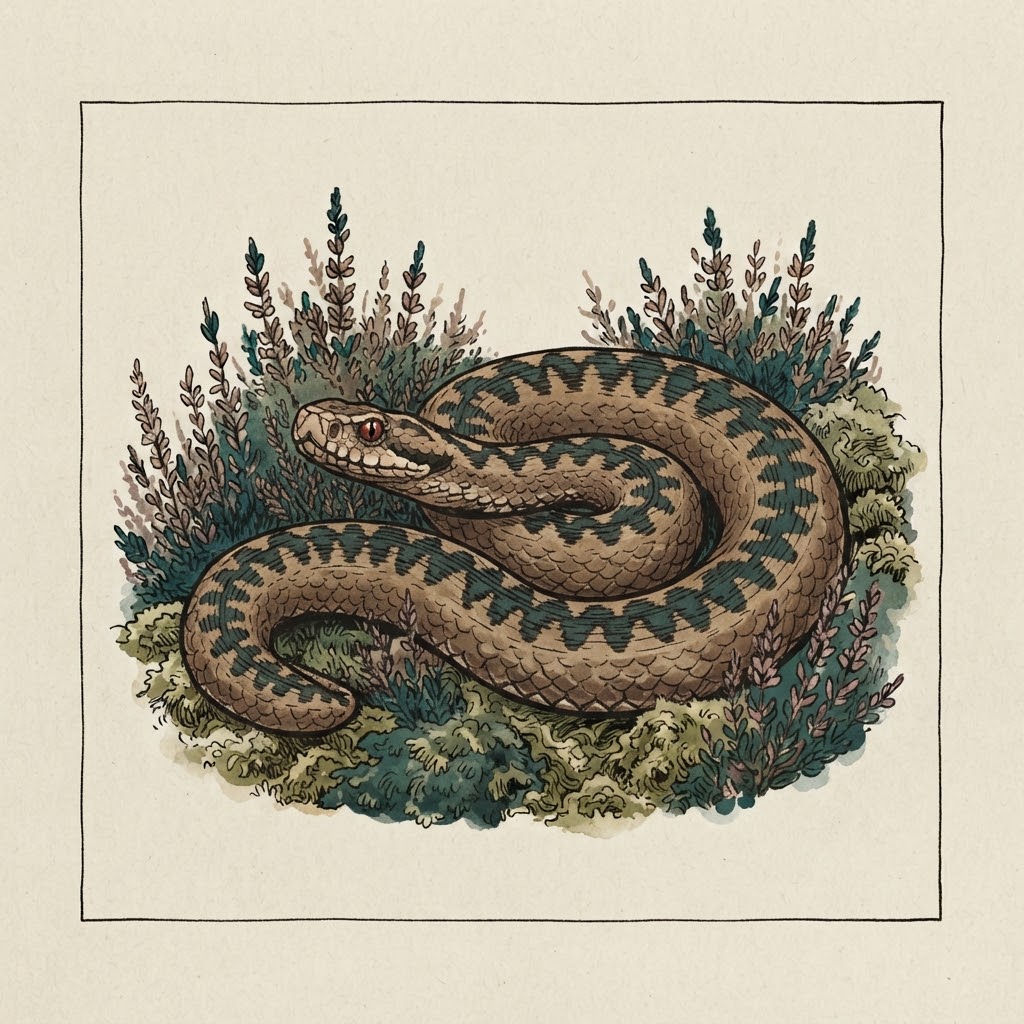
Vipera berus
● IUCN: Least Concern · threatened and protected in Belgium and the Netherlands
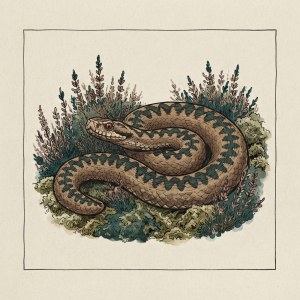
The only venomous snake in the Low Countries, and at the same time one of the shyest. You are more likely to hear an adder slip away than to see it. On a sunny spring morning it may lie coiled among the heather, warming up before the day begins.
| Habitat | Heath, raised bog, edges of fens and open spots in woodland |
| Length | Usually 50–65 cm |
| Weight | About 50–150 grams |
Card I of IV
Ecological profile
| Identification | Stocky snake with a dark zigzag band along the back, often a V or X mark on the head and a vertical pupil; males grey and black, females brown; sometimes entirely black |
| Not to be confused with | The grass snake (yellow collar, no zigzag) and the slow worm (a legless lizard, smooth and shiny) |
| Diet | Mice, young birds, lizards and frogs |
Where can you find them?
| Belgium | Rare: mainly in the Campine (Kempen) and at a few places in the High Fens and the Ardennes |
| Netherlands | On larger heath and bog areas in Drenthe, Friesland, the Veluwe and Twente |
| Tip | Look along the edges of heath paths on sunny, windless spring mornings, and always keep your distance |
Watching safely. Adders only bite when cornered or touched. Never touch an adder, stay on the paths and wear closed shoes. Bitten? Stay calm, keep the limb still and seek medical help immediately.
Card II of IV
Behaviour & seasons
The adder is cold-blooded and lives by the rhythm of the sun. After hibernation the males emerge first and bask close to where they spent the winter. In April they shed their skin and perform the famous ‘dance of the adders’: two males rearing up and twisting around each other to decide who may mate with the female. Adders do not lay eggs: the young are born live in late summer.
| March – April | End of hibernation; basking near the winter site |
| April – May | Skin shedding, dance of the adders and mating |
| August – September | Birth of 5–15 young, each about 17 cm |
| October – March | Hibernation in a burrow or among tree roots |
Card III of IV
Role in the ecosystem
As a hunter of mice, the adder helps keep rodent populations in check, and is itself prey for buzzards, herons, foxes and wild boar. The adder needs a very specific habitat: sunny spots to warm up, dense vegetation to hide in and frost-free burrows to hibernate, all close together. Because adders barely move around, populations easily become isolated when heathland is fragmented.
What helps? Varied heath management in small patches instead of mowing or burning large areas at once, links between heathland sites, and peace around hibernation sites in early spring.
Card IV of IV
Stories & culture
The word ‘adder’ has a curious history. The animal was once called a nadder. Because ‘a nadder’ was heard in everyday speech as ‘an adder’, the n disappeared, in both English and Dutch. The same happened to apron, which was once napron. Despite its bad reputation, in many folk tales the adder is also a protector of house and home.
Frequently asked questions
Questions about the adder
Is an adder dangerous?
A bite is painful and can cause serious swelling and symptoms, but is rarely life-threatening for healthy adults. Always seek medical help immediately after a bite, especially for children, older people or dogs.
How do you recognise an adder?
By the dark zigzag band along its back, its stocky build and its vertical pupil. A grass snake has a yellow collar and no zigzag.
Where do adders live in Belgium?
Mainly on the heaths and bogs of the Campine, and at a few places in the High Fens and the Ardennes. The species is rare and protected.
Habitat · Belgium