Amphibian · Fens & heath
Rana arvalis
● IUCN: Least Concern · vulnerable and strictly protected in Belgium
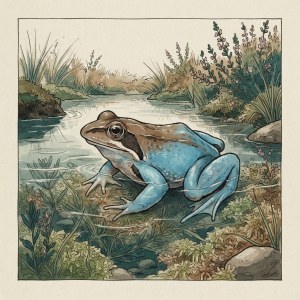
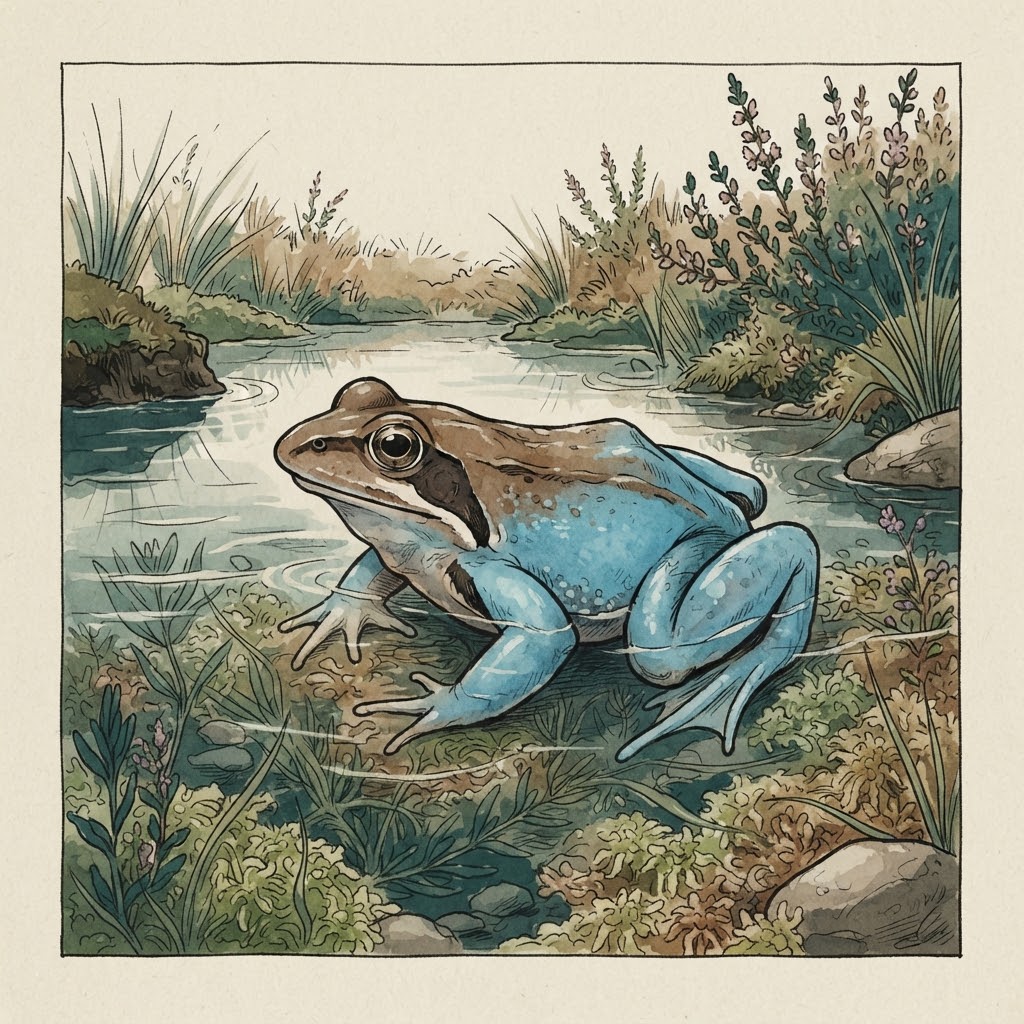
For most of the year a modest brown frog. But on a few sunny days in March the males turn sky-blue and float by the dozen in a heathland pool, bubbling like air escaping from a bottle under water.
| Habitat | Wet heath, bogs, heathland pools and damp grassland |
| Length | About 5–7 cm |
| Active | By day and in the evening; hibernates on land in winter |
Card I of IV
Ecological profile
| Identification | Brown with a dark temple patch, often a pale stripe down the back, a pointed snout and a hard, high tubercle on the inside of the hind foot |
| Not to be confused with | The common frog, which has a blunter snout, longer hind legs and a small, soft tubercle |
| Diet | Spiders, beetles, caterpillars, slugs and other small invertebrates |
Where can you find them?
| Belgium | Mainly in the heathland pools and bogs of the Campine (Kempen); rare elsewhere |
| Netherlands | Scattered across sandy soils and fenlands, including Drenthe, the Peel and De Weerribben |
| Tip | Visit a heathland pool on a sunny, windless day in mid-March: the blue males can only be seen for a few days |
Did you know the blue colour appears because the male’s skin swells with fluid? This changes the way light is reflected in the skin. After the breeding season he turns plain brown again.
Card II of IV
Behaviour & seasons
The moor frog is an explosive breeder: all the frogs of a pool come to the water at the same time, within a few days. The males call with a soft, bubbling sound while floating at the surface. The females lay their spawn clumps in shallow, sunlit water, often close together. After the breeding season the frogs leave the water again and spend the rest of the year on land, in wet heath and rough vegetation.
| March – April | Breeding season in pools; blue males and spawn clumps |
| April – June | Tadpoles grow up in the pool |
| Summer | Tiny froglets move onto land |
| October – February | Hibernation on land, buried in the soil |
Card III of IV
Role in the ecosystem
Moor frogs eat large numbers of insects and spiders, and are themselves food for herons, storks, grass snakes, adders and foxes. Their eggs and larvae are sensitive to acidification of pools, drought and too much fertiliser. Moor frogs therefore tell us a lot about the health of our wet heathland: where they disappear, the water has usually become unbalanced.
What helps? Rewetting heath and bogs, pools without fish, less nitrogen and the restoration of shallow ponds with sunny banks.
Card IV of IV
Stories & culture
The blue moor frog has become a small nature tradition. Every spring, nature organisations in Belgium and the Netherlands run walks along heathland pools to see the blue spectacle, and in some regions the first photo of a blue male is shared as a sign that spring has truly begun. For a moment, a modest brown frog becomes the star of the heath.
Frequently asked questions
Questions about the moor frog
Why does the moor frog turn blue?
Only the males turn blue, and only during the short breeding season in March. Their skin then swells with fluid, making them look blue.
What is the difference between a moor frog and a common frog?
The moor frog has a more pointed snout, shorter hind legs and a hard, high tubercle on the hind foot. The common frog is a little sturdier with a blunt snout.
Where can you see moor frogs in Belgium?
Mainly in the heathland pools and bogs of the Campine. The species is rare and strictly protected.
Habitat · Belgium