Bird · Baltic coast & wetlands
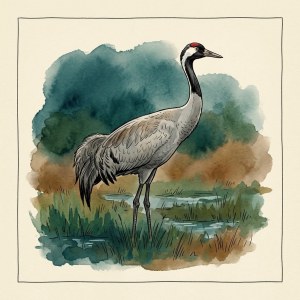
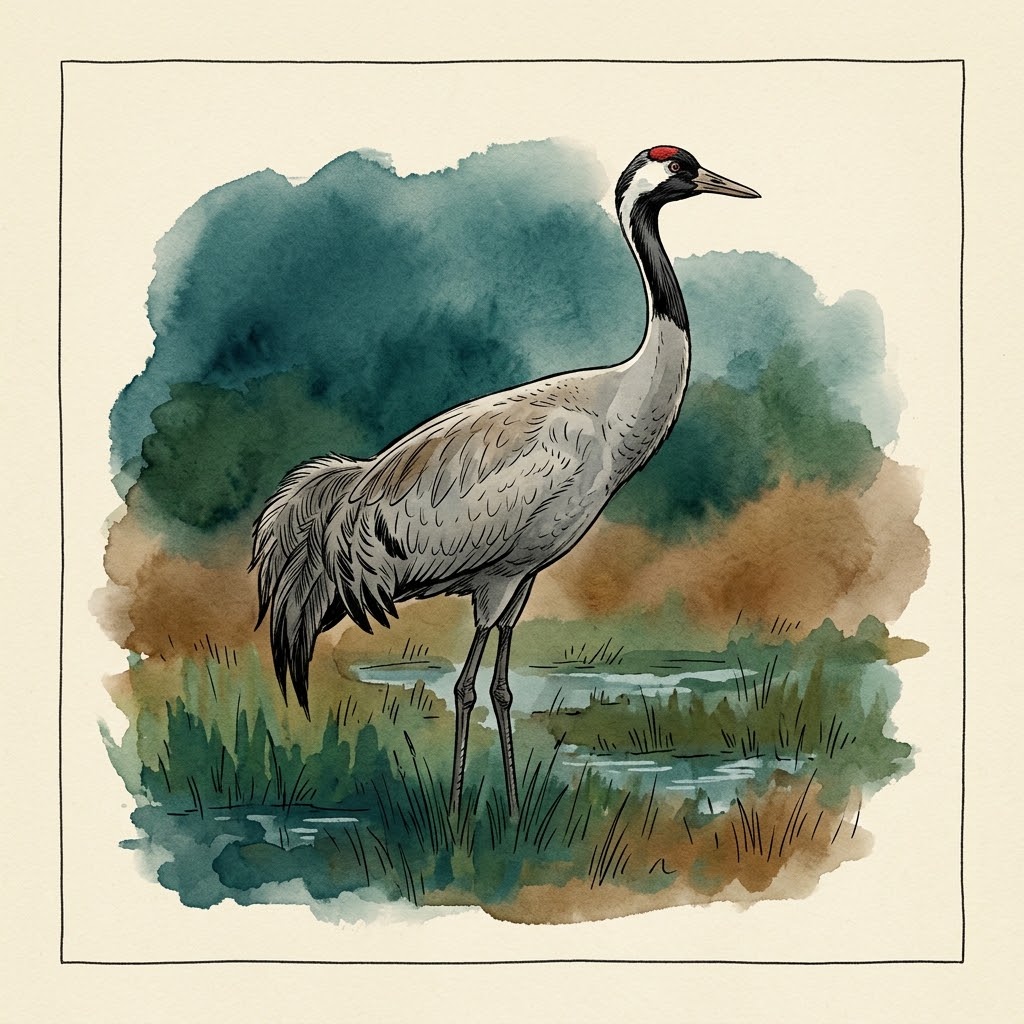
Grus grus
● IUCN: Least Concern · protected
An elegant grey giant with a trumpeting call that carries for kilometres. Every autumn tens of thousands of cranes land along Germany’s Baltic coast on their way south: one of the greatest natural spectacles in Europe.
| Habitat | Wet forests, bogs and marshes; during migration fields and grassland |
| Height | About 1.2 metres |
| Active | By day; at night on roosts in shallow water |
Card I of IV
Ecological profile
| Identification | Tall grey bird with a black-and-white head and neck, a small red crown and a bushy ‘bustle’ of drooping feathers over the tail |
| Wingspan | Over 2 metres |
| Diet | Seeds, leftover grain and maize, roots, insects and small animals |
In flight the crane stretches its neck and legs straight out, unlike the heron, which tucks its neck in. Cranes pair for life.
Where can you see them?
Difficulty: ●●●●● Easy
In October you see them by the thousand. Come at sunset, when they fly to their roosts.
| Baltic coast | The Rügen-Bock region and the Darß-Zingst lagoons in Mecklenburg-Western Pomerania |
| Inland | The Rhin-Havelluch near Linum, north-west of Berlin |
| Tip | Watch from a viewpoint such as the Kranorama at the Günzer See, without disturbing the birds |
Did you know the number of breeding pairs in Germany more than doubled in ten years, to around 12,000? Most breed in Mecklenburg-Western Pomerania and Brandenburg.
Card II of IV
Behaviour & seasons
In spring the pairs dance: they leap, bow and spread their wings while calling in duet. In autumn cranes from Scandinavia, the Baltic states and Russia migrate south. On the way they rest in large flocks: by day they feed on the fields, at night they sleep safely in shallow water.
| February – March | Return and spring migration; in March pairs occupy their breeding territory |
| Spring – summer | Breeding in wet forests and bogs |
| Mid-September – early November | Resting on the Baltic coast, with most birds in October |
| Winter | Most move on to France and Spain |
When is the best time to see them?
| Jan | Feb | Mar | Apr | May | Jun | Jul | Aug | Sep | Oct | Nov | Dec |
| winter | spring · dance | summer · breeding | autumn · migration | winter | |||||||
■ Good chance ■ Fair chance ■ Difficult
Card III of IV
Role in the ecosystem
Cranes are indicators of wet nature. They only breed where bogs, marshes and wet forests are quiet and wet enough. That the number of breeding pairs in Germany has grown so strongly is partly thanks to the protection and restoration of those wetlands.
Vulnerable: in autumn 2025 an estimated 40,000 cranes died of bird flu, about a tenth of the birds on the western European flyway. Dry summers also make breeding sites unsuitable. If you find a dead or sick crane, do not touch it and report it to the local authority or a nature organisation.
Card IV of IV
Stories & culture
The bird of happiness
In Germany the crane is called the Vogel des Glücks, the bird of happiness. Its arrival in spring meant winter was over, and its departure in autumn announced the cold. In Japan and China, too, the crane stands for happiness and a long life. Today the autumn migration draws thousands of ‘crane tourists’ to the Baltic coast every year.
Frequently asked questions
Questions about the common crane
Where can you see cranes in Germany?
Most spectacularly in autumn on the Baltic coast, in the Rügen-Bock region and the Darß-Zingst lagoons, and in the Rhin-Havelluch near Linum.
When is the crane migration?
From mid-September to early November they rest on the Baltic coast, with most birds in October. In spring they return in February and March.
Why do cranes dance?
The dance is part of courtship and strengthens the bond between partners. You see it mainly in spring, but sometimes also at autumn resting sites.
Habitat · Germany