Bird · Alps & mountain forests
Tetrao urogallus
● Threatened with extinction in Germany
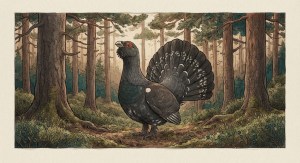
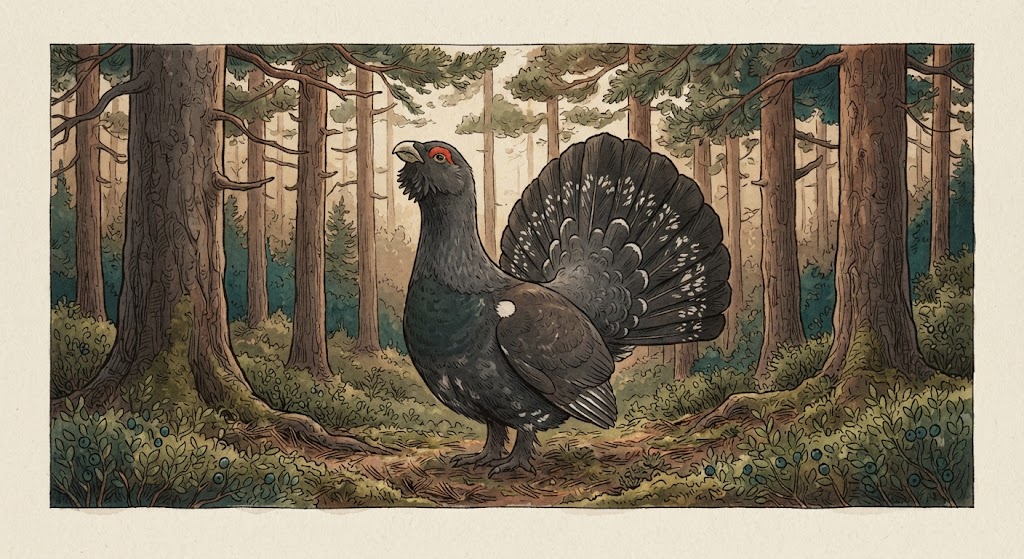
As big as a turkey, with a fan of tail feathers and a red eyebrow wattle: the capercaillie is the largest grouse in Europe. In spring, at dawn, it performs one of the strangest and most beautiful displays in the bird world.
| Habitat | Old, open conifer forests with bilberry undergrowth |
| Weight | Male 4–5 kg, female about 2 kg |
| Active | During the day; display at dawn |
Card I of IV
Ecological profile
| Male | Dark grey with a glossy green breast, red eyebrow wattle, shaggy ‘beard’ and a broad tail fan |
| Female | Much smaller, rusty-brown barred, with an orange breast patch |
| Diet | Summer: bilberries, buds and insects; winter: almost only pine needles |
Where can you find them?
| Germany | The Black Forest, the Bavarian Forest and the Bavarian Alps |
| Netherlands & Belgium | The capercaillie no longer occurs there |
| Important | Stay on the paths in spring and winter; disturbance costs these birds precious energy |
Did you know the capercaillie survives winter on pine needles? Few other birds can digest such a poor diet.
Card II of IV
Behaviour & seasons
In spring the males gather at first light at fixed display grounds. With tail fanned and head raised, they sing a strange song of clicks, a ‘cork-pop’ and a grinding sound. During that last part the male is almost deaf for a few seconds. The females choose the most impressive male and then incubate their eggs alone on the forest floor.
| March – May | Display at dawn |
| May – June | Six to ten eggs in a scrape on the ground |
| Summer | Chicks feed mainly on insects among the bilberries |
| Winter | Rests in trees and snow holes; lives on needles |
Card III of IV
Role in the ecosystem
The capercaillie is a so-called umbrella species: protect this bird and you protect an entire ecosystem. It needs old, open mountain forests with thick trees, clearings and a bilberry undergrowth. Intensive forestry, denser forests, climate change and disturbance from recreation have caused a sharp decline in Germany. In the Black Forest, special forest management is trying to restore its habitat.
Card IV of IV
Stories & culture
According to a well-known story, the Bavarian and Tyrolean Schuhplattler dance was copied from the capercaillie’s display: men stamping, leaping and puffing themselves up to impress the women, just like the males in the forest. Whether it really began that way, nobody knows for sure, but the comparison is popular in the Alps. The capercaillie is also a symbol of the Black Forest, appearing on logos, signs and in woodcarving.
Frequently asked questions
Questions about the capercaillie
Where does the capercaillie live in Germany?
In the Black Forest, the Bavarian Forest and the Bavarian Alps, in old and open conifer forests.
Why is the capercaillie endangered?
Because of the loss of old, open forests, climate change and disturbance by people, especially in winter and during the display season.
What is the capercaillie’s display?
The spring ritual in which males, at dawn and with fanned tails, sing a strange song of clicks and grinding sounds to impress the females.