Bird · Ardennes
Tetrastes bonasia
● IUCN: Least Concern · very rare in Belgium
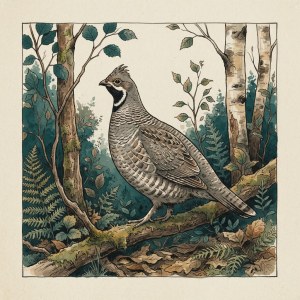
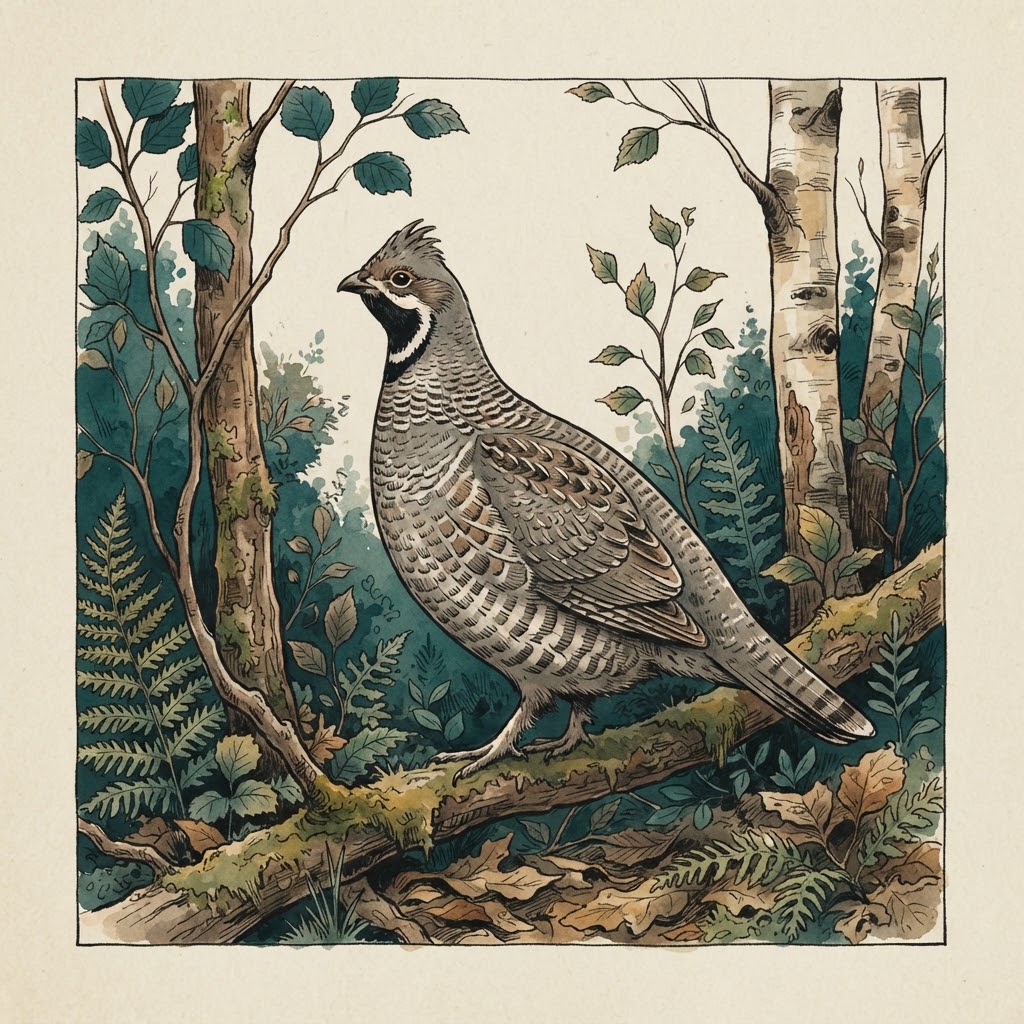
A small grey-brown forest grouse that you are more likely to hear than see: a thin, high whistle among the shrubs. The hazel grouse is Europe’s smallest forest grouse and one of the most secretive birds of the Ardennes.
| Habitat | Dense mixed forest with hazel, birch and alder |
| Length | About 35 cm |
| Weight | About 350–450 grams |
Card I of IV
Ecological profile
| Identification | Grey-brown with fine barring and spots, a small crest and a grey tail with a black terminal band |
| Male or female | The male has a black throat bordered with white; the female’s throat is paler |
| Diet | Buds and catkins of hazel, birch and alder, leaves and berries; chicks eat insects |
Where can you find them?
| Belgium | A small remnant population in the Ardennes |
| Elsewhere | More common in the forests of Central and Northern Europe and Scandinavia |
| Tip | The chance of seeing one is small; stay on the paths, as the birds are very sensitive to disturbance |
Did you know the hazel grouse sometimes dives into the snow to sleep in winter? Under a layer of snow it stays much warmer than in the open air.
Card II of IV
Behaviour & seasons
Hazel grouse stay in the same patch of forest all year and do not migrate. Unlike many other grouse, they form stable pairs. When in danger they freeze completely, or burst up with a whirring sound and vanish among the trees.
| March – April | The male whistles and defends his territory |
| May – June | A well-hidden nest on the ground with some 7 to 11 eggs |
| Summer | Chicks hunt for insects and can soon fly short distances |
| Winter | Lives on buds and catkins in the treetops |
Card III of IV
Role in the ecosystem
The hazel grouse is an indicator of varied forest. It needs a mosaic of young shrubs, old trees and clearings, with plenty of hazel, birch and alder. In uniform conifer plantations or overly tidy forests it disappears. That is why it has declined so sharply in Belgium; disturbance and predation also play a part.
What helps? Forest management that leaves room for shrubs, broadleaved trees and young growth. That benefits not only hazel grouse but also butterflies, songbirds and small mammals.
Card IV of IV
Stories & culture
The name says it all: in English, Dutch (hazelhoen) and German (Haselhuhn) this is the grouse of the hazel, the shrub it lives on. In French it is called gélinotte des bois. Nature photographers and birdwatchers see an encounter with a hazel grouse as a rare gift: a bird so well camouflaged that you only notice it was there once it has gone.
Frequently asked questions
Questions about the hazel grouse
Where does the hazel grouse live in Belgium?
Only in the Ardennes, in a small remnant population in varied forests with plenty of hazel, birch and alder.
How do you recognise a hazel grouse?
By its small size, finely barred grey-brown plumage and small crest. The male has a black throat bordered with white.
Why has the hazel grouse become so rare?
Mainly because varied forest with shrubs and young broadleaved trees has disappeared. Disturbance and predation also play a role.
Habitat · Belgium