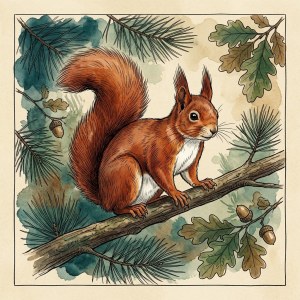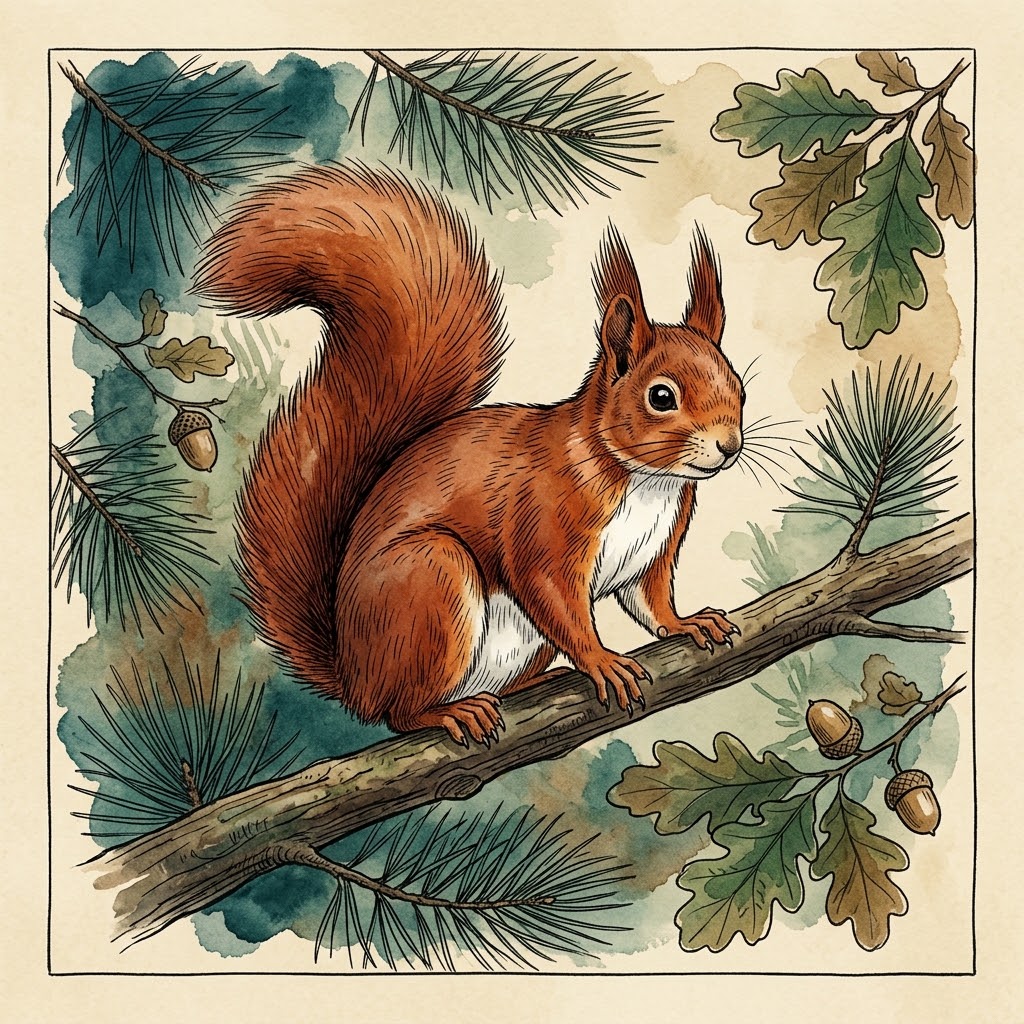
Mammal · Veluwe
Sciurus vulgaris
● IUCN: Least Concern · protected in NL
A red flash among the pines, with a bushy tail that serves as both rudder and blanket. The red squirrel is one of the best-known forest dwellers, and a tireless collector.
| Habitat | Coniferous and mixed forests, parks and gardens |
| Weight | 250–350 grams |
| Active | During the day |
Card I of IV
Ecological profile
| Habitat | Forests with conifers, oaks and beeches; also large parks |
| Identification | Reddish to dark brown coat, white belly, bushy tail and, in winter, clear ear tufts |
| Diet | Pine cone seeds, nuts, acorns, beechnuts, buds and fungi |
| Nest | A ball-shaped nest of twigs high in a tree: the drey |
Not every red squirrel is red: the colour ranges from orange-red to almost black. A squirrel can rotate its hind feet, which lets it climb down a tree trunk head first.
Where can you see them?
| Veluwe | In almost every forest |
| Rest of the Netherlands | Woods, country estates and city parks with old trees |
| Tip | Look under pines for gnawed cones: ‘stripped’ cones give a squirrel away |
Did you know a red squirrel does not hibernate? On cold days it stays longer in its drey, but in between it goes out to find its hidden stores.
Card II of IV
Behaviour & seasons
In autumn the squirrel is busy hiding food. It buries nuts and acorns one by one in hundreds of places and finds them again later using its memory and sense of smell. Not all of them, though: some it forgets.
| January – March | Mating season; wild chases through the treetops |
| Spring – summer | One or two litters of three to five young |
| Autumn | Building up food stores |
| Winter | Ear tufts and a thick coat; living off the stores |
Card III of IV
Role in the ecosystem
Those forgotten stores are exactly why the red squirrel matters so much. From the acorns, beechnuts and hazelnuts it never finds again, new trees grow. Without knowing it, the squirrel plants part of the forest of the future. At the same time it is prey for the goshawk and the pine marten.
Squirrel bridges: in some places rope bridges hang across roads so that squirrels can cross safely. Traffic is one of the biggest dangers for squirrels in the Netherlands.
Card IV of IV
Stories & culture
Ratatoskr, the gossiping squirrel
In Norse mythology stands Yggdrasil, the world tree that connects all the worlds. Up and down its trunk runs a squirrel: Ratatoskr. He carries messages between the eagle at the top and the dragon at the roots, and with his gossip makes their quarrel ever worse. A squirrel that never sits still: the old Scandinavians knew the animal well.
Frequently asked questions
Questions about the red squirrel
Does a red squirrel hibernate?
No. On cold days it stays longer in its nest, but it regularly comes out to eat from its hidden stores.
Is a black squirrel a different species?
No. The colour of the red squirrel ranges from orange-red to almost black. It is still the same species.
Can I feed a squirrel in my garden?
A few unsalted nuts in winter do no harm. Put out a water dish and make sure the food is out of reach of cats.
What is a squirrel’s nest called?
A drey: a ball-shaped nest of twigs, lined with moss and grass, high in a tree.
Habitat · The Netherlands