Mammal · Veluwe
Capreolus capreolus
● IUCN: Least Concern
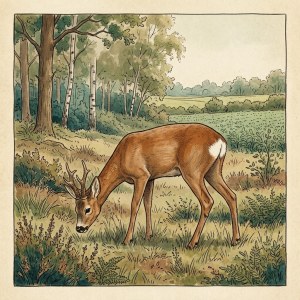
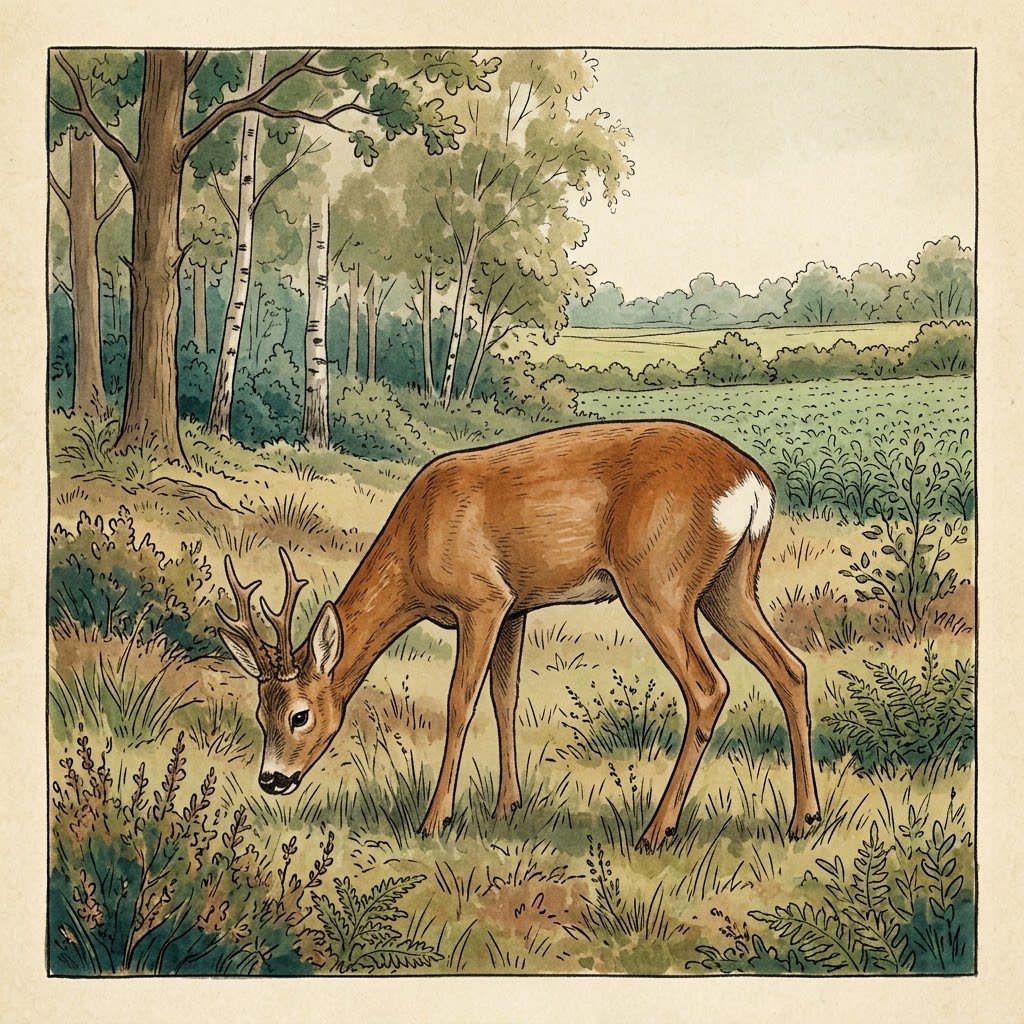
The smallest and most common deer in the Netherlands. You see roe deer not only in forests, but also in meadows and fields, often at dusk along the forest edge.
| Habitat | Forest edges, fields and meadows |
| Weight | About 20–30 kg |
| Active | Mainly at dawn and dusk |
Card I of IV
Ecological profile
| Habitat | A varied landscape of forest, forest edges, fields and meadows |
| Identification | Reddish-brown in summer, grey-brown in winter; white rump patch, almost no visible tail |
| Diet | Herbs, buds, young shoots, bramble leaves and acorns |
| Shoulder height | 60–75 cm |
A male is called a buck, a female a doe. Only the buck has antlers: small, upright and usually with three points per side. Roe deer are fussy eaters: they prefer to pick the most nutritious buds and herbs rather than graze on grass.
Where can you see them?
| Veluwe | Throughout the forests and along the forest edges |
| Rest of the Netherlands | In almost every province, including the dunes and farmland |
| Tip | Look along the edge of a forest or maize field at sunrise |
Did you know a startled roe deer barks? The short, harsh call sounds a little like a dog and warns other roe deer of danger.
Card II of IV
Behaviour & seasons
The roe deer has an unusual annual rhythm. The rut is already in summer, in July and August, but the fawns are not born until the following year. That is due to delayed implantation: the fertilised egg waits for months before it implants, so the young arrive in spring when there is plenty of food.
Find a fawn alone in the grass in May or June? Don’t touch it and walk on. The mother leaves her fawn on purpose and returns a few times a day to suckle it. A fawn that smells of people may be abandoned by its mother.
| October – December | The buck sheds his antlers |
| Winter | New antlers grow; roe deer often live in small groups |
| May – June | Birth of one to three spotted fawns |
| July – August | The rut |
Card III of IV
From wild to plate
Roe deer is considered one of the finest kinds of game: mild in flavour, tender and very lean. It is less pronounced than red deer or wild boar, which makes it appealing to people who have eaten little game.
Because it is so lean, roe deer dries out quickly. Searing it quickly over high heat and then letting it rest is the best method for the prime cuts. You can find it in autumn and winter at a game dealer.
| Saddle | The most prized cut; cook pink or roast whole |
| Haunch | For steaks or a small roast |
| Shoulder and neck | For stews and ragout |
These are general seasonal and preparation guidelines, not official hunting seasons or a food safety guarantee. Check local regulations and reliable sources.
Card IV of IV
Recipe & tradition
Roe deer loin with wild mushrooms and jus
| Meat | Roe deer loin, at room temperature |
| Flavourings | Butter, thyme, garlic, juniper berries and a splash of ruby port |
| Method | Sear briefly on all sides over high heat, rest for 10 minutes and serve pink |
| Serve with | Fried wild mushrooms, celeriac purée and cranberries |
Roe deer with wild mushrooms is autumn on a plate: the animal and the mushrooms come from the same forest, in the same season. In Dutch and Flemish cooking something sweet and sour traditionally goes with it, such as cranberries, stewed pears or a spoonful of berry jelly, to bring out the delicate game flavour.
These are general seasonal and preparation guidelines, not official hunting seasons or a food safety guarantee. Check local regulations and reliable sources.
Frequently asked questions
Questions about the roe deer
What is the difference between a roe deer and a red deer?
The roe deer is a small deer: about 60 to 75 centimetres tall, compared with up to 1.2 metres for the red deer. A roe buck also has much smaller antlers, usually with three points per side.
What should I do if I find a roe deer fawn?
Don’t touch it and walk on calmly. The mother leaves her fawn alone on purpose and returns regularly to suckle it.
When is the roe deer rut?
In July and August. Thanks to delayed implantation, the fawns are still only born in May or June of the following year.
Why does a roe deer bark?
The bark is an alarm call. A roe deer that is startled or smells something suspicious uses it to warn others nearby.
Is the roe deer endangered?
No. The IUCN Red List classifies the roe deer as Least Concern, and in the Netherlands it occurs in almost every province.
Habitat · The Netherlands