Bird · Brooks & rivers
Cinclus cinclus
● IUCN: Least Concern · protected
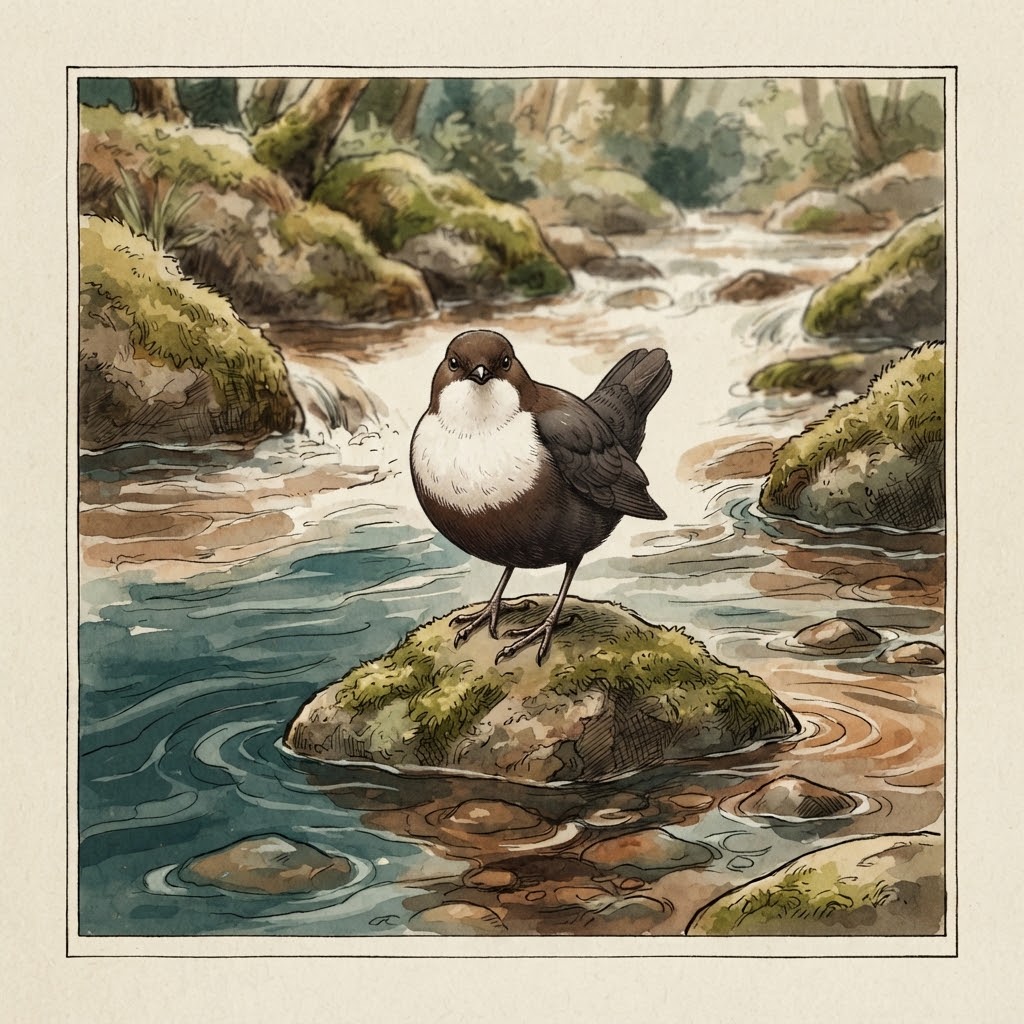
A round, dark-brown little bird with a gleaming white bib, bobbing on a stone in the middle of the stream. Then suddenly it dives in. The dipper is the only songbird that walks and swims underwater.
| Habitat | Fast-flowing, clear streams with stones and rapids |
| Length | About 18 cm |
| Weight | About 50–75 grams |
Card I of IV
Ecological profile
| Identification | Round and stocky, dark brown with a large white throat and breast; short, often cocked tail |
| Behaviour | Bobs and ‘curtsies’ on stones; flies low and fast over the water |
| Diet | Larvae of caddisflies, mayflies and stoneflies, freshwater shrimps and small fish |
Where can you find them?
| Belgium | Along fast-flowing streams and rivers in the Ardennes |
| Netherlands | Rare; mainly in winter, and occasionally breeding in South Limburg |
| Tip | Look near bridges and weirs: it often perches on a stone there or nests under the bridge |
Did you know the dipper walks along the bottom underwater, head down and wings spread? The current presses it against the stream bed while it searches between the stones for larvae.
Card II of IV
Behaviour & seasons
A pair of dippers defends a stretch of stream that can be a few kilometres long. They build a domed moss nest on a ledge just above the water: under a bridge, among tree roots or even behind a waterfall. Remarkably, the dipper also sings in the middle of winter, a babbling song that rises above the rush of the stream.
| Winter | Already singing and defending its stretch of stream |
| February – April | Nest building and a first clutch of 4–5 eggs; one of the earliest breeders |
| Spring – summer | Often a second clutch |
| Autumn | Young birds look for a stretch of stream of their own |
Card III of IV
Role in the ecosystem
The dipper is a living water-quality meter. It eats the larvae of insects that only survive in clean, oxygen-rich water. If a stream becomes polluted or acidified, those larvae disappear first, followed by the dipper. So if you see one along a stream, that is good news for the water.
What helps? Clean streams with natural banks. When bridges are renovated, special nest boxes for dippers are sometimes hung underneath.
Card IV of IV
Stories & culture
In Norway the dipper is the national bird: the fossekall, the ‘man of the waterfall’. People once believed it could walk on the stream bed because it was heavier than water. In reality it uses the current and its wings to push itself down, while an extra-thick coat of feathers and an oily preen gland keep it warm and dry.
Frequently asked questions
Questions about the dipper
Can a dipper really walk underwater?
Yes. It dives and walks along the bottom of the stream, with the current and its spread wings pressing it down.
Where can you see dippers in Belgium?
Along fast-flowing, clear streams and rivers in the Ardennes, often near bridges and weirs.
Why is it called a dipper?
Because of the way it bobs or ‘dips’ up and down on stones, and because it dips into the water to feed.