Bird · Atlantic coast
Fratercula arctica
● IUCN: Vulnerable · critically endangered in France
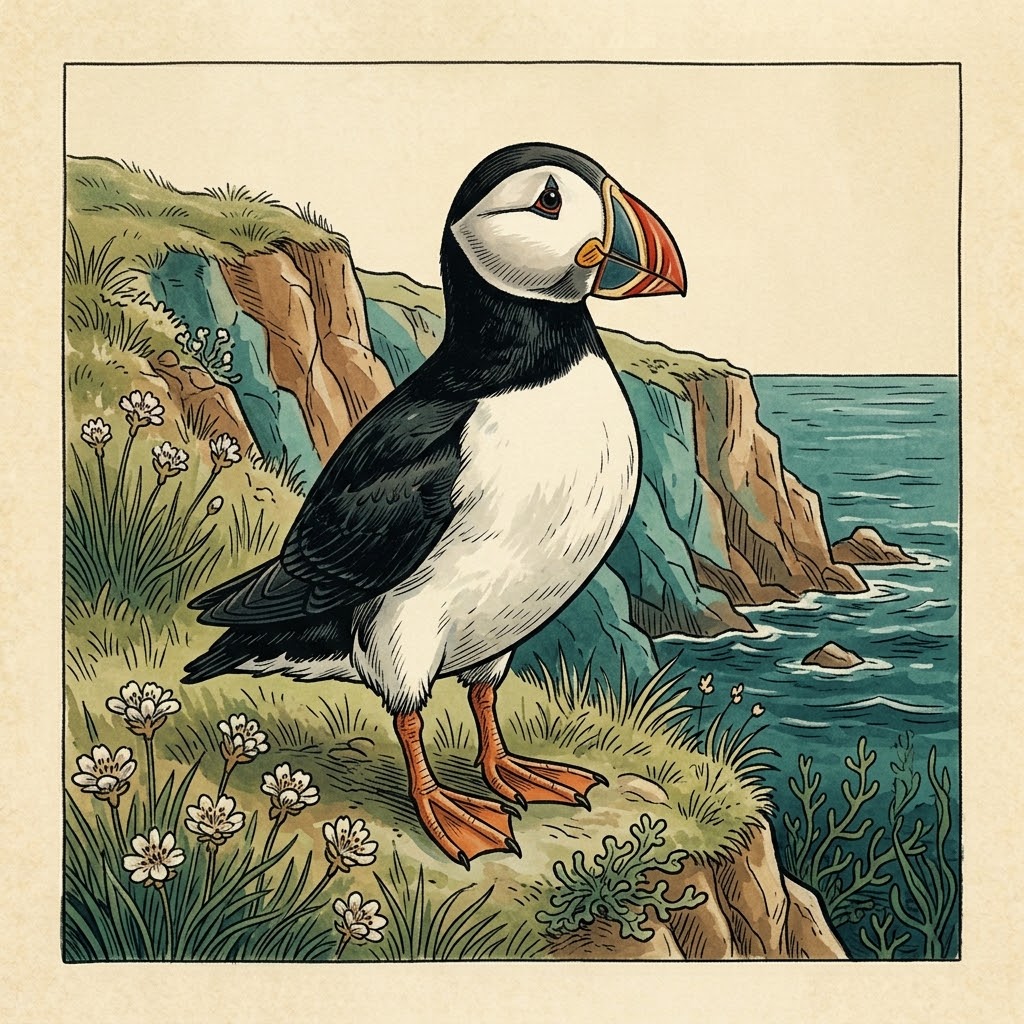
A seabird in a black-and-white suit, with a large striped bill in red, yellow and blue-grey and bright orange feet. On the Sept-Îles, off the coast of Brittany, lies France’s last true puffin colony. Thousands of pairs once bred there; now only a few dozen remain.
| Habitat | Grassy cliffs and islands; open sea for the rest of the year |
| Length | About 28–30 cm; around 400 grams |
| Present | On the islands from late March to mid-July |
Card I of IV
Ecological profile
| Identification | Black back, white belly and greyish-white cheeks; large triangular bill striped red, yellow and blue-grey; orange feet |
| In winter | Duller: the bill is smaller and greyer, the face darker |
| Diet | Small fish such as sand eels, sprat and young herring |
Where can you find them?
Difficulty: ●●●●● Difficult
Only in the breeding season, from a boat trip. With some luck you will see them on the water or by their burrows on the slope.
| Sept-Îles | Boat trips from Trestraou beach in Perros-Guirec, past the island of Rouzic and the other islands |
| On land | The LPO bird station in Pleumeur-Bodou, with live footage of the colony |
| Tip | Go in May or June and bring binoculars; landing is only allowed on the Île aux Moines |
Did you know a puffin can carry more than ten small fish crosswise in its bill at once? With its rough tongue it pins the catch against its palate while it keeps fishing.
Card II of IV
Behaviour & seasons
Puffins only come ashore to breed. Each pair digs a burrow in the grassy soil of a cliff, or uses an old rabbit hole, and lays a single egg. Both parents fly back and forth with fish for the chick. Underwater they ‘fly’ with their short wings and dive tens of metres deep. In mid-July they leave the islands and spend the rest of the year on the open sea, far out into the Atlantic.
| August – March | On the open sea, far offshore |
| Late March – April | Back at the colony; cleaning out burrows |
| May – June | Incubating and feeding the chick |
| July | The chick fledges at night; the colony empties |
When is the best time to see them?
| Jan | Feb | Mar | Apr | May | Jun | Jul | Aug | Sep | Oct | Nov | Dec |
| at sea | arrival | breeding · best time | departure | at sea | |||||||
■ Good chance ■ Fair chance ■ Difficult
Card III of IV
Threats & protection
In the 1950s some 7,000 pairs of puffins still bred on the Sept-Îles. Two major oil disasters, the Torrey Canyon in 1967 and the Amoco Cadiz in 1978, tore huge holes in the colony. It never recovered: in 2022 just 78 pairs were counted. A warmer sea, with fewer small fish, makes life even harder for a colony that already sits at the southern edge of the species’ range.
Quiet on the water: the islands are a strictly protected nature reserve. Tour boats keep their distance and go slowly. If you come in your own boat or kayak, stay outside the marked zones and never sail close to the cliffs in the breeding season.
Card IV of IV
Stories & culture
France’s first nature reserve
The puffin stood at the cradle of French nature conservation. In 1912 the Ligue pour la Protection des Oiseaux (LPO) was founded, and one of its first acts was to lease the Sept-Îles to protect the puffins. That created France’s first bird reserve. The puffin is still the LPO’s logo. The island of Rouzic is also home to France’s only northern gannet colony, with thousands of pairs.
Frequently asked questions
Questions about the Atlantic puffin
Where can you see puffins in France?
On the Sept-Îles off Perros-Guirec in Brittany, from a boat trip. It is the country’s last true colony.
When is the best time?
In May and June. From mid-July the puffins have left again for the open sea.
How many puffins still breed on the Sept-Îles?
In 2022, 78 pairs were counted, compared with some 7,000 in the 1950s.
Habitat · France