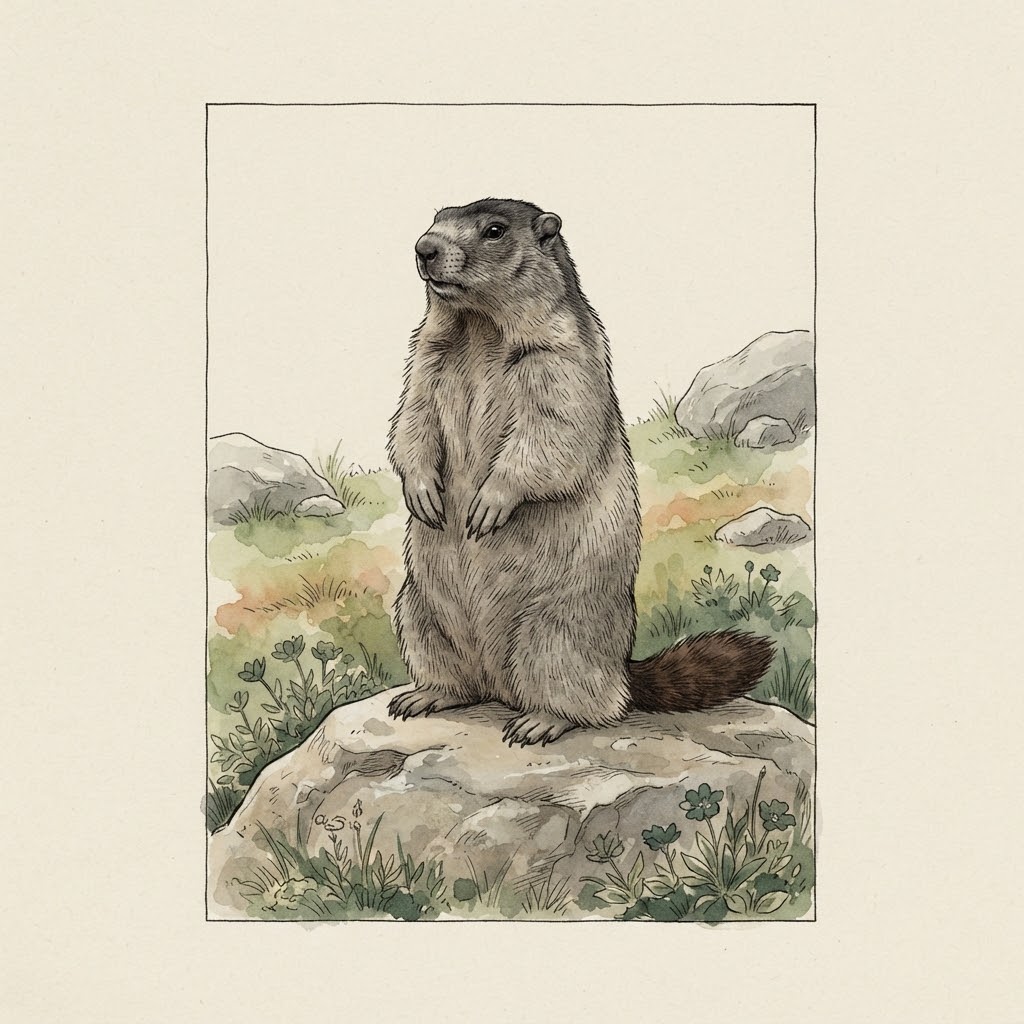
Mammal · Alps & Pyrenees
Marmota marmota
● IUCN: Least Concern
A shrill whistle echoes across the alpine meadow, and everywhere plump brown animals vanish into their burrows. The marmot is Europe’s largest rodent and the guardian of the mountain meadows. For half the year it sleeps; for the other half it eats its fill.
| Habitat | Alpine meadows and rocky slopes, usually above 1,400 metres |
| Length | 50–60 cm, including the tail |
| Active | By day, from April to September |
Card I of IV
Ecological profile
| Identification | Stocky, grey-brown rodent with short legs, a short bushy tail and small ears; often stands upright on guard |
| Weight | About 3 kg in spring, up to about 7 kg in autumn |
| Diet | Grasses, herbs and flowers, sometimes insects |
Where can you see them?
Difficulty: ●●●●● Child’s play
In summer you hear and see them on almost every alpine meadow. Follow the whistle.
| Alps | Vanoise National Park and the Écrins massif |
| Pyrenees | Around Gavarnie and in the Pyrenees National Park |
| Tip | Go early in the morning, when the marmots are lying out in the sun |
Don’t feed them! In busy places marmots sometimes beg for food. Bread, biscuits and chocolate are bad for them and can be fatal during hibernation.
Card II of IV
Behaviour & seasons
Marmots live in family groups with an extensive system of tunnels. One animal always keeps watch. If it spots an eagle or a fox, a sharp whistle sounds that can be heard more than two kilometres away, and the whole family dives underground. At the end of September they seal the burrow with grass, earth and stones, and huddle together for hibernation.
| April | Waking from hibernation; mating season straight after |
| June – July | The young marmots come above ground for the first time |
| Summer | Eating as much as possible to build up fat |
| October – April | Hibernation of about six months |
When is the best time to see them?
| Jan | Feb | Mar | Apr | May | Jun | Jul | Aug | Sep | Oct | Nov | Dec |
| hibernation | waking | active on the alpine meadow | hibernation | ||||||||
■ Good chance ■ Fair chance ■ Difficult
Card III of IV
Role in the ecosystem
The marmot is important prey for the golden eagle and the fox. With its tunnels it turns over the soil of the mountain meadow, which is good for plants and other animals. Research in the Pyrenees even shows that its presence boosts biodiversity there.
Did you know a marmot’s heart beats only about five times a minute during hibernation? Over those six months it loses a third to half of its weight.
Card IV of IV
Stories & culture
Awake after ten thousand years
In the Pyrenees the marmot had already disappeared at the end of the last Ice Age. In November 1947 six sleeping marmots were dug out of their burrow in the Alps. On 15 May 1948 they were released in the Barrada valley near Gavarnie. Until 1988 some 400 more followed. It was a great success: today the marmot lives in every valley of the Pyrenees, and its whistle is as familiar a mountain sound as the bells of the sheep.
Frequently asked questions
Questions about the alpine marmot
How long does a marmot hibernate?
About six months, from October to April. Its heart then beats only about five times a minute.
Why does a marmot whistle?
It is an alarm call. A lookout warns the group about an eagle or fox, and everyone dives into the burrow. The call can be heard more than two kilometres away.
Where can you see marmots in France?
In summer on almost every alpine meadow, for example in Vanoise National Park, the Écrins massif and around Gavarnie in the Pyrenees.
Can you feed marmots?
Better not. Bread, biscuits and chocolate are bad for them and can be fatal during hibernation.
Habitat · France