Mammal · Alps & Pyrenees
Capra ibex
● IUCN: Least Concern · protected in France
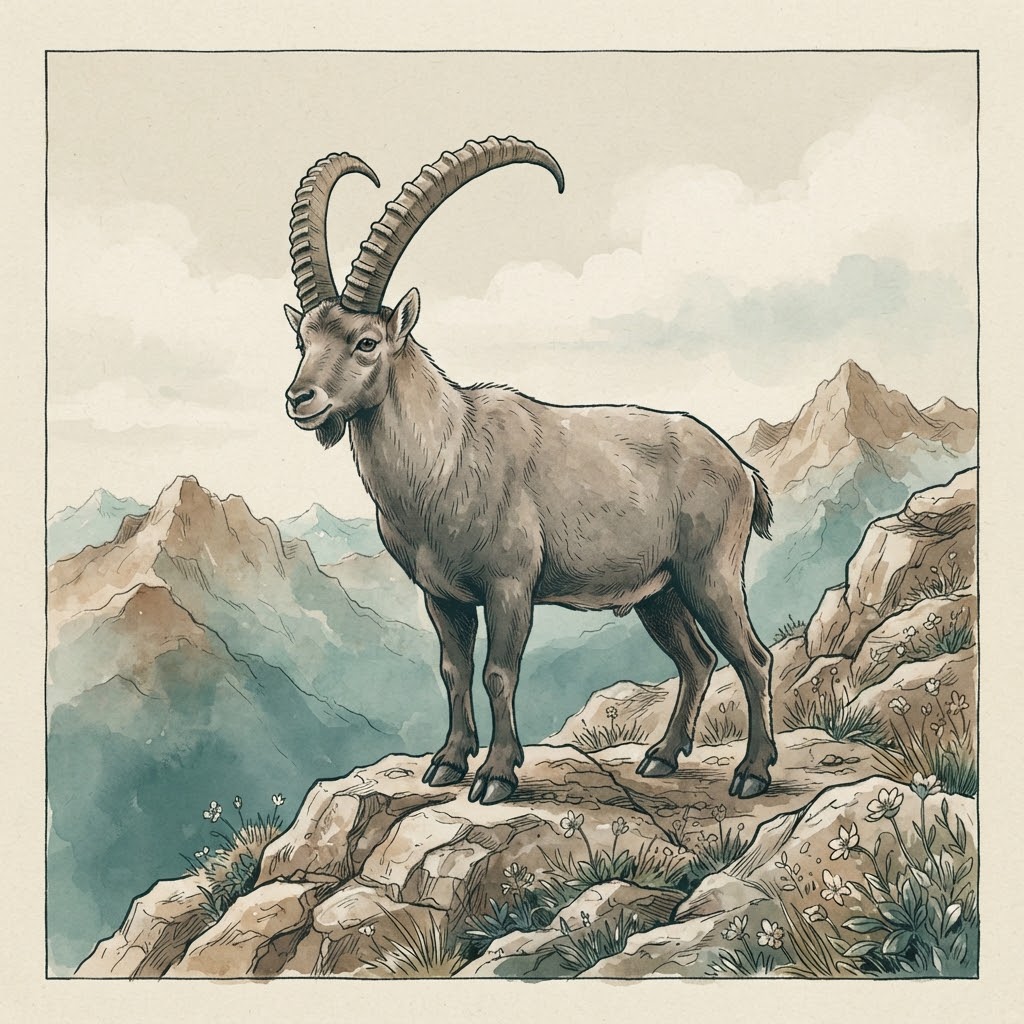
The king of the rock faces: a sturdy wild goat whose horns grow to more than a metre in old males. Two centuries ago the ibex had almost disappeared. Today it climbs again across almost the whole of the Alps, and since 2014 in the French Pyrenees too.
| Habitat | Steep rocky slopes and alpine meadows, up to above 3,000 metres |
| Weight | Males up to about 100 kg, females around 40–50 kg |
| Active | By day; on the mountain all year round |
Card I of IV
Ecological profile
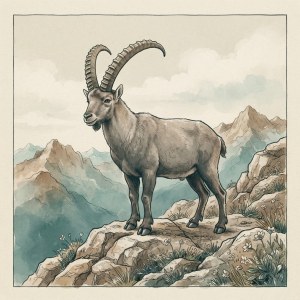
| Identification | Grey-brown wild goat with a sturdy body. The male has large, backward-curving horns with thick ridges and a small beard; the female has shorter, thinner horns |
| Difference from chamois | Larger and heavier, without the black-and-white face mask, and with much bigger horns |
| Diet | Grasses, herbs, mosses and twigs |
Where can you see them?
Difficulty: ●●●●● Easy
Ibex are not very shy. In summer you often see them close to the hiking trails.
| Vanoise | Around Pralognan-la-Vanoise, the Col de la Vanoise and the Leisse valley |
| Haute-Savoie | The Sixt-Passy nature reserve and the Bargy massif |
| Pyrenees | Iberian ibex in the Pyrenees National Park and the Ariège |
Did you know an ibex uses its non-slip hooves to climb almost vertical rock faces, and even dam walls, to lick the salt off them?
Card II of IV
Behaviour & seasons
Males and females live apart for most of the year: the males in their own groups, the females with the young. Only during the rut, from mid-November to mid-February, do they come together. Then the males test their strength in duels, their horns clashing with a loud crack. In summer they move high into the mountains; in spring they come lower to eat the first fresh grass.
| Spring | Lower on the slopes for the first fresh grass |
| June | The young, called kids, are born |
| Summer | High in the mountains, often close to the trails |
| December – January | Rut, with duels between the males |
When is the best time to see them?
| Jan | Feb | Mar | Apr | May | Jun | Jul | Aug | Sep | Oct | Nov | Dec |
| winter · rut | spring | mountain hiking season | autumn | rut | |||||||
■ Good chance ■ Fair chance ■ Difficult
Card III of IV
Role in the ecosystem
As a large plant-eater, the ibex keeps the vegetation on the rocky slopes short. It is prey for the golden eagle, which targets young animals, and sometimes for the wolf. Thanks to its climbing skills, an adult ibex usually escapes to places where no predator can follow. Old and sick animals that die in winter feed scavengers such as the bearded vulture.
Two species: the alpine ibex lives in the Alps. In the Pyrenees the original ibex died out; since 2014 Iberian ibex from Spain have been released there, a separate species with a darker coat. A few hundred now live in the French Pyrenees.
Card IV of IV
Stories & culture
Saved by a hundred animals
From the sixteenth century onwards the ibex was heavily hunted and poached. By the early nineteenth century only about a hundred were left in the whole of the Alps, in the Gran Paradiso massif in Italy. There it was protected, and all the ibex of the Alps descend from those last animals. In France the tide turned in 1963 with the founding of Vanoise National Park, the country’s first national park. The ibex even features on the medal of the first park rangers.
Frequently asked questions
Questions about the alpine ibex
What is the difference between an ibex and a chamois?
The ibex is larger and heavier and has much bigger, ridged horns. The chamois is slimmer, has small hooked horns and a black-and-white face mask.
Where can you see ibex in France?
Mainly in Vanoise National Park, for example around Pralognan-la-Vanoise. Iberian ibex live in the Pyrenees.
When is the ibex rut?
From mid-November to mid-February, with most duels in December.
Was the ibex nearly extinct?
Yes. By the early nineteenth century only about a hundred were left, in the Gran Paradiso massif in Italy. All the ibex of the Alps descend from those animals.
Habitat · France