Reptile · Camargue & wetlands
Emys orbicularis
● IUCN: Near Threatened · protected in France
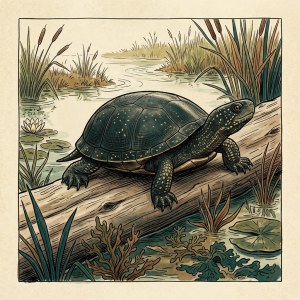
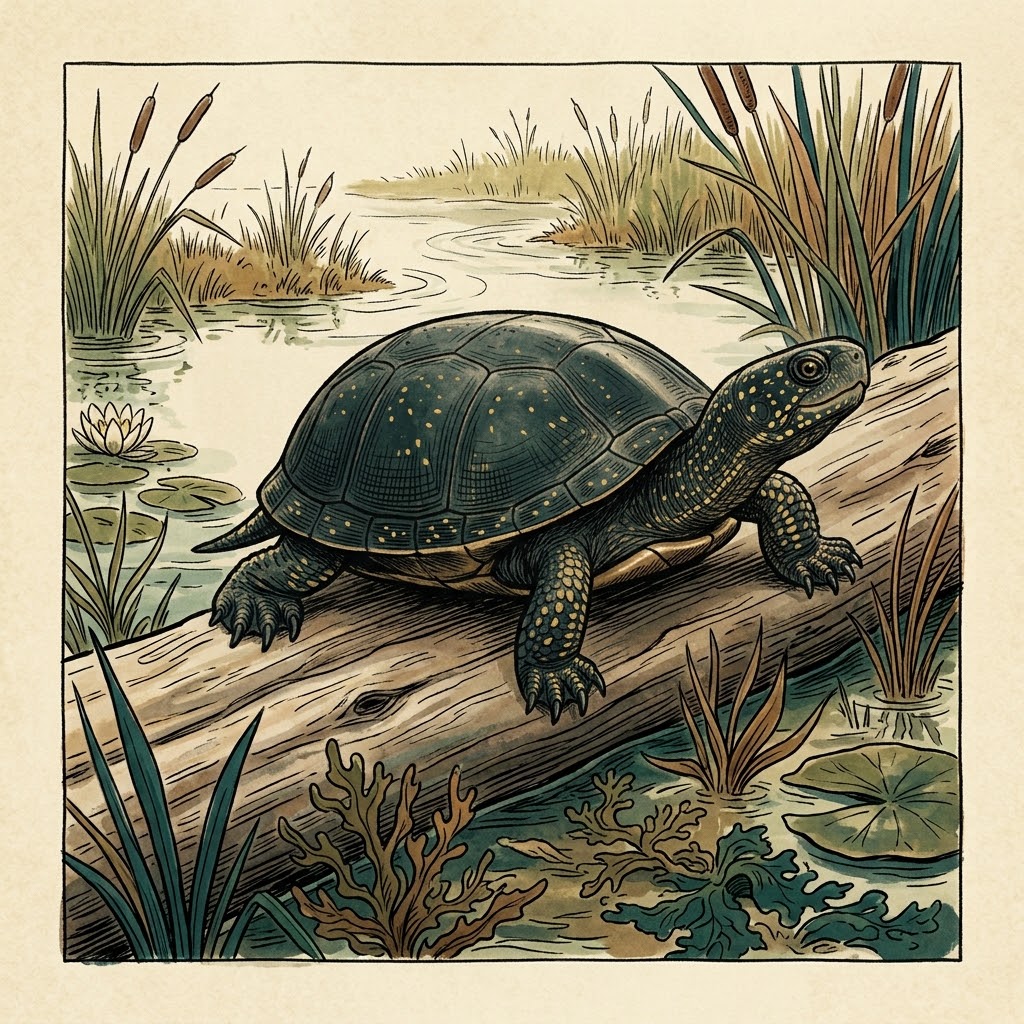
A dark turtle warming itself on a log in the sun, which vanishes into the water with a splash at the slightest sound. The European pond turtle is France’s only native freshwater turtle, and the marshes of the Camargue are one of its strongholds.
| Habitat | Marshes, ditches and ponds with plenty of water plants and sunny banks |
| Length | Shell usually 12–18 cm |
| Active | March to October; in winter it rests in the mud |
Card I of IV
Ecological profile
| Identification | Smooth, oval, almost black shell with fine yellow dots and streaks; head and legs are speckled yellow too |
| Don’t confuse with | The released American red-eared or yellow-bellied slider, with a striking red or yellow patch behind the eye |
| Diet | Insect larvae, snails, worms, tadpoles and carrion; sometimes water plants |
Where can you find them?
Difficulty: ●●●●● Moderate
With patience and binoculars you can see them lying on branches and banks on sunny spring mornings.
| Camargue | The marshes around the Tour du Valat and the Marais du Vigueirat |
| Also good | The ponds of the Brenne, in the heart of France |
| Tip | Approach quietly and keep your distance: as soon as they see you, they drop into the water |
Did you know the temperature of the nest decides whether the eggs hatch into males or females? A warm nest produces mostly females.
Card II of IV
Behaviour & seasons
As a cold-blooded animal, the pond turtle depends on the sun. In spring it lies for hours on branches, stones and banks to warm up, often several together. In summer the water is warm enough and you see it less often. In May and June the females come ashore to dig a small pit for their eggs in sunny, sandy ground. In winter it rests on the bottom, buried in the mud.
| November – February | Winter rest in the mud |
| March – April | First basking on branches and banks |
| May – June | Females lay their eggs on land |
| August – October | The young hatch; some spend the winter in the nest |
When is the best time to see them?
| Jan | Feb | Mar | Apr | May | Jun | Jul | Aug | Sep | Oct | Nov | Dec |
| winter rest | waking | basking · best time | mostly in the water | winter rest | |||||||
■ Good chance ■ Fair chance ■ Difficult
Card III of IV
Threats & protection
Across Europe the pond turtle has declined as marshes were drained. Traffic adds to that, because females cross roads on their way to their nesting sites, and so does competition from released American pet turtles, which are bigger and stronger. In France the species is fully protected: catching, disturbing or taking one is forbidden.
How you can help: if you see a turtle on the road, put it down on the far side, facing the way it was walking. And never release a pet turtle into the wild: take it to a rescue centre.
Card IV of IV
Stories & culture
A turtle as a yardstick
In the Camargue, the Tour du Valat research institute has been following its pond turtles since 1997. That is no coincidence: a pond turtle can live for decades and stays loyal to the same marsh all its life. If the turtles are doing badly, so is the marsh. In French it is called cistude d’Europe; the Latin name orbicularis refers to its round shell.
Frequently asked questions
Questions about the European pond turtle
How do you recognise a European pond turtle?
By its dark, smooth shell with fine yellow dots. A red-eared or yellow-bellied slider has a bright patch behind the eye; the pond turtle does not.
Where can you see pond turtles in France?
Among other places in the marshes of the Camargue and the ponds of the Brenne. They are easiest to see on sunny mornings in April and May.
Can you take a pond turtle home?
No. The species is strictly protected in France. Look, but leave it in peace.
Habitat · France