Bird · Alps & Pyrenees
Gyps fulvus
● IUCN: Least Concern · strictly protected
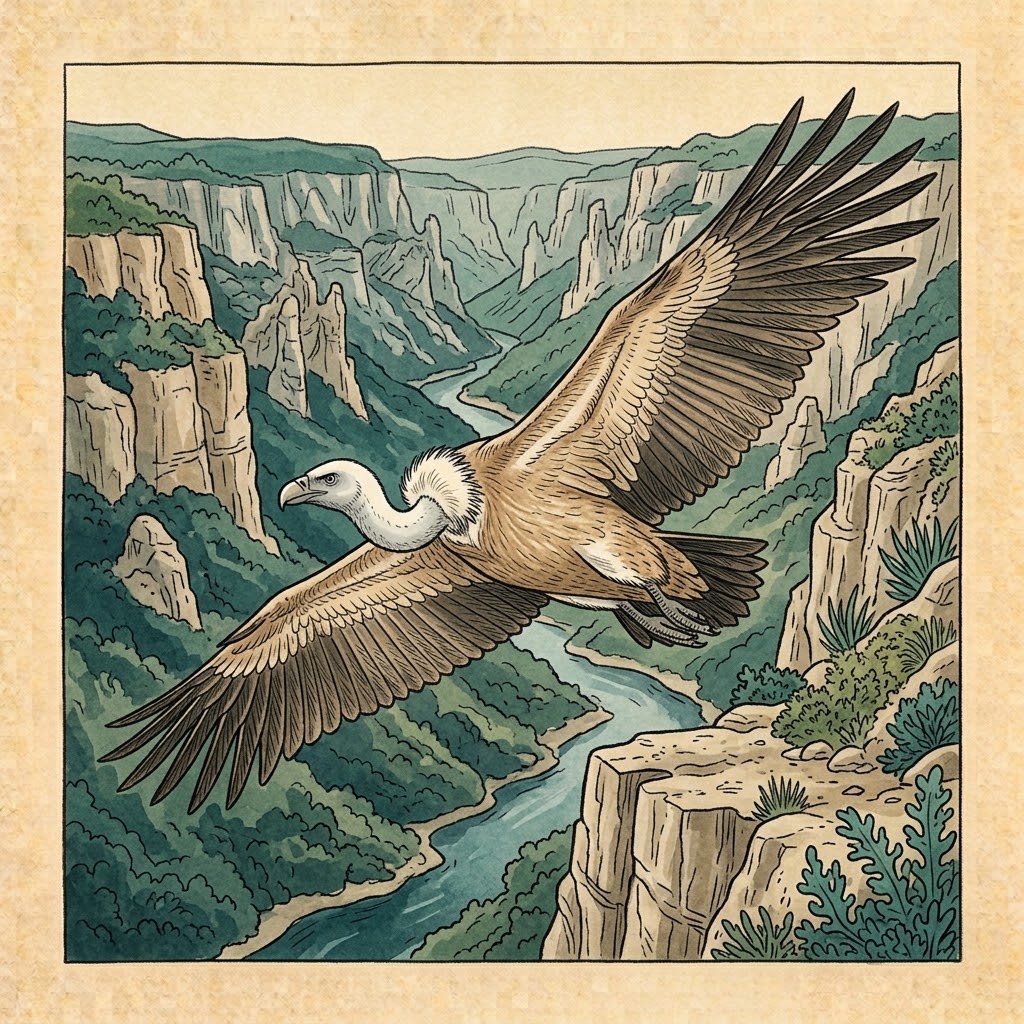
A giant with wings like planks, circling for hours above the gorges without a single wingbeat. The griffon vulture had vanished from large parts of France. Now it soars in groups again above the limestone cliffs of the Causses and the Pyrenees: one of the finest comebacks in French nature.
| Habitat | Limestone cliffs and gorges with open grassland and sheep pastures nearby |
| Wingspan | 2.3–2.8 metres; weight 6–11 kg |
| Active | By day, especially once the sun warms the air |
Card I of IV
Ecological profile
| Identification | Sandy-brown body, dark flight feathers, a bare, whitish downy head and neck and a pale ruff of feathers at the base of the neck |
| In flight | Long, broad wings with ‘fingers’ at the tips and a short tail; soars with wings slightly raised |
| Diet | Carrion only, mainly from sheep, goats and wild animals |
Where can you find them?
Difficulty: ●●●●● Very easy
In the Gorges de la Jonte and the western Pyrenees you are almost guaranteed to see dozens of vultures on a sunny day.
| Causses | The Gorges de la Jonte and the Gorges du Tarn, with the Belvédère des Vautours near Le Truel |
| Pyrenees | The Vallée d’Ossau and the rest of the Béarn and the Basque Country |
| Tip | Come between 10 am and 4 pm, when the vultures rise on the warm air along the cliffs |
Did you know the bare head is no accident? A vulture pushes its head deep into a carcass, and without feathers it stays clean. A vulture’s stomach acids are so strong that they kill most pathogens.
Card II of IV
Behaviour & seasons
Griffon vultures live in colonies on ledges in steep cliffs. They are faithful to their partner and lay just one egg a year. To find food they ride thermals, the rising warm air, and keep an eye on each other: when one drops, the rest follow. That way a group quickly finds a carcass across a large area. At the table there is a strict pecking order, with plenty of shoving and hissing.
| December – February | Display flights and laying the single egg |
| February – April | Incubation, taking turns, for about eight weeks |
| May – July | The chick grows up on the cliff ledge |
| August – November | Young vultures fledge; plenty of thermals above the gorges |
When is the best time to see them?
| Jan | Feb | Mar | Apr | May | Jun | Jul | Aug | Sep | Oct | Nov | Dec |
| winter · fewer thermals | plenty of thermals · vultures above the gorges | winter | |||||||||
■ Good chance ■ Fair chance ■ Difficult
Card III of IV
Vultures and shepherds
Vultures and sheep farmers need each other. On the Causses, farmers take dead sheep to fixed feeding sites, where the vultures clear them away within a few hours. That saves the farmers a collection by a rendering company and stops diseases from spreading. The vulture is a free, natural clean-up crew for the mountains.
Growing numbers: in the French Pyrenees alone, some 1,300 pairs bred in 2019, more than half as many again as in 2012. Vultures are, however, vulnerable to poison and to collisions with wind turbines and power lines.
Card IV of IV
Stories & culture
Back in the Causses
In the early twentieth century the griffon vulture disappeared from the Massif Central, through poison and persecution. Between 1981 and 1986 vultures were released in the Gorges de la Jonte, one of the first reintroductions of a large bird of prey in Europe. It worked: today hundreds of pairs breed in the Grands Causses again, and the cinereous vulture and the bearded vulture later followed. At the Belvédère des Vautours you can watch the colony up close on cameras.
Frequently asked questions
Questions about the griffon vulture
Where can you see griffon vultures in France?
Most easily in the Gorges de la Jonte and the Gorges du Tarn, and in the western Pyrenees, such as the Vallée d’Ossau.
Do vultures attack live animals?
Griffon vultures eat carrion and are not built to hunt. Very occasionally they go for a dying or helpless animal, but that is the exception.
How big is a griffon vulture?
Its wingspan is 2.3 to 2.8 metres and it weighs 6 to 11 kilos: one of the largest birds in Europe.
Habitat · France