Bird · Camargue & wetlands
Merops apiaster
● IUCN: Least Concern · protected
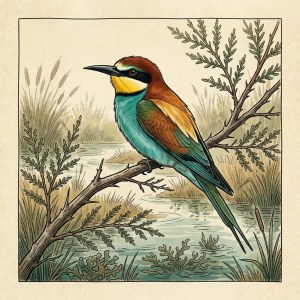
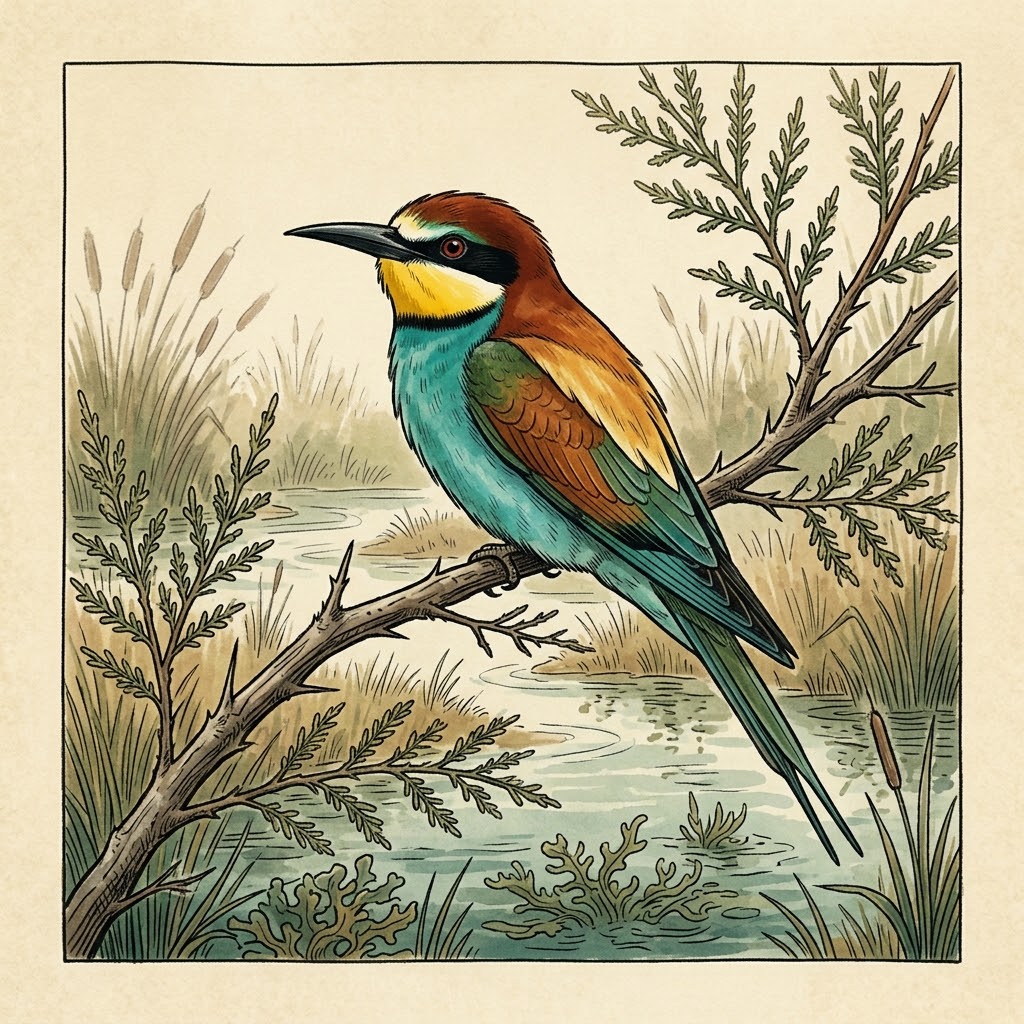
Chestnut, golden yellow and turquoise: the bee-eater may well be the most colourful bird in Europe. You often hear it before you see it, by its soft, rolling call high in the sky. Every spring it flies in from Africa to breed in the Camargue.
| Habitat | Open, warm landscapes with sandy or loamy banks and slopes to breed in |
| Length | About 27–29 cm, including the long central tail feathers |
| Present | From late April to early September |
Card I of IV
Ecological profile
| Identification | Chestnut crown and back, yellow throat with a black border, turquoise belly, black eye stripe and two projecting central tail feathers |
| Call | A soft, rolling ‘prruut’, often from groups high in the sky |
| Diet | Flying insects: bees, wasps, bumblebees, dragonflies and butterflies |
Where can you find them?
Difficulty: ●●●●● Easy
In summer you often see them in the Camargue perched on wires and dead branches, or circling in small groups.
| Camargue | Along tamarisks, banks and sandy roadsides, for example around the Marais du Vigueirat |
| Also good | Riverbanks and sand pits across southern France |
| Tip | If you find a colony, stay well away from the nest holes and watch with binoculars |
Did you know a bee-eater first beats a bee against a branch a few times and rubs it, so the sting and venom are gone before it swallows it?
Card II of IV
Behaviour & seasons
Bee-eaters like company. They breed in colonies, digging a tunnel one to two metres deep into a sandy or loamy bank with their bill and feet. They lay their eggs on the bare ground at the end of the tunnel. They hunt from a lookout, a wire or dead branch, darting out to snatch an insect in mid-air and flying back with it. In late August they head back to Africa in groups.
| October – March | Winters in Africa, south of the Sahara |
| Late April – May | Arrival; digging the nest tunnels |
| June – July | Eggs and chicks in the colony |
| August – September | Groups gather and leave for the south |
When is the best time to see them?
| Jan | Feb | Mar | Apr | May | Jun | Jul | Aug | Sep | Oct | Nov | Dec |
| in Africa | arrival | breeding · best time | departure | in Africa | |||||||
■ Good chance ■ Fair chance ■ Difficult
Card III of IV
Bee-eaters and beekeepers
The name says it all: the bee-eater is fond of honeybees. For beekeepers with hives near a colony that can make a real difference, which is why the bird was not always welcome. Yet honeybees usually make up only part of its menu; it catches wasps, bumblebees, dragonflies and beetles just as readily. In France the bee-eater is protected. Beekeepers and birdwatchers work together on solutions, for example by moving hives a little further from a colony at busy times.
A fragile home: a colony is often in a sand pit or eroded bank. If such a face is dug away or overgrown, the whole colony disappears. That is why nature managers increasingly leave sandy faces open on purpose.
Card IV of IV
Stories & culture
A southerner heading north
For a long time the bee-eater was a bird of France’s warm Mediterranean coast. With warmer summers it is moving further and further north: it now also breeds in the Loire valley, and occasionally even in the Netherlands. In French it is called guêpier d’Europe, after guêpe, wasp. Its Latin name apiaster comes from apis, bee.
Frequently asked questions
Questions about the European bee-eater
When can you see bee-eaters in the Camargue?
From late April to early September. Your chances are best in June and July, when they are feeding chicks.
Does a bee-eater really only eat bees?
No. Bees are on the menu, but it also catches wasps, bumblebees, dragonflies, beetles and butterflies.
Do bee-eaters breed in the Netherlands?
Occasionally, mainly in Limburg. With warmer summers that is likely to happen more often.
Habitat · France