Fish · Lakes, rivers & ponds
Silurus glanis
● IUCN: Least Concern
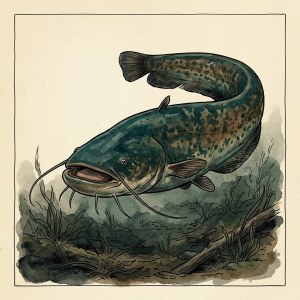
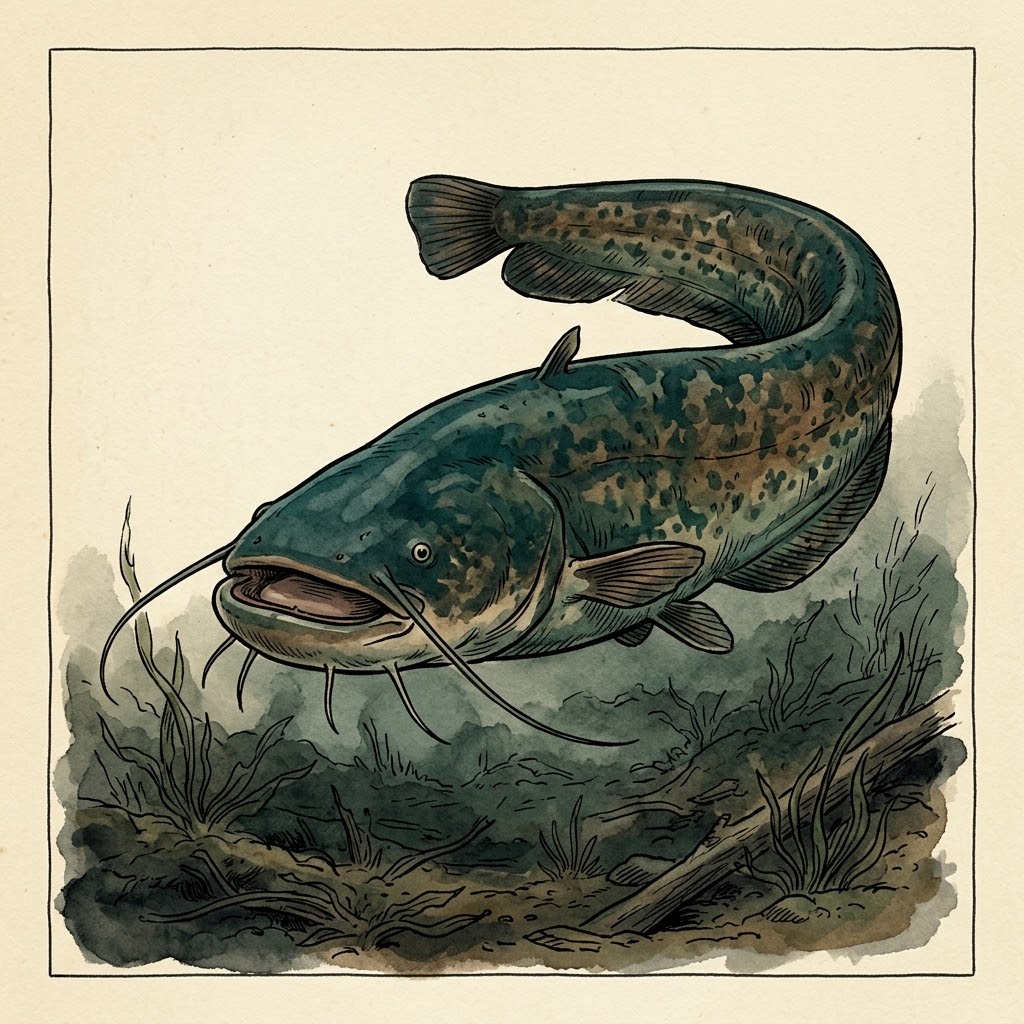
Germany’s largest native freshwater fish: up to three metres long and 150 kilos, with a broad mouth and long barbels. For a long time it was rare, but in warmer water the wels is on the advance. In 2026 it is Germany’s Fisch des Jahres (Fish of the Year).
| Habitat | Large lakes, reservoirs and slow-flowing rivers |
| Length | Usually 1–1.5 metres, exceptionally up to about 3 metres |
| Active | Mainly at dusk and at night |
Card I of IV
Ecological profile
| Identification | Long, scaleless body, huge flat head with three pairs of barbels (two very long) and a long anal fin |
| Diet | Mainly fish, but also frogs, waterbirds, small mammals and carrion |
| Age | Can live to about 80 years |
Where can you find them?
Difficulty: ●●●●● Difficult
It lives deep and is active at night. Only in the spawning season does it come into shallow water near the bank.
| Originally | The Danube and Rhine catchments |
| Now | In more and more lakes and rivers, partly through stocking and canals such as the Main-Danube Canal |
| Tip | Look along quiet, shaded banks with fallen trees on warm summer evenings |
Swimming? Attacks on people in Germany are rare: you can count them on one hand. They happen almost only when a male is guarding his nest. In May and June, prefer to swim at sandy beaches, and give a wels a wide berth if you see one.
Card II of IV
Behaviour & seasons
The wels is a warmth-loving predator. By day it rests in the depths or under tree roots; at night it hunts. In the spawning season the male builds a nest in a dark, shallow spot near the bank, for example under a fallen tree, and guards the eggs fiercely.
| Spring | Becomes more active as the water warms |
| May – June | Spawning; the male builds and guards a nest in shallow water |
| Summer | Hunts on warm nights, sometimes close to the surface |
| Winter | Rests in deep water and hardly eats |
When is the best time to see them?
| Jan | Feb | Mar | Apr | May | Jun | Jul | Aug | Sep | Oct | Nov | Dec |
| winter · depths | spring | spawning & warm summer nights | autumn | winter | |||||||
■ Good chance ■ Fair chance ■ Difficult
Card III of IV
From wild to plate
Wels has firm, white, almost boneless flesh with a mild flavour, and is a prized food fish. It is also farmed, and the wels fillet in shops and restaurants often comes from fish farms. Young fish of a few kilos taste best; very large specimens have fattier, firmer flesh.
In its native range the wels helps keep the water healthy by clearing up carrion and sick fish. Where it is new, there are concerns about its impact on other fish. Hence the debate about how to deal with its spread.
These are general seasonal and preparation guidelines, not official fishing rules or a food safety guarantee. Check local regulations and reliable sources.
Card IV of IV
Recipe & tradition
Danube-style wels with paprika
| Fish | Wels fillet in large pieces |
| Base | Onion and pepper gently stewed with sweet paprika powder and a little tomato |
| Method | Simmer the fish gently in the sauce for the last 10 minutes, with a spoonful of sour cream |
| Serve with | Broad noodles or boiled potatoes |
Along the Danube, from Bavaria to Hungary, the wels has been part of the kitchen for centuries. Dishes with paprika and sour cream, such as the Hungarian harcsapaprikás, show how well the firm flesh suits a spicy sauce. In November 2025 the wels was chosen as Germany’s Fisch des Jahres 2026, with over 56 percent of the vote.
These are general seasonal and preparation guidelines, not official fishing rules or a food safety guarantee. Check local regulations and reliable sources.
Frequently asked questions
Questions about the wels catfish
How big does a wels get?
Usually 1 to 1.5 metres, but exceptional specimens reach about 3 metres and 150 kilos. That makes it Germany’s largest native freshwater fish.
Is a wels dangerous to swimmers?
Almost never. Incidents are rare and happen almost only when a male defends his nest in May or June. At that time, prefer to swim at sandy beaches.
Why are there more and more wels?
It loves warm water and benefits from warming. It has also been stocked in many places since the nineteenth century and spread further via canals.
How old does a wels get?
Up to about 80 years.
Habitat · Germany