Fish · Lakes, rivers & ponds
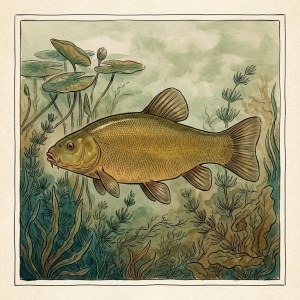
Tinca tinca
● IUCN: Least Concern
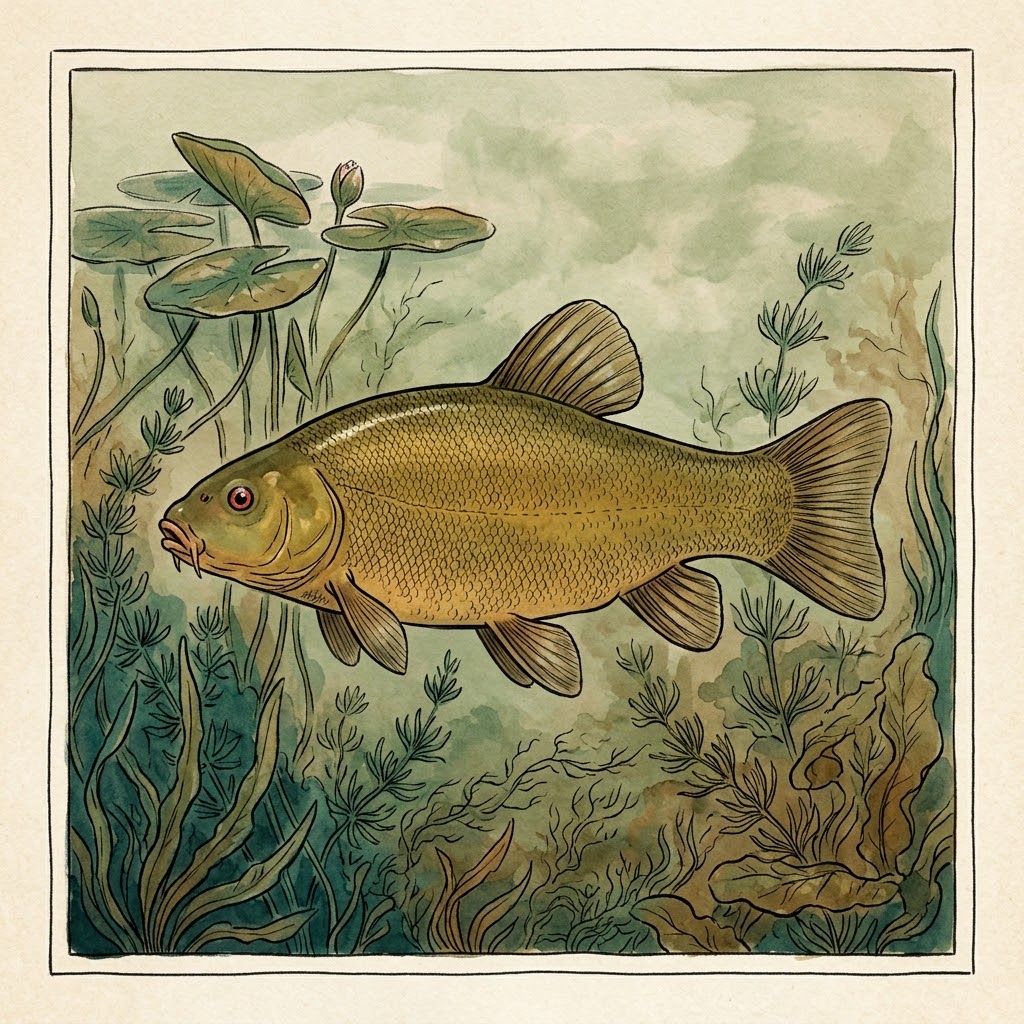
A calm, green-gold bottom fish with small red eyes and a skin full of slime. The tench loves warm, still water full of plants, and often gives itself away only by the bubbles that rise as it roots in the mud for food.
| Habitat | Warm, plant-rich ponds, lakes and slow-flowing water with a muddy bottom |
| Length | Usually 20–40 cm |
| Active | At dusk and at night |
Card I of IV
Ecological profile
| Identification | Stocky, dark olive to golden-green body, small scales, red eyes, two short barbels and a deep tail stalk with a straight tail |
| Diet | Insect larvae, snails, small mussels and sometimes plants |
| Notable | Can go months without food and survives in low-oxygen water |
Where can you find them?
Difficulty: ●●●●● Difficult
The tench lives hidden among plants on the bottom. On summer evenings you sometimes see its trail: bubbles rising from the mud.
| Germany | Almost nationwide, in ponds, lakes and old river arms |
| Fish ponds | Often together with carp, for example in the pond regions of Franconia and Lusatia |
| Tip | Watch the weedy edge of a pond on a calm summer evening |
Did you know the tench owes its German name Schleie to its slime? According to research, that slime works against bacteria and fungi, for the fish itself and for its eggs.
Card II of IV
Behaviour & seasons
The tench is a warmth-loving fish. Only when the water reaches 18 to 20 degrees does it start to spawn, sticking its eggs onto water plants. In winter it rests on the bottom. But too warm is no good either: above 28 degrees it stops eating and sometimes burrows into the mud.
| Spring | Becomes active again as the water warms up |
| May – July | Spawning once the water is 18 to 20 degrees, often mainly in June and July |
| Summer | Roots in the mud for food in small groups |
| Winter | Winter rest close to the bottom |
When is the best time to see them?
| Jan | Feb | Mar | Apr | May | Jun | Jul | Aug | Sep | Oct | Nov | Dec |
| winter · rest | spring | summer · spawning | autumn | winter | |||||||
■ Good chance ■ Fair chance ■ Difficult
Card III of IV
From wild to plate
The tench is a prized food fish and is considered tastier than carp, with soft, white, mild flesh. Most tench on the plate comes from fish ponds, where it is farmed as a ‘side fish’ alongside carp. Wild tench have declined in some regions because there are fewer plant-rich waters.
These are general seasonal and preparation guidelines, not official fishing rules or a food safety guarantee. Check local regulations and reliable sources.
Card IV of IV
Recipe & tradition
Tench with dill sauce
| Fish | Tench fillets or a whole, cleaned tench |
| Method | Poach gently in fish stock with white wine, bay leaf and a slice of lemon |
| Sauce | Reduced stock with cream and plenty of fresh dill |
| Serve with | Boiled new potatoes and cucumber salad |
An old legend holds that the tench is the ‘doctor of the fishes’: sick fish were said to rub against its slimy skin to be healed. There is no proof of that, but research does show that the slime works against bacteria and fungi. In 2007 the tench was chosen as Fisch des Jahres (Fish of the Year) in Germany and Austria.
These are general seasonal and preparation guidelines, not official fishing rules or a food safety guarantee. Check local regulations and reliable sources.
Frequently asked questions
Questions about the tench
Why is a tench so slimy?
Its thick skin is full of mucus cells. That slime protects it and, according to research, works against bacteria and fungi.
When does the tench spawn?
As soon as the water reaches 18 to 20 degrees, usually between May and July. The eggs are stuck onto water plants.
Is the tench really a ‘doctor fish’?
That is an old legend without proof. It is true, though, that its slime has a protective effect.
Can you eat tench?
Yes, it is a prized food fish with mild, white flesh. Most tench comes from fish ponds, where it is farmed alongside carp.
Habitat · Germany