Fish · Lakes, rivers & ponds
Hucho hucho
● IUCN: Endangered
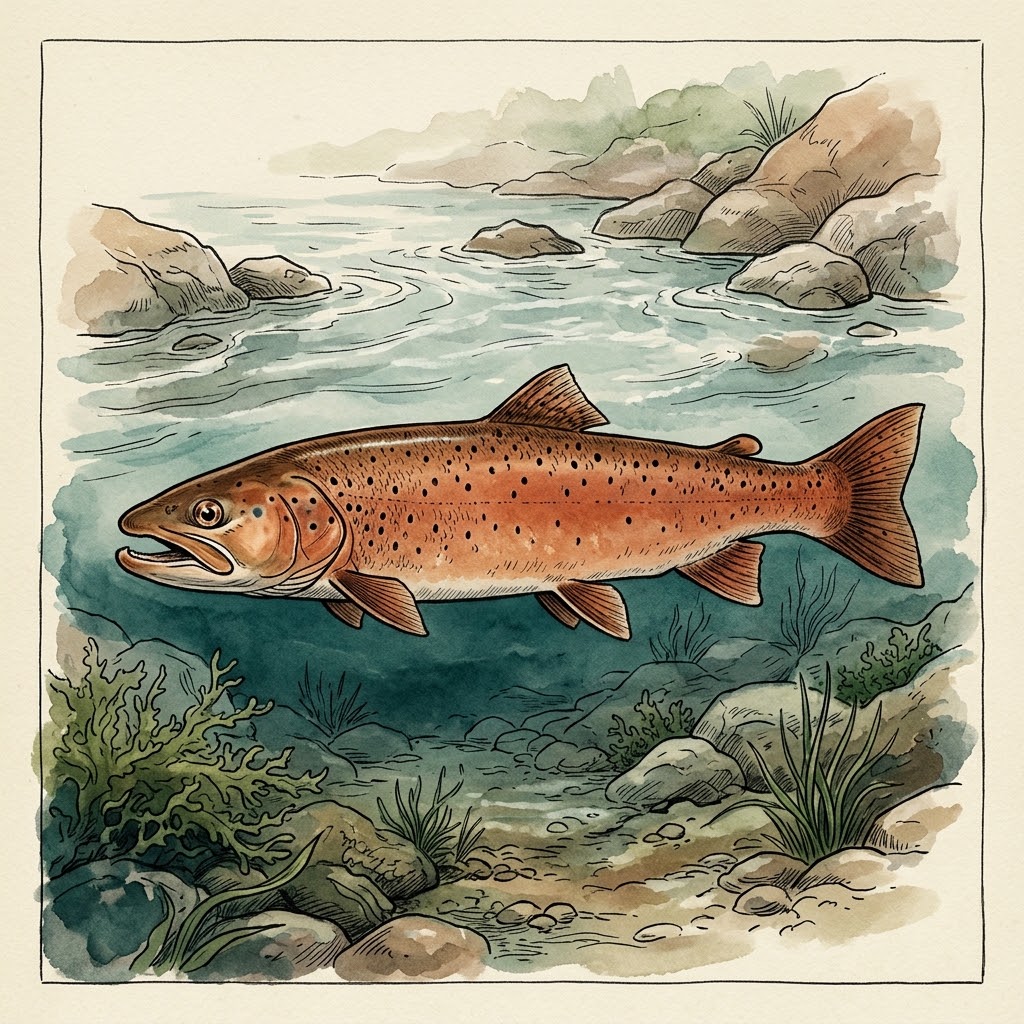
The king of the Danube: Europe’s largest trout-like fish, up to 1.3 metres long and 30 kilos. Unlike the Atlantic salmon, it never goes to sea. It lives only in the Danube catchment, and there its space is shrinking.
| Habitat | Deep stretches of fast-flowing, oxygen-rich rivers |
| Size | Up to about 1.3 metres and 30 kilos |
| Active | Mainly at dusk; rests in deep pools by day |
Card I of IV
Ecological profile
| Identification | Long, round, torpedo-shaped body, broad head with a large mouth, copper-red to silvery flanks with small black spots |
| Other names | Huchen, Donaulachs, ‘Rotfisch’ |
| Diet | Mainly fish, such as the nase, but also frogs and sometimes small mammals |
Where can you find them?
Difficulty: ●●●●● Rare chance
Only a few are left, and they live deep. Your best chance is in spring, when they spawn on shallow gravel beds.
| Bavaria | Tributaries of the Danube, such as the Isar, Inn, Lech, Regen and Ilz |
| Tip | In March and April, look from bridges at shallow gravel beds in clear rivers, and keep your distance from spawning sites |
Did you know the Danube salmon once lived in more than 250 rivers in Austria and Bavaria, along more than 7,400 kilometres of river? Today only a small part of that remains.
Card II of IV
Behaviour & seasons
The Danube salmon spends its whole life in fresh water. In spring, when the water reaches about eight degrees, it moves upstream to shallow gravel beds with fast-flowing water. There the female digs a spawning pit, in which the eggs are covered with gravel. Afterwards the fish return to their deep pools.
| March – April | Spawning migration upstream to gravel beds |
| Spring – summer | The young fish grow up among the gravel |
| Rest of the year | Hunts from deep pools, mainly at dusk |
When is the best time to see them?
| Jan | Feb | Mar | Apr | May | Jun | Jul | Aug | Sep | Oct | Nov | Dec |
| winter | spawning run | summer · deep pools | autumn | winter | |||||||
■ Good chance ■ Fair chance ■ Difficult
Card III of IV
Role in the ecosystem
As a top predator, the Danube salmon sits at the top of the river’s food chain. That makes it an indicator: where the Danube salmon thrives, the river is healthy, with free passage, clean gravel beds and plenty of prey fish.
Why it is endangered: weirs and hydropower plants block the way to spawning sites and destroy gravel beds, and straightened rivers offer little living space. Researchers warn that the Danube salmon could die out in Bavaria and Austria if numbers keep falling. Fish-eating animals such as otters, goosanders and cormorants are also mentioned; opinions on that differ. Fish passes large enough for it and free-flowing rivers help most.
Card IV of IV
Stories & culture
A fish to protect, not to eat
The Danube salmon was once a prized food fish in the Alpine countries. Now it is so rare that it has become above all a symbol of free-flowing rivers. In 2015 it was chosen as Germany’s Fisch des Jahres (Fish of the Year), and in Austria as early as 2012. That is why this page deliberately has no recipe: the Danube salmon belongs in the river, not on the plate.
Frequently asked questions
Questions about the Danube salmon
Is the Danube salmon a real salmon?
It belongs to the salmon family, but it never goes to sea. It spends its whole life in the rivers of the Danube region.
How big does a Danube salmon get?
Up to about 1.3 metres and 30 kilos. That makes it Europe’s largest trout-like fish.
When does the Danube salmon spawn?
In March and April, when the water is around eight degrees. It then moves upstream to shallow gravel beds.
Why is the Danube salmon endangered?
Mainly because of weirs, hydropower plants and straightened rivers, which damage its migration routes and spawning sites.
Habitat · Germany