Crustacean · Atlantic coast
Homarus gammarus
● IUCN: Least Concern · caught with pots
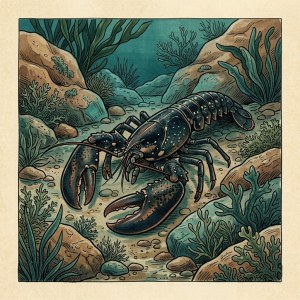
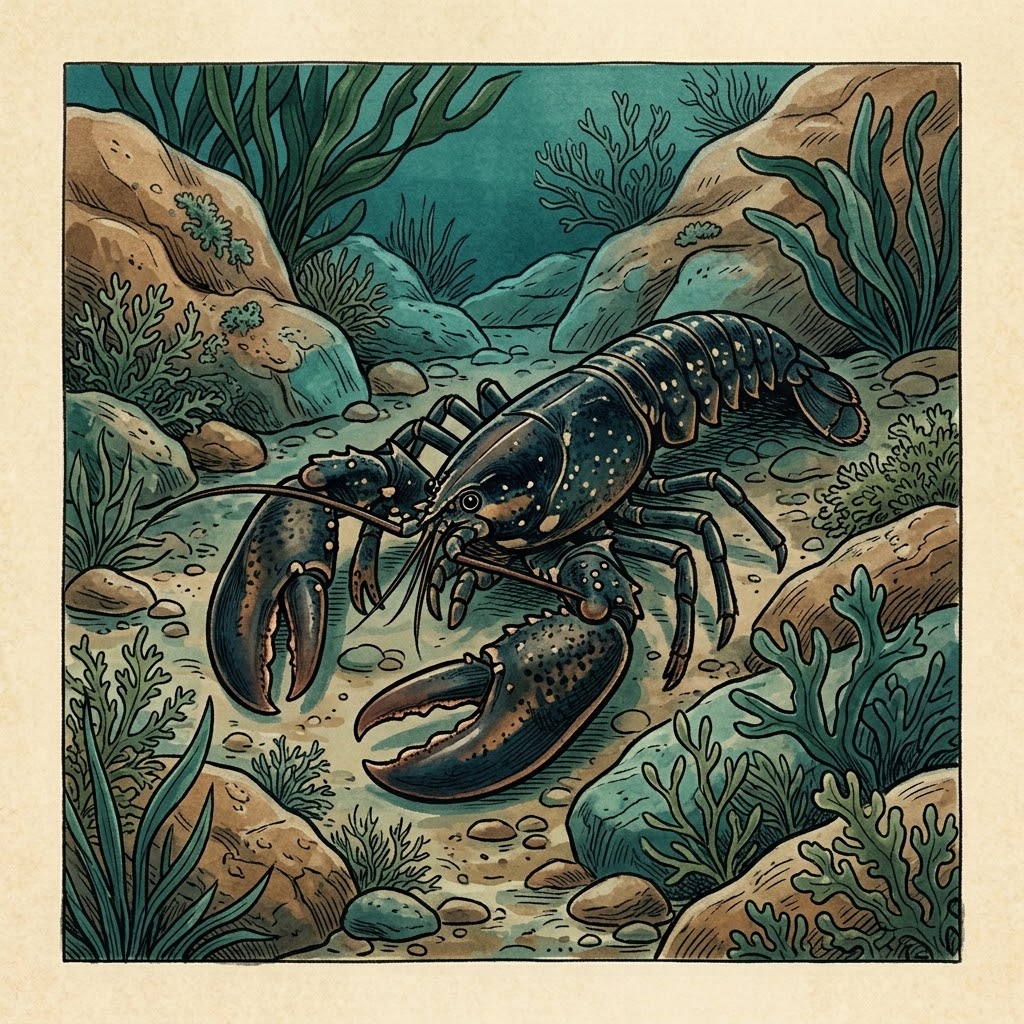
If you think a lobster is red, you have only seen it on a plate. Alive, the European lobster is a deep blue-black, with small pale spots. In Brittany it is simply called homard breton, or homard bleu: one of the most expensive and prized shellfish in France.
| Habitat | Rocky seabeds with crevices and holes, from the low-tide line to tens of metres deep |
| Length | Usually 25–50 cm; usually 0.5–1.5 kg at market |
| Season on the plate | April to September |
Card I of IV
Ecological profile
| Identification | Blue-black shell with small pale spots, two large unequal claws (a crusher and a cutter) and long red antennae |
| Don’t confuse with | The American lobster, which is brownish green to orange and often comes frozen or live from Canada |
| Diet | Crabs, shellfish, sea urchins, worms and carrion |
Where can you find them?
Difficulty: ●●●●● Difficult
By day it hides in a rock crevice. Divers sometimes see only the antennae and claws sticking out.
| Brittany | The rocky coasts and islands, from Roscoff to the Glénan islands |
| At market | Alive in the tanks of fish halls and fishmongers along the Breton coast |
| Tip | At the Océanopolis aquarium in Brest you can see it in its natural colours |
Did you know a lobster only turns red when it is cooked? Its shell holds a red pigment bound to a protein, which makes it look blue. Heat breaks that bond, and the red comes out.
Card II of IV
Behaviour & seasons
The lobster is a hermit. By day it defends its own den among the rocks; at night it goes looking for food. To grow it has to shed its shell; young lobsters do this several times a year, old lobsters once every few years. The female carries the fertilised eggs under her tail for almost a year, until the larvae hatch. A lobster grows slowly and can live for decades.
| Winter | Quiet in deeper dens; not very active in cold water |
| Spring | More active; the pot-fishing season begins |
| Summer | Moulting and mating; the larvae hatch |
| Autumn | The new shell hardens; moving to deeper water |
When to eat them?
| Jan | Feb | Mar | Apr | May | Jun | Jul | Aug | Sep | Oct | Nov | Dec |
| winter · low supply | season · plenty of Breton lobster | autumn & winter | |||||||||
■ Plenty fresh ■ Fair supply ■ Better to skip
Card III of IV
From sea to plate
Breton lobster is caught with pots, cages set on the seabed among the rocks. It is a selective way of fishing: undersized lobsters go back alive. There is a minimum size of 87 mm, measured along the carapace. Breton lobster has firmer, sweeter meat than the cheaper Canadian lobster, and is clearly more expensive. Buy it alive: a fresh lobster moves vigorously and feels heavy for its size.
These are general seasonal and preparation guidelines, not official fishing rules or a food safety guarantee. Check local regulations and reliable sources.
Card IV of IV
Recipe & tradition
Homard à l’armoricaine
| Lobster | A live lobster of about 700 grams, cut into pieces |
| Searing | Briefly in olive oil and butter until the shell turns red |
| Sauce | Shallot, garlic, tomato, white wine and a splash of cognac, with tarragon and a pinch of cayenne pepper |
| Serve with | White rice or baguette to mop up the sauce |
Is it à l’armoricaine, after Armorica, the old name for Brittany, or à l’américaine? French cooks have been arguing about it for a century and a half. The most popular story: the cook Pierre Fraysse, who had worked in America, created the dish around 1860 in his Paris restaurant and named it after America. The Bretons insist the dish is theirs. Whatever you call it, it tastes best with Breton lobster.
These are general seasonal and preparation guidelines, not official fishing rules or a food safety guarantee. Check local regulations and reliable sources.
Frequently asked questions
Questions about the European lobster
Why is a live lobster blue?
The red pigment in the shell is bound to a protein, which makes it look blue. Cooking releases that bond and the lobster turns red.
When is Breton lobster in season?
From April to September, with the biggest landings in June and July.
How does it differ from Canadian lobster?
Canadian or American lobster is a different species, brownish green and cheaper. Breton lobster is blue-black and has firmer, sweeter meat.
Habitat · France