Crustacean · Atlantic coast
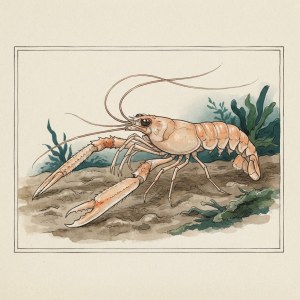
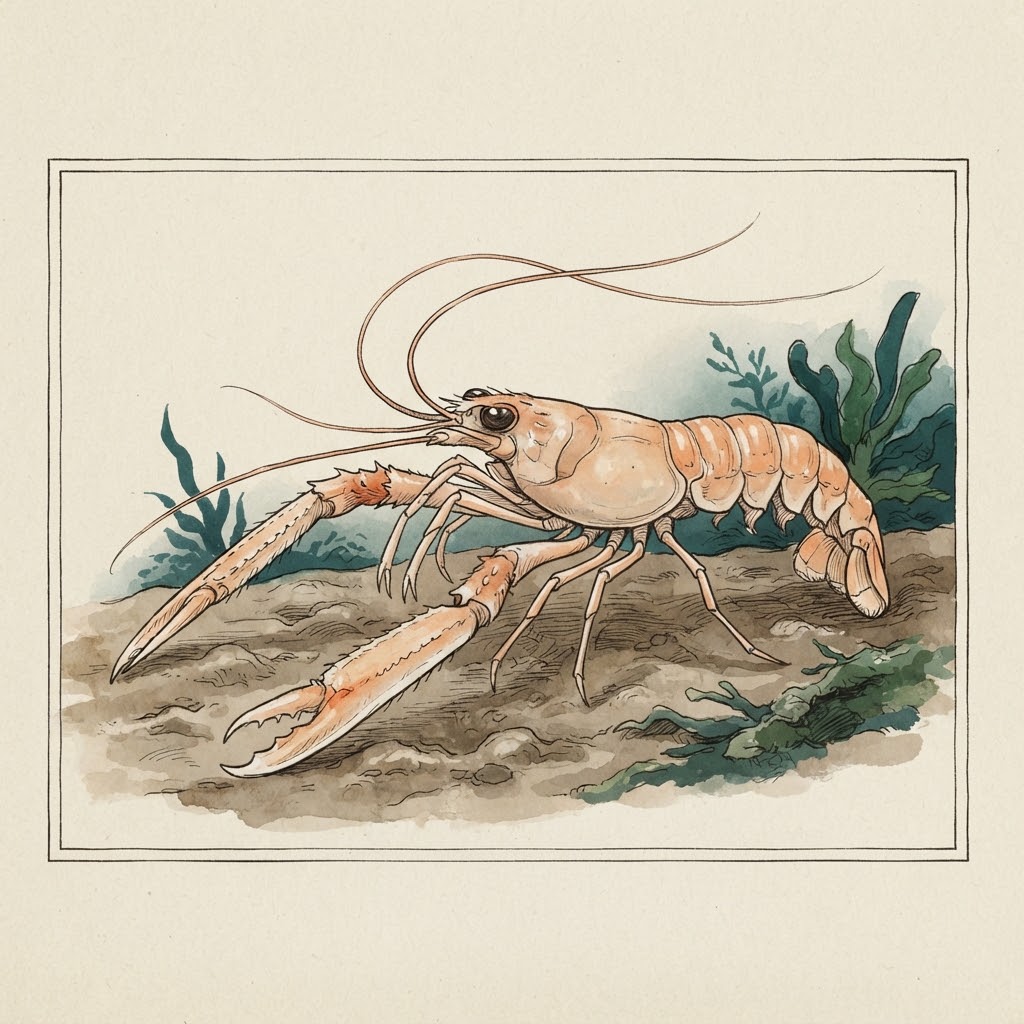
Nephrops norvegicus
● Bay of Biscay stock sharply reduced
An elegant, orange-pink lobster with long, slender claws that spends most of its life in a burrow in the mud. In the ports of southern Brittany it is sold alive on the very day it is caught. But the stock in the Bay of Biscay has shrunk sharply in just a few years.
| Habitat | Soft muddy seabeds, at around 70 to 120 metres deep |
| Length | Usually 10–20 cm, longer including the claws |
| Season on the plate | All year, peaking from April to August |
Card I of IV
Ecological profile
| Identification | Slender, orange-pink to salmon-coloured lobster with long, narrow, spiny claws and large black eyes |
| Other names | Norway lobster, Dublin Bay prawn, scampi |
| Diet | Worms, small crustaceans, molluscs and carrion from the seabed |
Where can you find them?
Difficulty: ●●●●● Rare chance
You almost never see them in the wild: they live deep and hidden in burrows. On the quay, though, you see them in abundance.
| Bay of Biscay | The ‘Grande Vasière’, a large muddy plain off the coast of southern Brittany |
| Ports | Le Guilvinec, Le Croisic and La Cotinière on Oléron |
| Tip | In Le Guilvinec, visit Haliotika, the visitor centre at the fish auction, and watch the boats come in during the afternoon |
Did you know researchers count langoustines without catching a single one? With an underwater camera they count the burrow entrances on the seabed, and from that they estimate how many langoustines live there.
Card II of IV
Behaviour & seasons
The langoustine digs a burrow with several entrances in the mud and comes out mainly at dusk to feed. Twice a year it moults in order to grow. A female carries her eggs under her tail for about seven months, and stays mostly in her burrow during that time. That is why fishermen in spring and summer mainly catch males and females without eggs.
| Autumn – winter | Females carry eggs and stay in the burrow |
| Spring | The larvae hatch and drift in the water for a while |
| April – August | Peak season in the Breton ports |
| All year | Active at dusk, around the burrow |
When to eat them?
| Jan | Feb | Mar | Apr | May | Jun | Jul | Aug | Sep | Oct | Nov | Dec |
| winter | spring | peak season | autumn | winter | |||||||
■ Plenty fresh ■ Fair supply ■ Little fresh catch
Card III of IV
From sea to plate
In southern Brittany the fishing boats go out for just one day, because the fishing grounds lie close to the coast. As a result the langoustine comes ashore still alive and is sold as ‘langoustine vivante’: the fresher, the sweeter the meat. Buy them alive if you can, or at least freshly cooked, and eat them the same day.
Fewer langoustines: according to camera counts by the French research institute Ifremer, the number of langoustines in the Bay of Biscay fell from about 4.2 billion in 2016 to 1.5 billion in 2024. Why is not yet clear; climate change is one of the explanations being studied. So eat them in moderation, and ask where they come from.
These are general seasonal and preparation guidelines, not official fishing rules or a food safety guarantee. Check local regulations and reliable sources.
Card IV of IV
Recipe & tradition
Plain langoustines, Breton style
| Shellfish | Fresh, preferably live langoustines |
| Method | In plenty of boiling, well-salted water or a court-bouillon; 1 to 2 minutes after it returns to the boil, depending on size |
| Finish | Drain briefly and serve lukewarm |
| Serve with | Homemade mayonnaise, brown bread and salted Breton butter |
Le Guilvinec is one of France’s most important fishing ports, and the langoustine is a valuable catch there. Every afternoon the boats come in and the fish is auctioned straight away. In Breton restaurants a plate of lukewarm langoustines with mayonnaise is a classic: simple, and all about freshness.
These are general seasonal and preparation guidelines, not official fishing rules or a food safety guarantee. Check local regulations and reliable sources.
Frequently asked questions
Questions about the langoustine
When are langoustines at their best?
They are caught all year, but peak season in Brittany runs from April to August.
How long should you cook langoustines?
Briefly: 1 to 2 minutes after the water returns to the boil, depending on size. Overcooking makes the meat tough and mealy.
Is the langoustine doing well?
Not in the Bay of Biscay: numbers fell from about 4.2 billion in 2016 to 1.5 billion in 2024. Researchers are still looking for the cause.
Is langoustine the same as scampi?
Originally yes: scampi is the Italian name for langoustine. In shops, though, ‘scampi’ is now also used for all sorts of large prawns.
Habitat · France