Fish · Atlantic coast
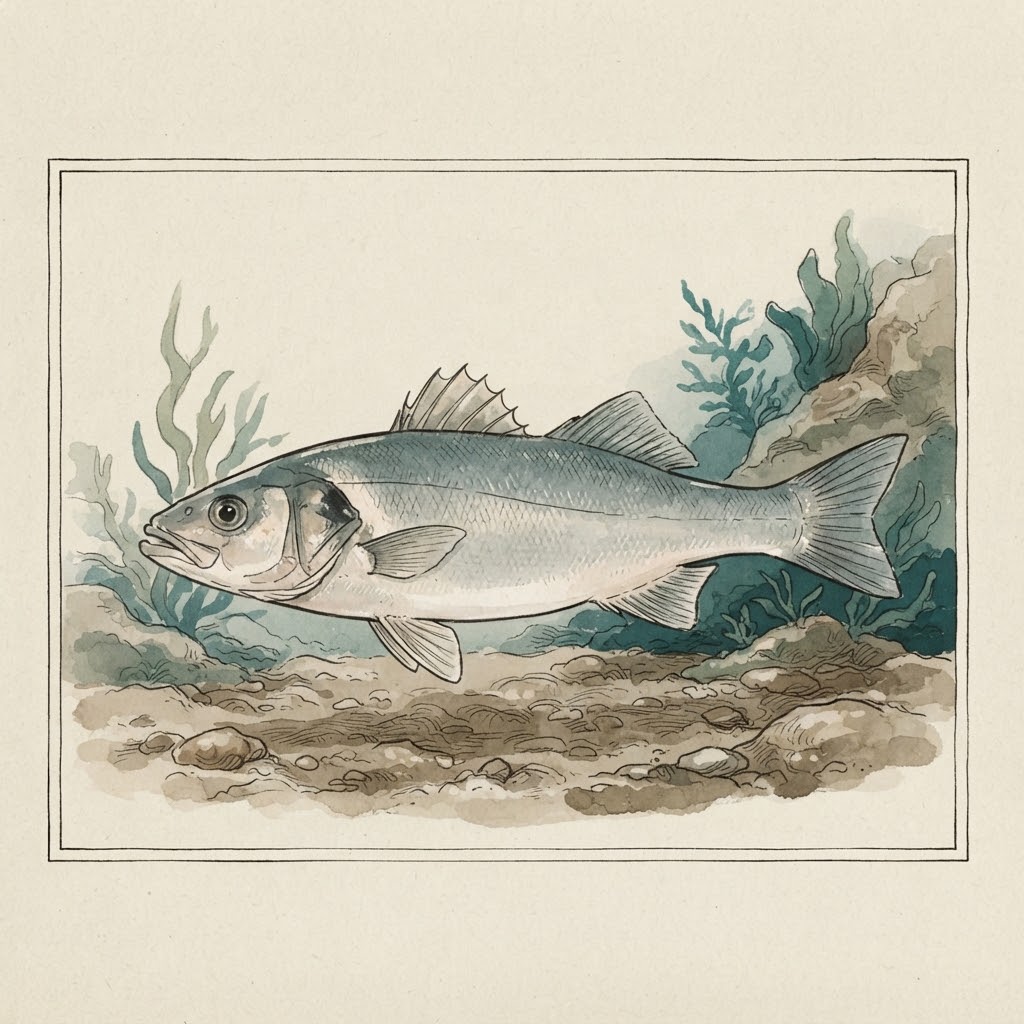
Dicentrarchus labrax
● IUCN: Least Concern · choose line-caught
A powerful, silver predator of the surf, hunting among rocks and waves. In France it is called ‘bar’ on the Atlantic coast and ‘loup’ on the Mediterranean. Line-caught sea bass from Brittany is one of the most prized fish in the country.
| Habitat | Coastal waters, rocky shores, surf and estuaries |
| Length | Usually 40–70 cm, exceptionally up to 1 metre |
| Season on the plate | May to November, outside the spawning season |
Card I of IV
Ecological profile
| Identification | Streamlined, silver-grey body with a dark back, two dorsal fins (the front one spiny) and a dark spot on the gill cover |
| Other names | Bar, loup, sea perch |
| Diet | Crabs, shrimps, small squid and small fish such as sand eels and sardines |
Where can you find them?
Difficulty: ●●●●● Moderate
With a snorkel mask or from a rocky point you can sometimes see them hunting in the surf in summer.
| Brittany | The rocky coasts around the Pointe du Raz and the Raz de Sein |
| Also good | The Loire and Gironde estuaries, and the coasts of the Vendée |
| Tip | On a rising tide, look in the foaming surf along the rocks |
Did you know a sea bass only spawns for the first time after four to seven years? That makes it vulnerable to overfishing, which is why Europe has a minimum size of 42 cm.
Card II of IV
Behaviour & seasons
In summer the sea bass hunts close to the coast, often in small groups, in the surf and in estuaries. In autumn it moves into deeper water. In winter it gathers at spawning grounds offshore, where it releases its eggs into open water. The young fish grow up in sheltered estuaries.
| February – March | Spawning at sea; fishing is restricted then |
| Spring | Back to the coast |
| Summer | Hunting in the surf and estuaries |
| Autumn | Well fed, gradually moving to deeper water |
When to eat them?
| Jan | Feb | Mar | Apr | May | Jun | Jul | Aug | Sep | Oct | Nov | Dec |
| winter | spawning | spring | season · best in late summer | winter | |||||||
■ Plenty fresh ■ Fair supply ■ Better to skip
Card III of IV
From sea to plate
Sea bass has firm, white, lean flesh with few bones. Most sea bass in shops comes from fish farms, often in the Mediterranean, and usually weighs less than 1 kilo. Wild, line-caught sea bass is bigger, firmer and considerably more expensive.
Line fishing is the most selective way of fishing: each fish is caught individually and is hardly damaged. So choose line-caught sea bass where you can, and skip it during the spawning season in February and March.
These are general seasonal and preparation guidelines, not official fishing rules or a food safety guarantee. Check local regulations and reliable sources.
Card IV of IV
Recipe & tradition
Bar en croûte de sel (sea bass baked in salt)
| Fish | A whole sea bass of 1 to 1.5 kg, gutted but with its scales on |
| Crust | Coarse sea salt mixed with a few egg whites and a little water, with thyme and lemon in the belly |
| Method | Pack completely in the salt and bake for about 30–40 minutes in a hot oven |
| Serve with | Olive oil, lemon and boiled new potatoes |
At the Pointe du Raz, in the wild currents of the Raz de Sein, small boats have fished for sea bass by hand for generations. Since the 1990s a group of these line fishermen has given every fish a numbered tag on the gill. That way, as a buyer, you know exactly where and how your sea bass was caught.
These are general seasonal and preparation guidelines, not official fishing rules or a food safety guarantee. Check local regulations and reliable sources.
Frequently asked questions
Questions about the European sea bass
What is the difference between bar and loup?
None: it is the same fish. On the Atlantic coast it is called bar, on the Mediterranean loup.
When is the best time to eat sea bass?
From May to November, with late summer as the high point. Skip wild sea bass during the spawning season in February and March.
Is farmed sea bass a good choice?
It is an affordable alternative and takes pressure off wild stocks. Look for labels for responsible farming.
What is the minimum size for sea bass?
In Europe the minimum size is 42 cm. Always check the current rules, as they can vary by area and year.
Habitat · France