Fish · Mediterranean
Sardina pilchardus
● IUCN: Least Concern · under pressure in the Gulf of Lion
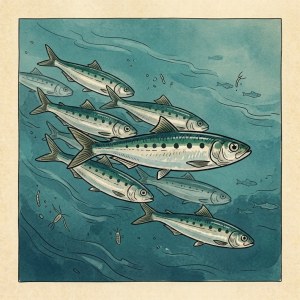
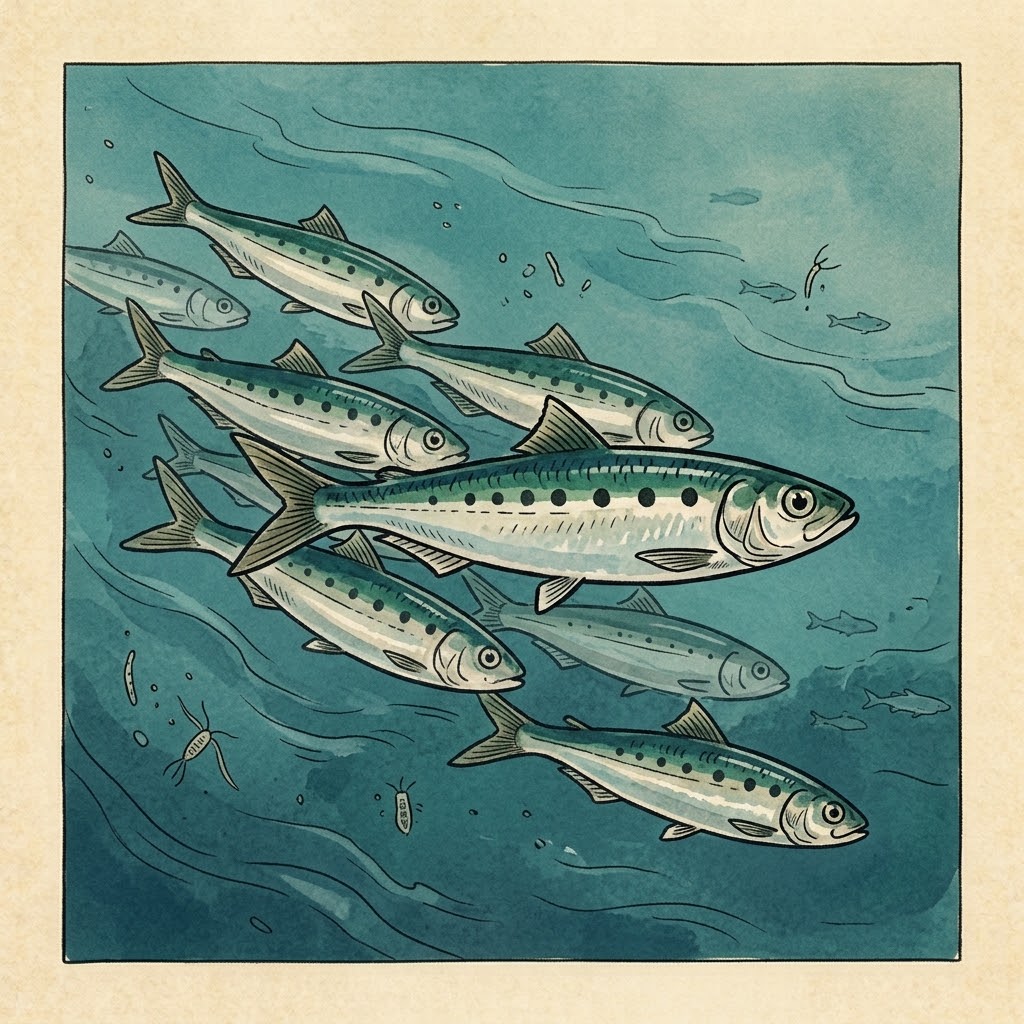
A flashing silver cloud that changes direction as one animal: a school of sardines. This little fish is the foundation of life in the sea, and of one of the simplest summer dishes in southern France. But in the Gulf of Lion, sardines have become smaller and thinner within just a few years.
| Habitat | Open coastal water, in large schools, from the surface to about 100 metres deep |
| Length | Usually 12–20 cm |
| Season on the plate | June to October, when they are at their fattest |
Card I of IV
Ecological profile
| Identification | Slender little fish with a blue-green back, silver sides with a row of dark spots and large scales that come off easily |
| Don’t confuse with | The anchovy, which is slimmer and has a mouth reaching back behind the eye |
| Diet | Plankton: tiny crustaceans, eggs and larvae, which it filters from the water |
Where can you find them?
Difficulty: ●●●●● Easy
When snorkelling in summer you sometimes see schools flash past; at the fish market you will almost always find them.
| Mediterranean | The fish halls of Sète, Port-Vendres and Marseille |
| Atlantic coast | Douarnenez and Saint-Gilles-Croix-de-Vie, old sardine ports with canneries |
| Tip | Fresh sardines are stiff and shiny, with clear, bulging eyes |
Did you know the sardine is probably named after the island of Sardinia, where it was once caught in huge numbers?
Card II of IV
Behaviour & seasons
Sardines live in schools of thousands of fish, which together react faster than any predator. By day they swim deeper; at night they rise to feed on plankton. In the Mediterranean they mostly spawn in autumn and winter, in open water, which leaves them lean in spring. In summer they feed up, and in late summer they are at their fattest and tastiest.
| November – March | Spawning in open water |
| Spring | Lean after spawning; plenty of plankton |
| Summer | Feeding up in large schools close to the coast |
| Late summer | At their fattest: the best time for the grill |
When to eat them?
| Jan | Feb | Mar | Apr | May | Jun | Jul | Aug | Sep | Oct | Nov | Dec |
| spawning · lean | spring | season · fattest in late summer | spawning | ||||||||
■ Plenty fresh ■ Fair supply ■ Better to skip
Card III of IV
From sea to plate
Since 2008 the sardines of the Gulf of Lion have become smaller and thinner, and the large, older sardines have almost disappeared. Researchers at the French marine institute Ifremer see the main cause in a change in the plankton: there is less food, and it is smaller. Because small sardines fetch little money, the fishery there has almost come to a halt. Most fresh sardines now come from the Atlantic coast.
Sardines are oily, rich in omega-3 and cheap. Choose them in season, from June to October, and eat them quickly: sardines spoil fast. Tinned sardines are a French speciality too; some producers even age their tins for years, like a good wine.
These are general seasonal and preparation guidelines, not official fishing rules or a food safety guarantee. Check local regulations and reliable sources.
Card IV of IV
Recipe & tradition
Sardinade (grilled sardines)
| Fish | Fresh whole sardines, about six per person; scales gently removed |
| Seasoning | Coarse sea salt, a little olive oil and some thyme or rosemary |
| Method | 2–3 minutes per side over glowing charcoal, until the skin is crisp |
| Serve with | Baguette, lemon, tomato salad and a cool glass of rosé |
In the south of France a sardinade is a party: long tables, a fire and platters of grilled sardines eaten with your fingers. The tin has a French history too. In 1824 Joseph Colin opened one of the first sardine canneries in Nantes, using Nicolas Appert’s new preserving method. After that, Breton ports such as Douarnenez grew into true sardine towns.
These are general seasonal and preparation guidelines, not official fishing rules or a food safety guarantee. Check local regulations and reliable sources.
Frequently asked questions
Questions about the European sardine
When are sardines at their best?
From June to October, with late summer as the high point. That is when they are at their fattest.
Why are the sardines in the Gulf of Lion so small?
Since 2008 they have become smaller and thinner. Researchers point mainly to changes in the plankton, their food, rather than to overfishing.
Do you need to gut a sardine before grilling?
In southern France small sardines are often grilled whole. Larger sardines are better gutted first.
Habitat · France