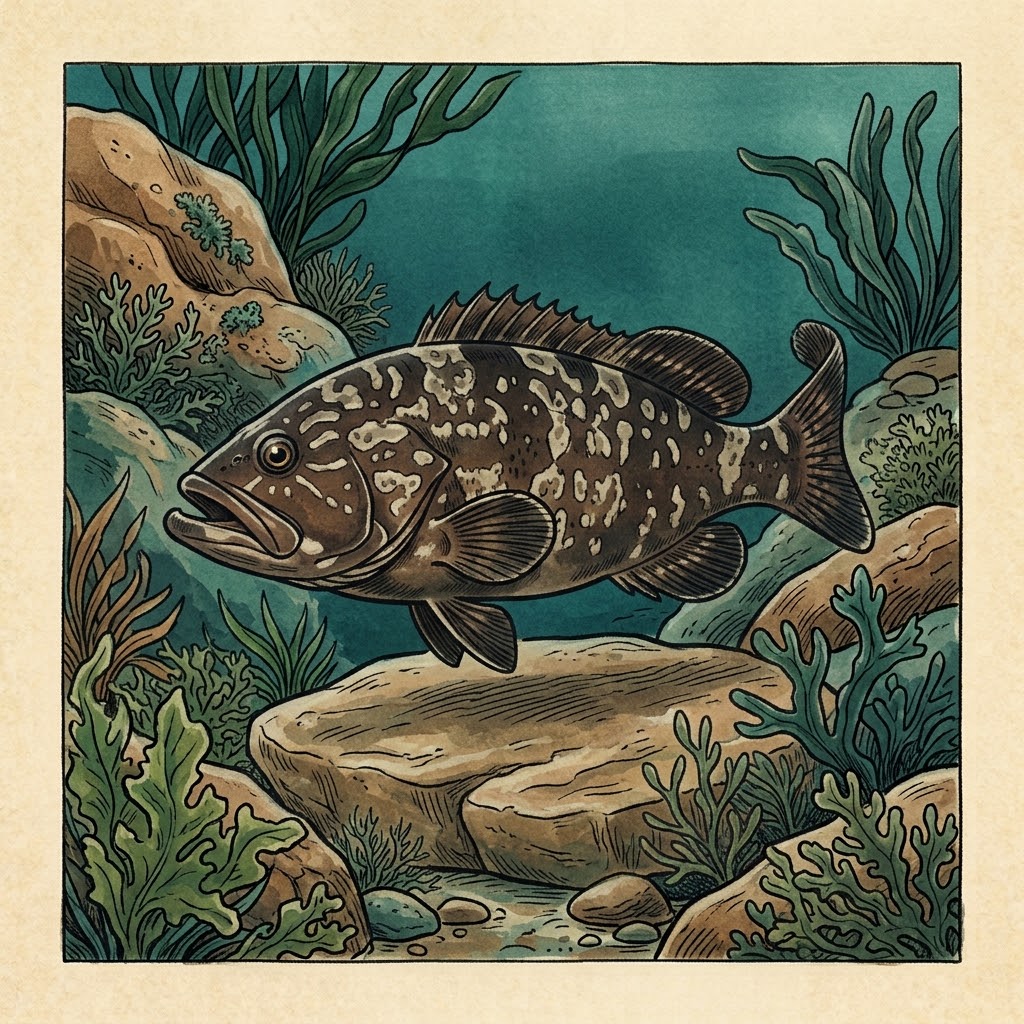
Fish · Mediterranean
Epinephelus marginatus
● IUCN: Vulnerable · fishing ban in France
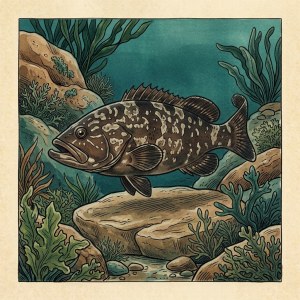
A heavy, dark-brown fish with pale blotches, a huge mouth and thick lips, watching you curiously from its den. In France it is called mérou. Thirty years ago it had almost vanished from the French coast; thanks to a fishing ban it is now the symbol of a recovering Mediterranean.
| Habitat | Rocky reefs with caves and crevices, from a few metres to about 50 metres deep |
| Length | Up to 1.5 metres and more than 50 kilos |
| Age | Can live for more than fifty years |
Card I of IV
Ecological profile
| Identification | Large, stocky fish, dark brown with irregular pale blotches; broad head, big mouth with a jutting lower jaw and a rounded tail |
| Other names | Mérou brun, dusky grouper |
| Diet | Octopuses, squid, crabs and fish, which it sucks in with a quick gulp |
Where can you find them?
Difficulty: ●●●●● Moderate
In protected marine areas you are almost sure to see them when diving; with some luck even when snorkelling in a few metres of water.
| Provence | Port-Cros National Park and the Calanques |
| Also good | The Cerbère-Banyuls marine reserve and Corsica, around Scandola and the Lavezzi islands |
| Tip | Go with a dive school in a protected area: that is where the fish let you come closest |
Did you know every dusky grouper starts life as a female? Only after ten years or so, once it is big enough, does it turn into a male.
Card II of IV
Behaviour & seasons
The dusky grouper is a homebody. It has a fixed den in the reef and often stays in the same area for years. It hunts from ambush: with a lightning-fast movement it opens its mouth and sucks its prey in. In summer, when the water is warm, the fish gather to spawn. The males then take on a striking pattern with pale stripes and defend their patch of reef against rivals.
| Winter | Quiet, often deeper and close to the den |
| Spring | More active in the warming water |
| July – August | Spawning season; males in breeding colours |
| Autumn | Still active in the warm water |
When is the best time to see them?
| Jan | Feb | Mar | Apr | May | Jun | Jul | Aug | Sep | Oct | Nov | Dec |
| cold water · still present | dive season · spawning in summer | winter | |||||||||
■ Good chance ■ Fair chance ■ Difficult
Card III of IV
Diving with groupers
In the protected marine areas, groupers have lost their fear of people. They lie calmly in front of their den, or swim up to divers out of curiosity. For many divers, meeting a large mérou is the highlight of a dive in the Mediterranean. Fishing for dusky grouper is banned in France, so it is not on the menu.
Dive with respect: don’t feed the fish, don’t touch them and don’t swim into their den. Keep your distance during the spawning season in July and August, when the fish are sensitive to disturbance.
Card IV of IV
Stories & culture
An underwater comeback
Because the dusky grouper grows slowly and stays faithful to its den, it was an easy target. In the 1970s and 1980s the large ones disappeared almost everywhere along the French coast. Divers and researchers raised the alarm, and in 1993 a fishing ban came into force, which has since been extended by ten years each time. It worked: in areas such as Port-Cros, numbers have grown strongly since then. The mérou became the figurehead of France’s marine reserves.
Frequently asked questions
Questions about the dusky grouper
Can you eat dusky grouper in France?
No. A fishing ban applies along the French Mediterranean coast and around Corsica. If you see mérou on a menu, ask where it comes from.
Where can you see groupers in France?
Mainly in protected marine areas: Port-Cros, the Calanques, Cerbère-Banyuls and around Corsica.
Is a grouper dangerous to divers?
No. It is curious and sometimes pushy, but not dangerous. Don’t touch it and don’t feed it.
Habitat · France