Mammal · Forest & heath
Procyon lotor
● Non-native · invasive species in the EU
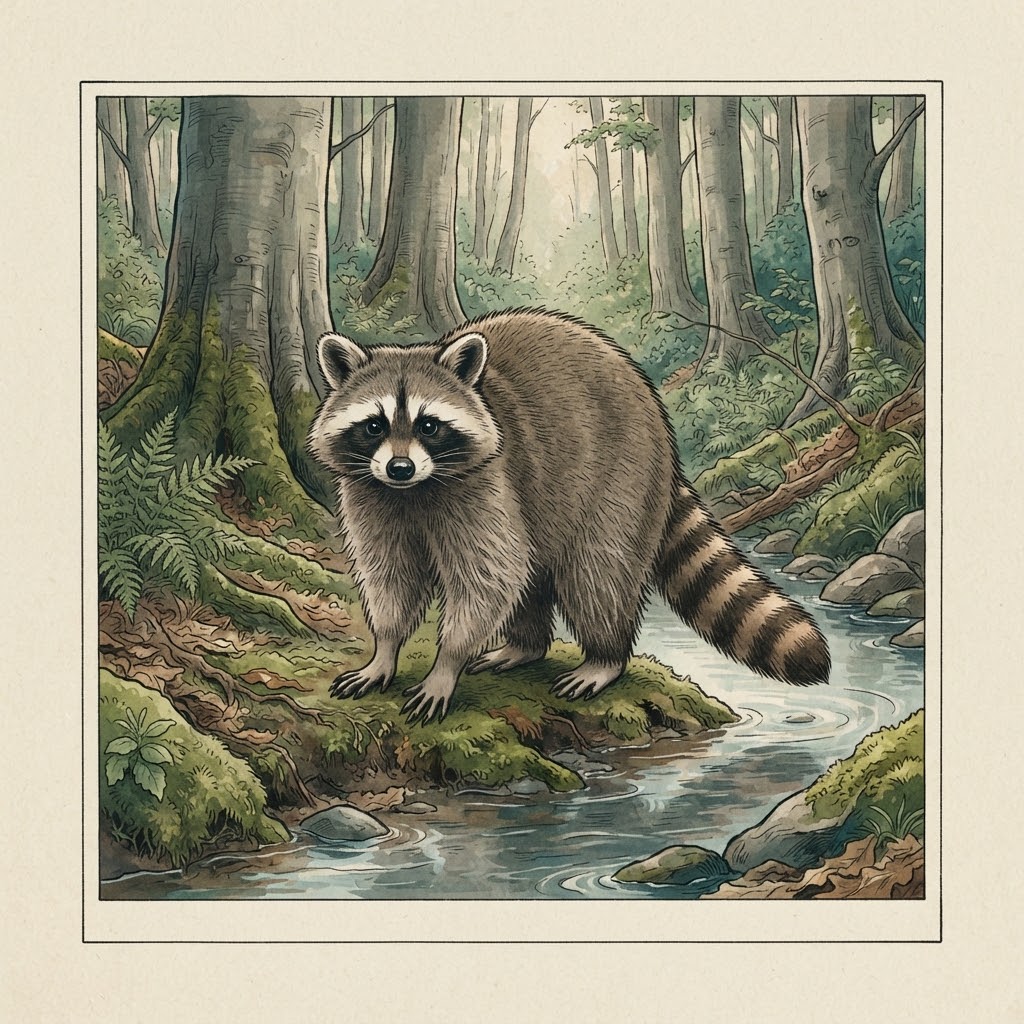
A black mask, a ringed tail and little hands that feel everything. The raccoon comes from North America, yet nowhere outside that continent do so many live as in Germany. Cute to look at, but a big problem for some native animals.
| Habitat | Deciduous forest near water, but also parks, gardens and cities |
| Weight | Usually 5–9 kg |
| Active | At dusk and at night |
Card I of IV
Ecological profile
| Identification | Grey-brown coat, a black ‘Zorro mask’ across the eyes and a thick tail with four to seven dark rings |
| Diet | Omnivore: fruit, nuts, insects, worms, amphibians, eggs, small animals and our rubbish |
| Notable | Sensitive front paws with which it feels its food, often in water |
Where can you see them?
Difficulty: ●●●●● Easy
In northern Hesse and around Kassel you often see them at dusk, even in residential areas.
| Hesse | Kassel and its surroundings, with the highest densities in Germany |
| East | Brandenburg and Berlin |
| Tip | Look at sunset along forest edges and stream banks, and in parks with old trees |
Did you know an estimated more than a hundred raccoons live per 100 hectares in Kassel? That is more than one per hectare.
Card II of IV
Behaviour & seasons
Raccoons are clever, curious opportunists. By day they sleep in tree hollows, but in towns just as happily in attics and sheds. In winter they rest: not true hibernation, but in cold spells they stay in their shelter for days.
| February – March | Mating season |
| April – May | Birth of usually three to five young |
| Summer – autumn | The young go out with their mother; feeding up for winter |
| Winter | Winter rest; little activity in the cold |
When is the best time to see them?
| Jan | Feb | Mar | Apr | May | Jun | Jul | Aug | Sep | Oct | Nov | Dec |
| winter · rest | spring · young | summer · families out | autumn · feeding up | winter | |||||||
■ Good chance ■ Fair chance ■ Difficult
Card III of IV
Role in the ecosystem
In Germany the raccoon has almost no natural enemies. It deliberately seeks out the nests of ground-nesting birds and places where amphibians and reptiles gather. In spring it catches toads and frogs on their way to their breeding water, and even raids the buckets at toad fences. Locally that is a real threat to some protected species. Since 2016 the raccoon has therefore been on the EU list of invasive species.
What can you do? Never feed raccoons, close bins and compost heaps securely, and make attics and sheds inaccessible. The less food and shelter near people, the fewer problems.
Card IV of IV
Stories & culture
From two pairs to two million
The raccoon came to Germany in the 1920s and 1930s as a fur animal. In April 1934 two pairs were deliberately released at the Edersee in northern Hesse, to ‘enrich’ the native wildlife. In 1945, 25 animals also escaped from a fur farm in Brandenburg. From those small groups grew a population of an estimated 1.6 to 2 million animals: more than in any country outside North America.
How Germany should deal with the raccoon is disputed. Some researchers argue for stronger intervention to protect vulnerable species. Others focus on prevention and reducing nuisance in towns. In Kassel, for example, a pilot project is running whose legal admissibility is still being assessed.
Frequently asked questions
Questions about the raccoon
How did the raccoon end up in Germany?
It was imported as a fur animal. In 1934 two pairs were released at the Edersee, and in 1945, 25 animals escaped from a fur farm in Brandenburg.
How many raccoons live in Germany?
An estimated 1.6 to 2 million, and their number is still growing.
Is a raccoon dangerous to people?
Normally not; it prefers to avoid conflict. It is, however, a danger to some birds, amphibians and reptiles. Do not approach it and never feed it.
Why is the raccoon an invasive species?
Because it does not originally belong in Europe and harms native animals here. Since 2016 it has been on the EU list of invasive species.
Habitat · Germany