Bird · Forest & heath
Dryocopus martius
● IUCN: Least Concern · strictly protected
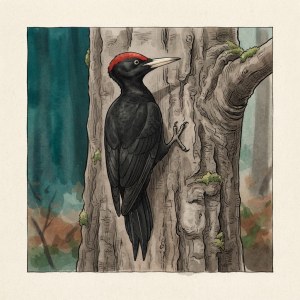
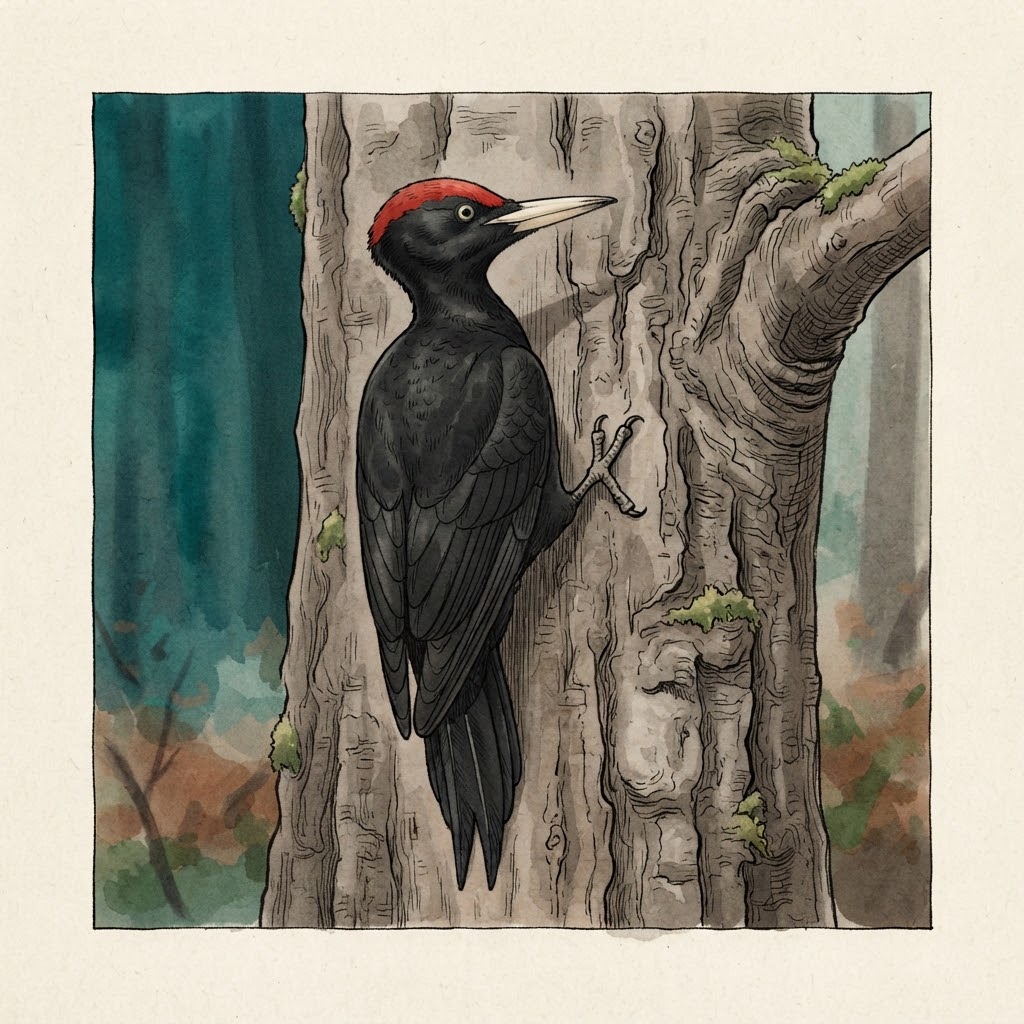
Europe’s largest woodpecker, raven-black with a fiery red crown. You often hear it before you see it: a loud, rolling drum that echoes through the whole forest. And with its bill it builds homes for dozens of other animals.
| Habitat | Extensive forests with old, thick trees, especially beeches |
| Length | Up to about 50 cm, including tail |
| Active | By day; in its territory all year round |
Card I of IV
Ecological profile
| Identification | All matt black with pale eyes and an ivory bill. The male has a fully red crown, the female only a red patch on the back of the head |
| Diet | Mainly ants, their larvae and pupae, and wood-boring beetles |
| Sound | Loud drumming, a clear ‘kleeah’ and in flight a rolling ‘krü-krü-krü’ |
Where can you see them?
Difficulty: ●●●●● Takes patience
Hearing one is easy, seeing one takes patience. Follow the drumming in spring, while the trees are still bare.
| Germany | Almost anywhere with large forests of old beeches, such as the beech forests of Hesse |
| Signs | Large oval holes high in a beech trunk, and fresh coarse chips under rotten stumps |
| Tip | Go into the forest early in the morning in March or April and listen |
Did you know a black woodpecker can strike the wood up to 17 times per second? Carving one nest hole in hard beech wood takes it three to four weeks and about 10,000 chips.
Card II of IV
Behaviour & seasons
A pair of black woodpeckers needs a huge territory, usually more than 200 hectares of forest. From mid-February courtship begins: the male drums loudly on dry branches or hollow trunks to attract a female and mark his territory. Then together they carve a new hole or renovate an old one.
| Mid-February – April | Courtship; loud drumming and calling |
| Late March – April | The female usually lays three to five white eggs |
| May – June | The young are fed in the hole for about four weeks |
| Summer – winter | Quieter; searching for ants in stumps and on the forest floor |
When is the best time to see them?
| Jan | Feb | Mar | Apr | May | Jun | Jul | Aug | Sep | Oct | Nov | Dec |
| winter · drumming | spring · courtship | summer · leaf cover | autumn | winter | |||||||
■ Good chance ■ Fair chance ■ Difficult
Card III of IV
Role in the ecosystem
The black woodpecker is the carpenter of the forest. It makes the largest holes of any woodpecker, and once it moves on, others move in. More than fifty species use its holes, including the stock dove, Tengmalm’s owl, the pine marten, the jackdaw and bats. Without the black woodpecker, many of those animals would hardly find a place to live.
Keep the old trees: an estimated 28,000 to 44,000 pairs breed in Germany, and numbers are stable. But the woodpecker depends directly on forestry: it needs old, thick trees. Trees with holes are therefore protected by law.
Card IV of IV
Stories & culture
The bird of Mars
The scientific name martius refers to Mars, the Roman god of war. To the Romans, the woodpecker was sacred to Mars. According to legend, a she-wolf and a woodpecker cared for the twins Romulus and Remus, the founders of Rome. In Germany, the black woodpecker was chosen as Vogel des Jahres (Bird of the Year) in 1981.
Frequently asked questions
Questions about the black woodpecker
How big is a black woodpecker?
Up to about 50 centimetres, including the tail. That makes it Europe’s largest woodpecker.
How do you tell male from female?
The male has a fully red crown. In the female only the back of the head is red.
When can you hear the black woodpecker drumming?
Mainly from mid-February to April, during courtship. Early morning gives you the best chance.
Which animals use its holes?
More than fifty species, including the stock dove, Tengmalm’s owl, the pine marten, the jackdaw and bats.
Habitat · Germany