Mollusc · Countryside
Helix pomatia
● IUCN: Least Concern · strict gathering rules
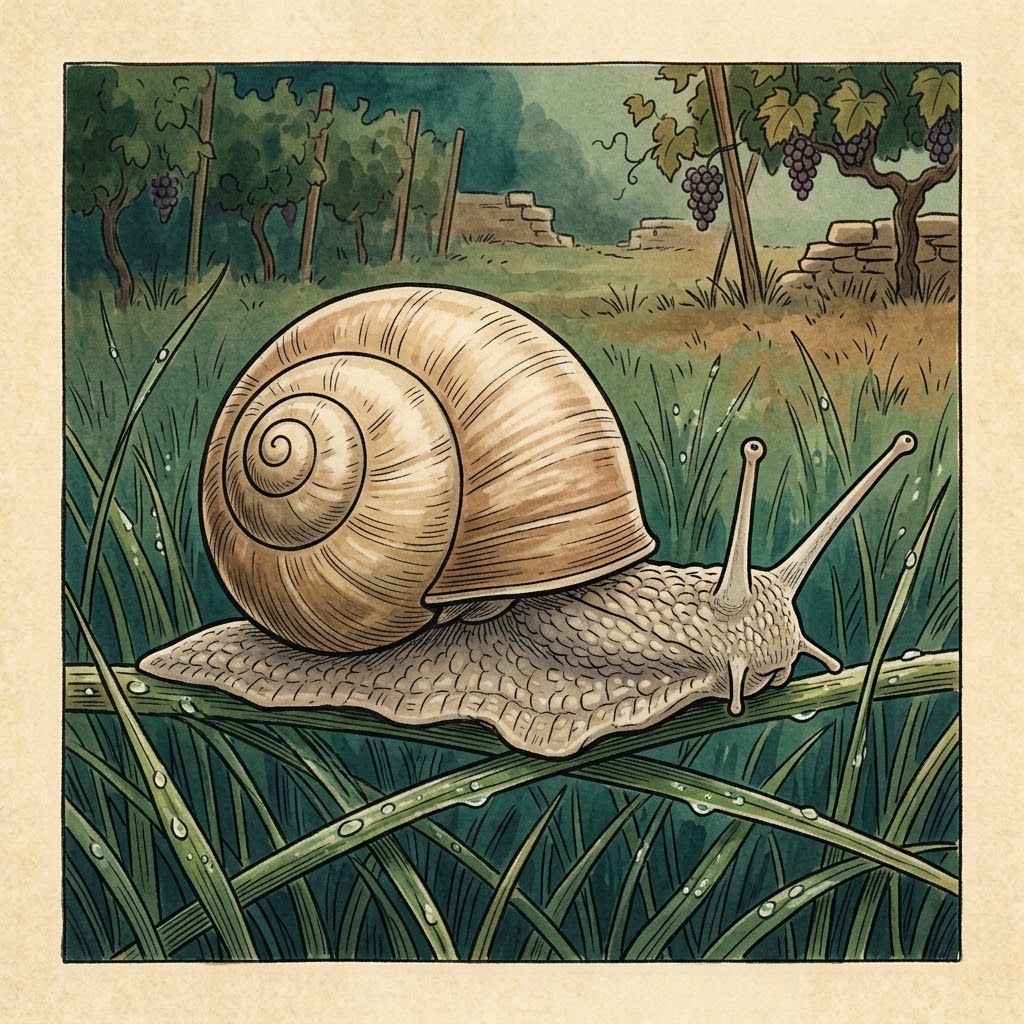
France’s largest land snail, with a creamy brown shell the size of a walnut. After a warm shower of rain it emerges between the vines and the grass. As the escargot de Bourgogne it is world-famous, even though the snail on your plate almost never comes from Burgundy.
| Habitat | Chalky soil: vineyards, hedges, woodland edges and rough grassland |
| Size | Shell 3–5 cm across |
| Active | From April to October, mainly at night and after rain |
Card I of IV
Ecological profile
| Identification | Large, globular, creamy brown shell with faint lighter and darker bands; body pale grey to greyish brown |
| Don’t confuse with | The garden snail (petit-gris), which is smaller, with a darker, mottled shell; that one is widely farmed |
| Diet | Young plants, leaves, nettles and decaying plant matter |
Where can you find them?
Difficulty: ●●●●● Easy
After a warm shower or on a dewy morning they crawl along verges, hedges and vineyards.
| Burgundy | Vineyards and hedges on the limestone slopes of the Côte d’Or |
| Also good | Chalky areas across eastern and central France, and in South Limburg in the Netherlands |
| Tip | Look, but leave them be: gathering is banned in spring |
Did you know a Burgundy snail seals its shell in winter with a white chalky lid? That way it survives months of cold and drought, buried in the ground.
Card II of IV
Behaviour & seasons
The Burgundy snail lives slowly. It takes a few years to grow up and can live for more than ten years. Every snail is both male and female. In late spring they mate, after a long courtship in which they touch each other, and a few weeks later the snail lays a clutch of eggs in a small hole in the ground. In autumn it digs itself in and seals its shell for the winter.
| November – March | Hibernation, buried and sealed |
| April – June | Waking and mating season; gathering banned |
| June – July | Eggs in the ground; young snails hatch |
| August – October | Feeding to build up reserves for winter |
When is the best time to see them?
| Jan | Feb | Mar | Apr | May | Jun | Jul | Aug | Sep | Oct | Nov | Dec |
| hibernation | waking | active · especially after rain | autumn | hibernation | |||||||
■ Good chance ■ Fair chance ■ Difficult
Card III of IV
From vineyard to plate
More than 95 percent of the snails eaten in France come from abroad, including Romania, Hungary and Turkey. The Burgundy snail grows too slowly to farm well, so it is still gathered in the wild. ‘Escargots de Bourgogne’ therefore tells you the species, not the origin. Farmed snails are usually the smaller garden snail (petit-gris or gros-gris). If you want truly French snails, look for a local snail farmer, a héliciculteur.
Rules in France: from 1 April to 30 June, the mating season, no snails may be gathered. Burgundy snails with a shell smaller than 3 cm are off limits all year. Some départements have stricter rules, and in other countries, such as the Netherlands, the species is protected.
These are general seasonal and preparation guidelines, not official rules or a food safety guarantee. Check local regulations and reliable sources.
Card IV of IV
Recipe & tradition
Escargots à la bourguignonne
| Snails | A dozen pre-cooked snails per person, with the empty shells |
| Herb butter | Soft butter with plenty of finely chopped garlic, parsley, a small shallot, salt and pepper |
| Method | Snail in the shell, seal with a good knob of butter, 8–10 minutes in a hot oven until it sizzles |
| Serve with | Baguette to mop up the butter and a glass of white Burgundy |
Eating snails is centuries old in France, but the dish with garlic-parsley butter only became famous in the nineteenth century. Legend has it that in 1814 the diplomat Talleyrand had the celebrated chef Antonin Carême prepare snails for a dinner with the Russian tsar. Nobody knows for sure whether that is true; what is certain is that escargots have been a fixed classic at Christmas and New Year’s Eve ever since.
These are general seasonal and preparation guidelines, not official rules or a food safety guarantee. Check local regulations and reliable sources.
Frequently asked questions
Questions about the Burgundy snail
Do escargots de Bourgogne come from Burgundy?
Almost never. The name refers to the species. Most Burgundy snails are gathered in the wild in Eastern Europe and Turkey.
Can you gather snails in France?
Not from 1 April to 30 June, and never Burgundy snails smaller than 3 cm. Check the rules of the département too.
Is the Burgundy snail protected in the Netherlands?
Yes. In the Netherlands, where it lives mainly in South Limburg, you may not collect it.
Habitat · France