Fish · Baltic coast & wetlands
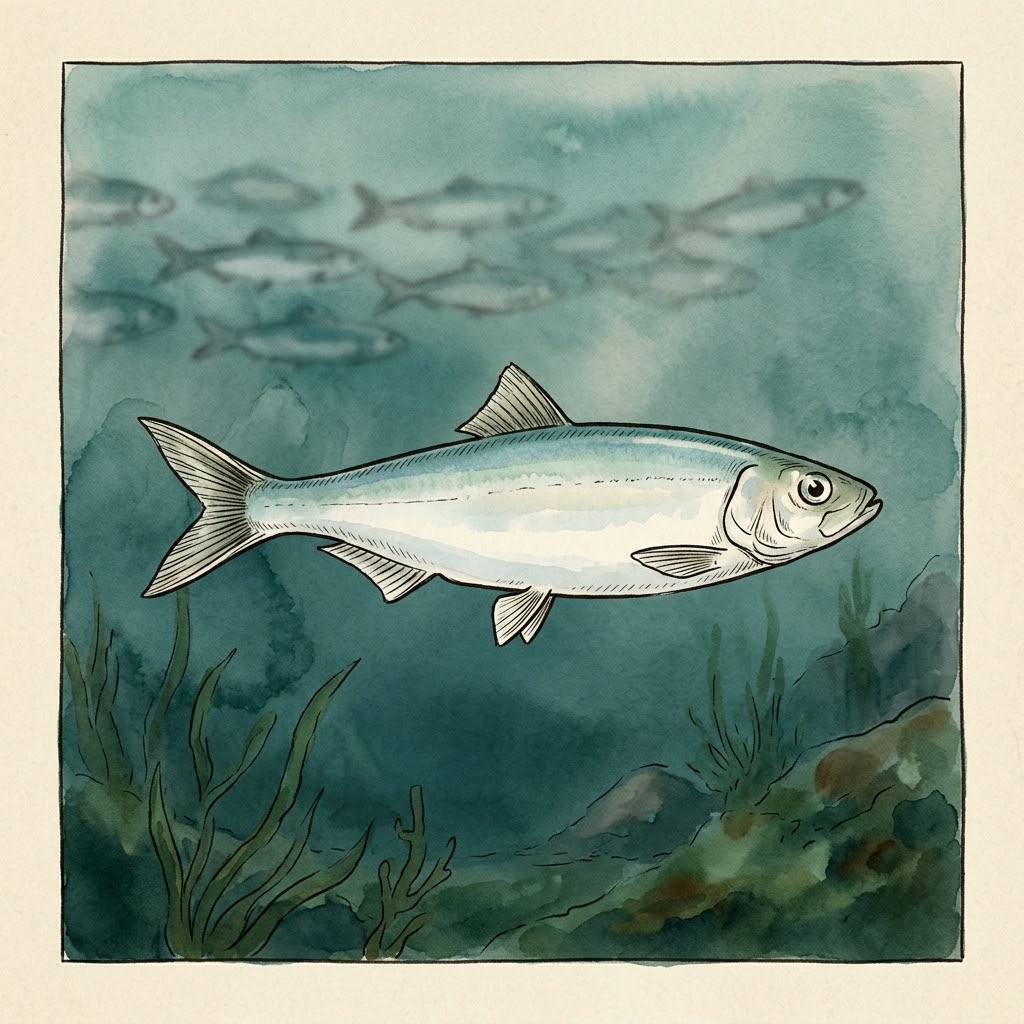
Clupea harengus
● IUCN: Least Concern · western Baltic stock under pressure
A small silvery fish with a big history. For centuries the herring was the ‘bread fish’ of the Baltic coast and made cities such as Stralsund and Lübeck rich. Today it is precisely the herring of the western Baltic that is under great pressure.
| Habitat | Open water of the North Sea and Baltic; in spring shallow coastal waters to spawn |
| Length | Usually 20–30 cm |
| Active | In schools; closer to the surface at night |
Card I of IV
Ecological profile
| Identification | Slender silvery fish with a blue-green back, a single dorsal fin and a forked tail |
| Diet | Plankton, especially small crustaceans such as copepods |
| Notable | Lives in huge schools that move as one body |
Where can you find them?
Difficulty: ●●●●● Takes patience
For most of the year it is far out at sea. In spring it comes to the coast to spawn.
| Spawning area | The Greifswald Bay and the Strelasund, the strait between Rügen and the mainland |
| Rest of the year | The open water of the western Baltic |
| Tip | In spring you often see schools along the quays in harbours such as Stralsund and Greifswald |
Did you know the herring of the western Baltic spawns in spring, while North Sea herring does so in autumn? They are separate stocks, each with its own rhythm.
Card II of IV
Behaviour & seasons
In spring the herring of the western Baltic move into shallow, sheltered coastal waters. There they stick their eggs onto water plants. The larvae that hatch need to coincide exactly with the spring bloom of plankton. Because the water warms up earlier and earlier, that is going wrong more and more often.
| Spring | Spawning in the Greifswald Bay and the Strelasund |
| Late spring | The larvae grow up in the sheltered lagoon waters |
| Summer – winter | In schools in the open water of the Baltic |
When is the best time to see them?
| Jan | Feb | Mar | Apr | May | Jun | Jul | Aug | Sep | Oct | Nov | Dec |
| winter | spring · spawning | summer · open sea | autumn | winter | |||||||
■ Good chance ■ Fair chance ■ Difficult
Card III of IV
From wild to plate
Herring is oily, soft and full of flavour, and remarkably versatile: raw and salted, marinated, smoked or fried. In Mecklenburg-Western Pomerania it is still regarded as the ‘bread fish’.
Yet the herring of the western Baltic is in a bad way. The number of larvae in the Greifswald Bay has fallen drastically since the early 2000s. Targeted herring fishing is hardly allowed in that zone any more, and the EU wants to restrict catches further. The herring in the shops therefore usually comes from the North Sea or Norwegian waters.
| Matjes | Young, fatty herring caught before spawning, mildly salted and matured |
| Bismarck herring | Butterflied herring marinated in vinegar with onions and spices |
| Rollmops | Rolled, marinated herring around gherkin and onion |
| Bratheringe | Fried herring, then pickled |
Choose consciously: ask where it comes from and choose herring from a stock in good condition, for example with an MSC label.
These are general seasonal and preparation guidelines, not official fishing rules or a food safety guarantee. Check local regulations and reliable sources.
Card IV of IV
Recipe & tradition
Matjes nach Hausfrauenart
| Fish | Matjes fillets |
| Sauce | Sour cream and yoghurt with pieces of apple, red onion and gherkin |
| Method | Mix everything and leave to infuse in the fridge for a few hours |
| Serve with | Fried potatoes (Bratkartoffeln) or boiled potatoes |
Bismarck herring is named after the German chancellor Otto von Bismarck. According to the story, a fish processor from Stralsund sent him a small barrel of his marinated herring and asked permission to name it after him. That is how a simple fish came to bear the name of one of the most famous Germans.
These are general seasonal and preparation guidelines, not official fishing rules or a food safety guarantee. Check local regulations and reliable sources.
Frequently asked questions
Questions about the herring
Why is the herring in the Baltic in trouble?
Through a combination of warming, past overfishing and the loss of spawning grounds. The larvae increasingly hatch at a moment when there is not yet enough plankton.
What is the difference between matjes and Bismarck herring?
Matjes is young, fatty herring that is mildly salted and matured. Bismarck herring is marinated in vinegar with onions and spices.
When does the herring spawn in the Baltic?
The herring of the western Baltic spawns in spring, mainly in the Greifswald Bay and the Strelasund. Because of warmer water, this is happening earlier and earlier in the year.
Habitat · Germany