Amphibian · Countryside
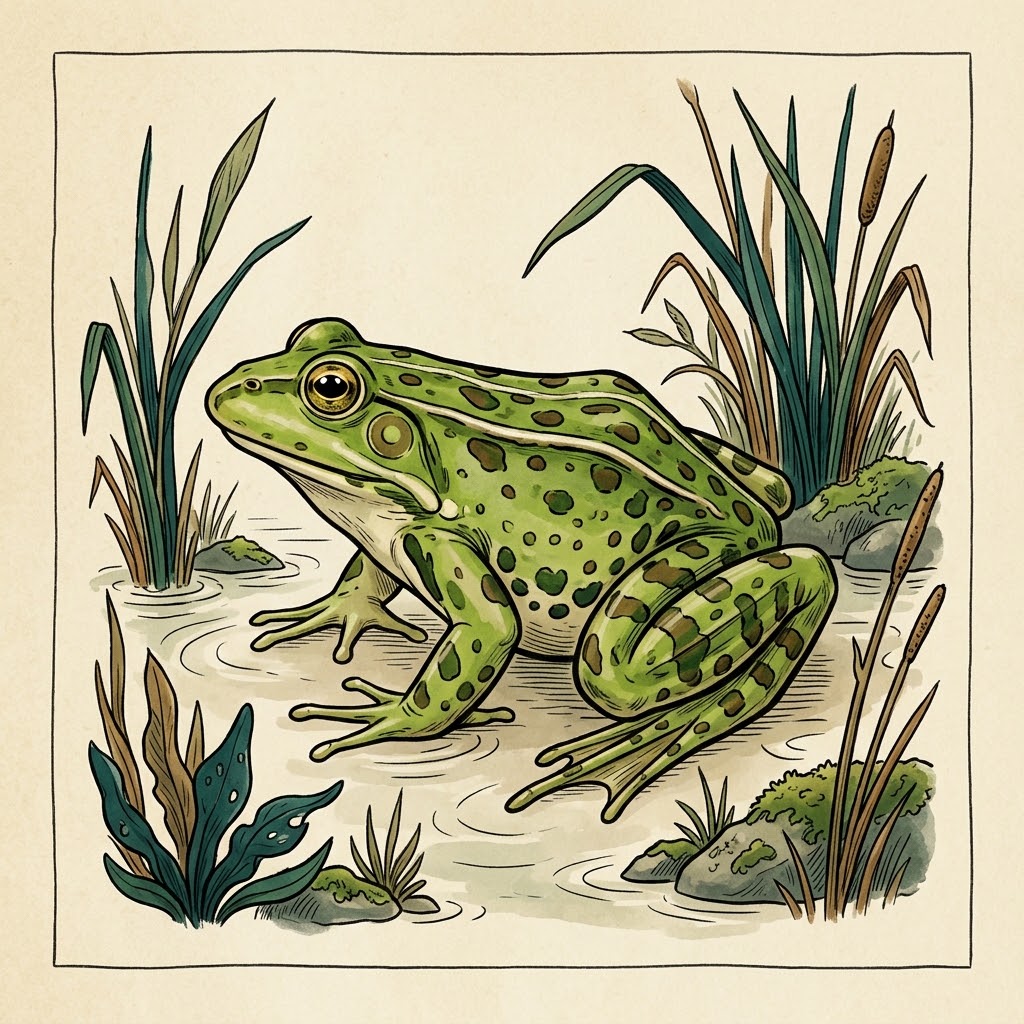
Pelophylax kl. esculentus
● Common · protected in France
On a warm evening in May the same concert breaks out at every pond: a cacophony of croaking, rattling edible frogs. This is the frog of French cuisses de grenouilles. And yet the frogs’ legs on your plate almost never come from a French pond.
| Habitat | Ponds, ditches, pools and marshes with plenty of water plants and sunny banks |
| Length | Usually 7–10 cm |
| Active | From March to October, by day and by night |
Card I of IV
Ecological profile
| Identification | Bright green to brownish-green frog with dark spots, often a pale stripe down the middle of the back and golden eyes; males with two white vocal sacs at the corners of the mouth |
| Special | Not an ordinary species, but a hybrid of the pool frog and the marsh frog that has maintained itself for centuries |
| Diet | Insects, spiders, snails and worms |
Where can you find them?
Difficulty: ●●●●● Very easy
On a sunny day you will see them sitting on water-lily leaves and banks. Get too close and they leap into the water with a splash.
| France | Ponds across almost the whole country, from the Dombes and the Brenne to the Camargue |
| Also | Common throughout the Netherlands and Belgium |
| Tip | Go to a pond on a warm evening in May or June and listen |
Did you know a frog uses its eyes to help it swallow? As it swallows, it pulls its eyes inwards so they push the prey towards the throat.
Card II of IV
Behaviour & seasons
The edible frog is a true water frog: it rarely strays far from the bank. It likes to sit in the sun and wait for an insect to pass. In May and June the males croak in chorus to attract females, with their vocal sacs puffed out. Each female then lays thousands of eggs in clumps among the water plants. In autumn the frogs crawl into the mud or under leaves to hibernate.
| November – February | Hibernation in the mud or on land |
| March – April | Waking up and returning to the water |
| May – June | Croaking choruses and egg-laying |
| July – September | Tadpoles turn into young froglets |
When is the best time to see them?
| Jan | Feb | Mar | Apr | May | Jun | Jul | Aug | Sep | Oct | Nov | Dec |
| hibernation | waking | active · croaking choruses in May–June | autumn | hibernation | |||||||
■ Good chance ■ Fair chance ■ Difficult
Card III of IV
From pond to plate?
Since 2007 all amphibians in France have been legally protected, and wild frogs from French ponds may not be sold. Yet France is Europe’s biggest importer of frogs’ legs: around 3,000 tonnes a year, about 80 percent from Indonesia, and most of the rest from Vietnam and Turkey. Much of that is caught in the wild, and conservation groups are worried about the impact on frogs in those countries.
If you do want to eat frogs’ legs, ask where they come from and preferably choose farmed frogs with a clear origin.
These are general preparation guidelines, not official rules or a food safety guarantee. Check local regulations and reliable sources.
Card IV of IV
Recipe & tradition
Cuisses de grenouilles à la provençale
| Frogs’ legs | About 250 grams per person, soaked briefly in milk and dusted with flour |
| Frying | In olive oil and butter for a few minutes until golden brown |
| Finishing | At the end, a generous handful of chopped garlic and parsley and a squeeze of lemon juice |
| Serve with | Baguette and a fresh green salad |
Frogs’ legs are so French that the British have long teasingly called the French ‘frogs’. The meat is tender and white, reminiscent of chicken or fish. In the Dombes, the pond country north of Lyon, and in the Vosges, they are a traditional item on the menu. The spa town of Vittel even holds a big frog festival every spring, with frogs’ legs in every shape and form.
These are general preparation guidelines, not official rules or a food safety guarantee. Check local regulations and reliable sources.
Frequently asked questions
Questions about the edible frog
Do French frogs’ legs come from France?
Almost never. France imports around 3,000 tonnes a year, mainly from Indonesia. Wild French frogs may not be sold.
When can you hear frogs croaking?
Mainly on warm evenings in May and June, in the breeding season. But also on sunny days in summer.
Is the edible frog a separate species?
Not quite. It is a hybrid of the pool frog and the marsh frog that has maintained itself in the wild for a very long time.
Habitat · France