Bird · Alps
Gypaetus barbatus
● IUCN: Near Threatened · strictly protected
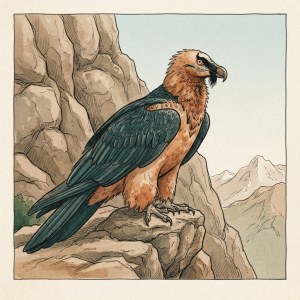
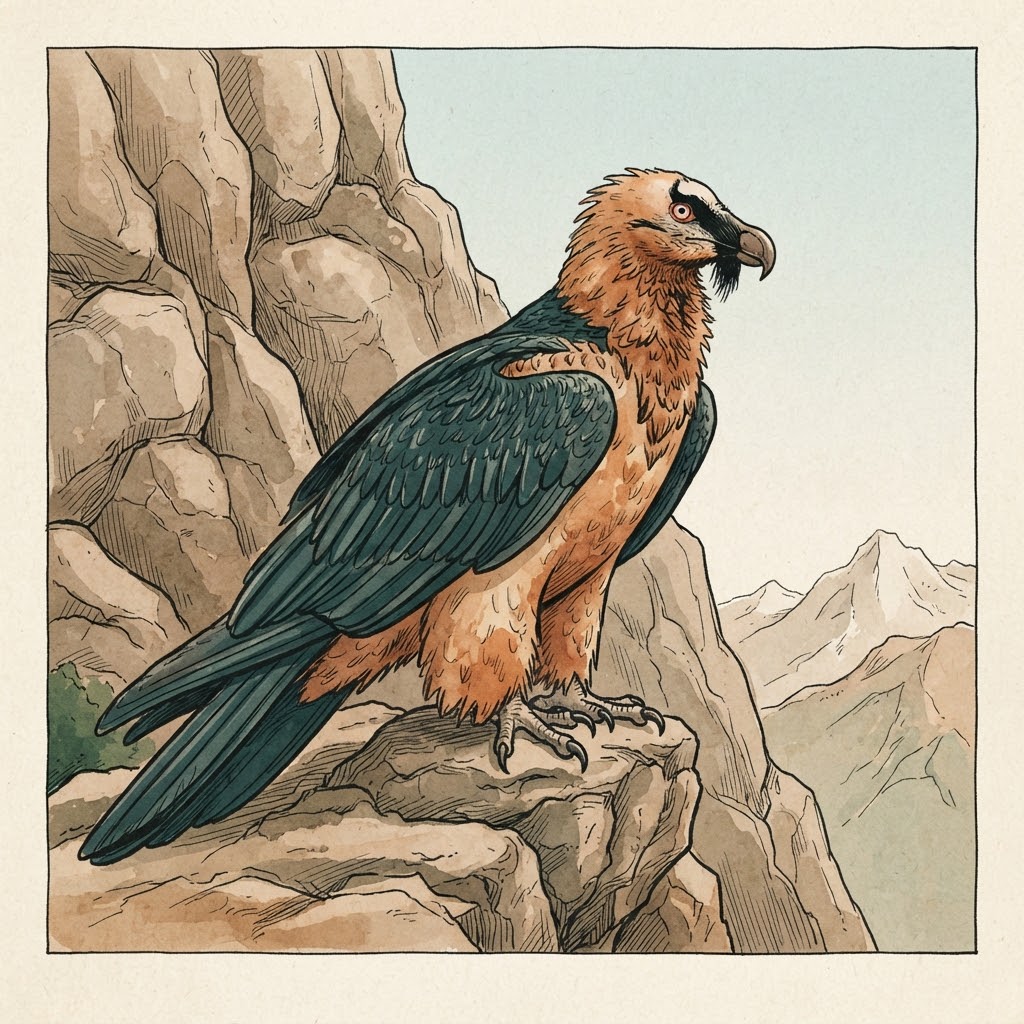
The largest bird of the Alps, with a wingspan of up to 2.90 metres, and one of the strangest eaters in the world: it lives almost entirely on bones. After more than a century of absence, the bearded vulture has been soaring over the German Alps again since 2021.
| Habitat | High mountains with rock faces and alpine meadows |
| Weight | Around 6 kg |
| Active | By day, soaring on thermals |
Card I of IV
Ecological profile
| Identification | Long, narrow wings and a wedge-shaped tail; adults with a rusty-orange breast, a black mask and a ‘beard’ below the bill. Young birds are dark brown |
| Wingspan | Up to 2.90 metres |
| Diet | Adults eat almost exclusively bones and bone marrow |
Where can you see them?
Difficulty: ●●●●● Difficult
Only a few fly in the German Alps yet, but around Berchtesgaden National Park they are seen more and more often.
| Berchtesgaden | The Klausbach valley and the area around the Königssee |
| Elsewhere | Also seen in the Karwendel and the Lechtal Alps |
| Tip | In summer there is an information stand on the trail to the Halsalm, and free guided walks |
Did you know the bearded vulture is about the only vertebrate that lives almost entirely on bones? Bones too large to swallow it drops from a great height onto rocks until they break.
Card II of IV
Behaviour & seasons
Young bearded vultures roam the whole Alps for years. Only at about eight years old are they sexually mature and settle in a fixed territory. The birds released in Berchtesgaden carry a GPS transmitter so researchers can follow their journeys. Most of them keep returning to the National Park.
| Winter | Adult pairs breed in the middle of winter |
| June | Young birds that cannot yet fly are released into a rock niche in the Klausbach valley |
| July | After about 120 days they make their first flight |
| Autumn | The young birds set off on their journeys through the Alps |
When is the best time to see them?
| Jan | Feb | Mar | Apr | May | Jun | Jul | Aug | Sep | Oct | Nov | Dec |
| winter | spring | summer · release & first flight | autumn | winter | |||||||
■ Good chance ■ Fair chance ■ Difficult
Card III of IV
Role in the ecosystem
The bearded vulture is the last link in the mountains’ clean-up crew. When other scavengers have finished with a carcass, only the bones remain: exactly its food. In this way it clears away remains that nobody else eats. It does not hunt living animals.
The return: since 2021, two young bearded vultures have been released in the Klausbach valley every year, as part of the reintroduction across the Alps. In June 2026 Alosa and Zierli joined them, bringing the total released since the start to twelve. Wild-hatched bearded vultures are now also seen in the Berchtesgaden Alps.
Card IV of IV
Stories & culture
An undeserved bad name
The old name says it all: people once believed this bird stole lambs. According to old tales the ‘Lämmergeier’ (lamb vulture) carried off livestock, game and even small children. That was nonsense, since it eats mainly bones and carrion. Yet for that reason it was driven out and shot. By the early twentieth century it had been wiped out across the whole of the Alps. Now, more than a hundred years later, it is flying again, and conservationists prefer the name Bartgeier: bearded vulture.
Frequently asked questions
Questions about the bearded vulture
Is the bearded vulture dangerous to lambs or people?
No. It does not hunt living animals and lives mainly on bones and carrion. The old name comes from superstition.
Where can you see the bearded vulture in Germany?
Mainly around Berchtesgaden National Park, in the Klausbach valley and near the Königssee. Released birds have also been seen in the Karwendel and the Lechtal Alps.
How big is a bearded vulture?
With a wingspan of up to 2.90 metres it is the largest bird of the Alps. It weighs around 6 kilos.
Can you follow the bearded vultures live?
Yes. The Bavarian bird protection society LBV runs a webcam at the release site and publishes the birds’ GPS routes.
Habitat · Germany