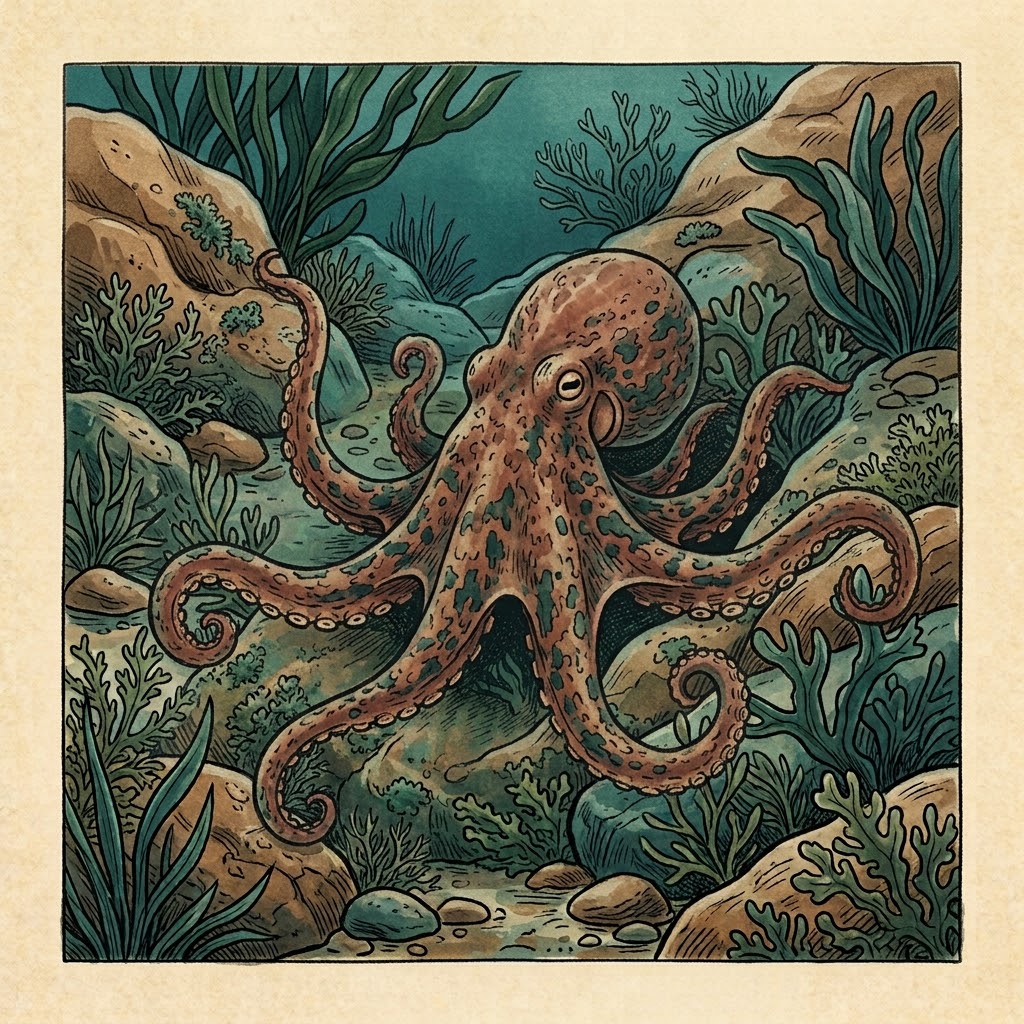
Mollusc · Mediterranean
Octopus vulgaris
● IUCN: Least Concern · choose locally caught
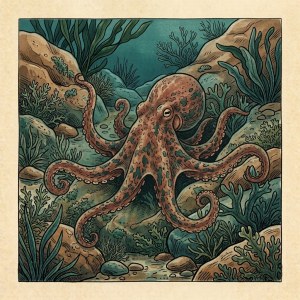
Eight arms, three hearts, blue blood and a skin that changes colour and texture in a split second. The octopus is one of the cleverest animals in the sea: it solves puzzles, escapes from jars and recognises people. And yet it lives for only one or two years.
| Habitat | Rocky seabeds, seagrass meadows and sandy plains with hiding places, from shallow water to over 100 metres |
| Size | Up to about 1 metre including arms; usually 1–3 kg |
| Active | Mainly at dusk and at night |
Card I of IV
Ecological profile
| Identification | Soft, round body and eight arms, each with two rows of suckers; mottled reddish-brown skin that can change colour and texture |
| Don’t confuse with | The cuttlefish, which has ten arms, two of them long feeding tentacles, and a shell inside its body |
| Diet | Crabs, shellfish and small fish |
Where can you find them?
Difficulty: ●●●●● Moderate
When snorkelling you often find them in a den among the rocks; look for a little heap of empty shells by the entrance.
| Provence | The Calanques near Marseille and the underwater trail of Port-Cros |
| Also good | The rocky coasts of the Côte Vermeille near Banyuls, and Corsica |
| Tip | Watch calmly, don’t touch it, and never block the entrance to its den |
Did you know an octopus has three hearts and blue blood? Two hearts pump blood through the gills, the third through the rest of the body.
Card II of IV
Behaviour & seasons
The octopus is a loner. By day it usually sits in its den, which it sometimes closes off with stones and shells. At dusk it goes hunting, probing crevices with its arms for crabs. After mating, the female lays tens of thousands of eggs in strings from the ceiling of her den. For weeks she guards them, fans them with fresh water and does not eat. Shortly after the young hatch, she dies.
| Spring | Octopuses move into shallow, warmer water; mating season |
| Summer | Females guard their eggs in the den |
| Late summer – autumn | Young octopuses settle on the bottom |
| Winter | Many octopuses move into deeper water |
When is the best time to see them?
| Jan | Feb | Mar | Apr | May | Jun | Jul | Aug | Sep | Oct | Nov | Dec |
| cold water · few snorkellers | spring | snorkel season · best time | autumn | winter | |||||||
■ Good chance ■ Fair chance ■ Difficult
Card III of IV
From sea to plate
Along France’s Mediterranean coast, small fishing boats catch octopus with pots and traps. But most octopus in French shops arrives frozen from North Africa. Freezing, incidentally, makes the meat more tender. Because octopuses are so intelligent and live so briefly, debate is growing about how we catch and eat them; plans for a first octopus farm in Spain have met with strong opposition.
If you want to eat octopus, choose local, small-scale catches where possible, and leave small octopuses alone: they have not yet bred.
These are general seasonal and preparation guidelines, not official fishing rules or a food safety guarantee. Check local regulations and reliable sources.
Card IV of IV
Recipe & tradition
Poulpe à la provençale
| Octopus | An octopus of 1 to 1.5 kg, frozen first and thawed, cut into pieces |
| Sauce | Onion, garlic, tomatoes, a glass of white wine, black olives and herbes de Provence |
| Method | Simmer gently with the lid on for 1 to 1.5 hours, until the meat is tender |
| Serve with | Rice, boiled new potatoes or baguette |
Provençal fishermen used to beat a freshly caught octopus dozens of times against the rocks to tenderise the meat; today the freezer does that job. The French word for octopus, pieuvre, was made famous by Victor Hugo. In his 1866 novel Les Travailleurs de la mer (The Toilers of the Sea), the hero fights a giant octopus, and with that Hugo turned the animal into a sea monster for generations.
These are general seasonal and preparation guidelines, not official fishing rules or a food safety guarantee. Check local regulations and reliable sources.
Frequently asked questions
Questions about the common octopus
How long does an octopus live?
Usually just one or two years. Females die shortly after their eggs hatch.
What is the difference between an octopus and a squid?
An octopus has eight arms and no shell. A cuttlefish or squid has ten arms and a shell or pen inside its body.
How do you make octopus tender?
Freeze it for a day or two first, then simmer it slowly. That works better than boiling it long and hard.
Habitat · France