Bird · Camargue & wetlands
Phoenicopterus roseus
● IUCN: Least Concern · protected
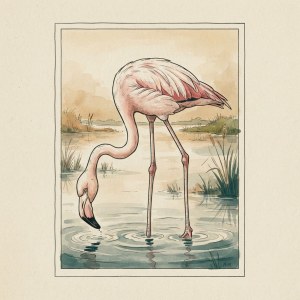
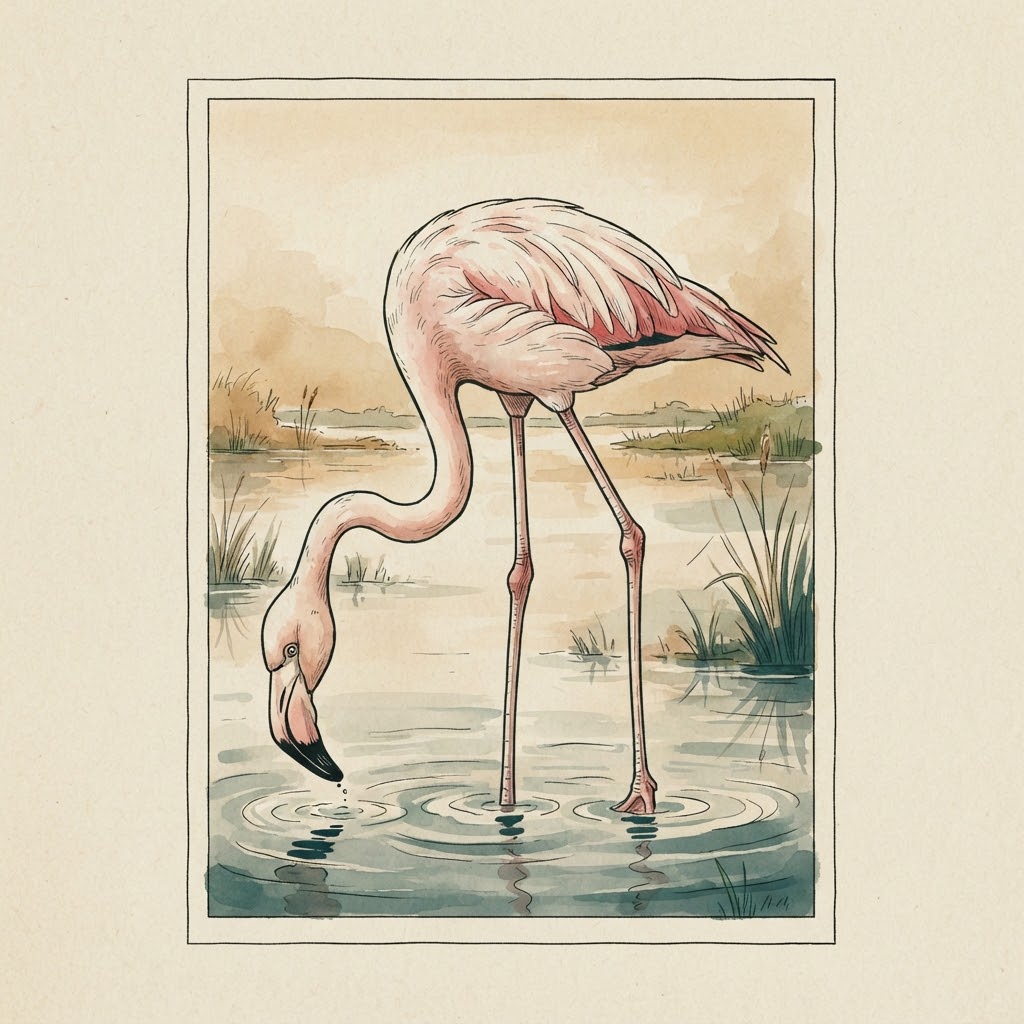
The symbol of the Camargue: pink birds on long legs, feeding with their heads upside down in the water. The lagoons of the Rhône delta hold the flamingo’s only breeding site in France, with more than 15,000 pairs in some years.
| Habitat | Shallow, salty lagoons and salt pans |
| Height | Up to about 1.5 metres |
| Active | Day and night; present all year round |
Card I of IV
Ecological profile
| Identification | Pale pink body, long pink legs and neck, a bent pink bill with a black tip, and in flight bright red wings edged with black |
| Diet | Small crustaceans such as brine shrimp, insect larvae, seeds and algae |
| Young birds | Grey-brown; the pink colour only comes after a few years |
Where can you see them?
Difficulty: ●●●●● Child’s play
In the Camargue you see them all year round, often up close.
| Easiest | The Parc ornithologique du Pont de Gau near Saintes-Maries-de-la-Mer, with hundreds of flamingos all year round |
| Breeding colony | The Étang du Fangassier near Salin-de-Giraud; not accessible itself, but visible from a distance |
| Also good | The salt pans of Aigues-Mortes and the Marais du Vigueirat |
Did you know a flamingo feeds with its head upside down? Its bill works like a sieve: it pumps water in and holds back tiny crustaceans and algae.
Card II of IV
Behaviour & seasons
Flamingos live in large groups. In winter they start their famous courtship dance: hundreds of birds march together, turn their heads and spread their wings. The pairs then build a mud cone on an islet, on which the female lays a single egg. The parents feed the chick with a kind of ‘milk’ from their crop.
| December – February | Courtship dances, best in bright light |
| Spring | The colony settles and breeds |
| Summer | The chicks grow up in large ‘crèches’ |
| Winter | The largest number of flamingos in the Camargue |
When is the best time to see them?
| Jan | Feb | Mar | Apr | May | Jun | Jul | Aug | Sep | Oct | Nov | Dec |
| winter · courtship | spring · breeding | summer · chicks | autumn | courtship | |||||||
■ Good chance ■ Fair chance ■ Difficult
Card III of IV
Role in the ecosystem
Flamingos are pink because of what they eat. The brine shrimp and algae of the salt pans contain pigments, carotenoids, that end up in their feathers. The water of the salt pans itself sometimes turns pink too, because of a microscopic alga. Where the water is good, the flamingos do well: they are an indicator of healthy lagoons.
A tricky guest: flamingos also feed in the Camargue’s rice fields and cause damage there. Farmers and conservation organisations work together to scare the birds away without harming them. So always respect closures around the breeding sites.
Card IV of IV
Stories & culture
An island for flamingos
In the 1960s flamingos were doing badly in France. So in 1969 the salt producer Salins and the research centre Tour du Valat together built an artificial island in the Étang du Fangassier. It was a success: the flamingos came to breed there in huge numbers. The Tour du Valat has been following the birds with rings since 1954, one of the longest bird studies in the world. That is how researchers know that flamingos can live for decades.
Frequently asked questions
Questions about the flamingo
Why is a flamingo pink?
Because of pigments (carotenoids) in the crustaceans and algae it eats. Young flamingos are grey-brown and only turn pink after a few years.
Where can you see flamingos in France?
Mainly in the Camargue, most easily at the Parc ornithologique du Pont de Gau near Saintes-Maries-de-la-Mer. The breeding colony is on the Étang du Fangassier.
When can you see the flamingos’ courtship dance?
From December to the end of February, best in bright light.
How many flamingos breed in the Camargue?
Usually between 10,000 and 15,000 pairs, and even more in good years.