Bird · Countryside
Emberiza hortulana
● Sharply declining in France · strictly protected
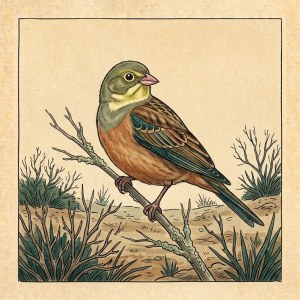
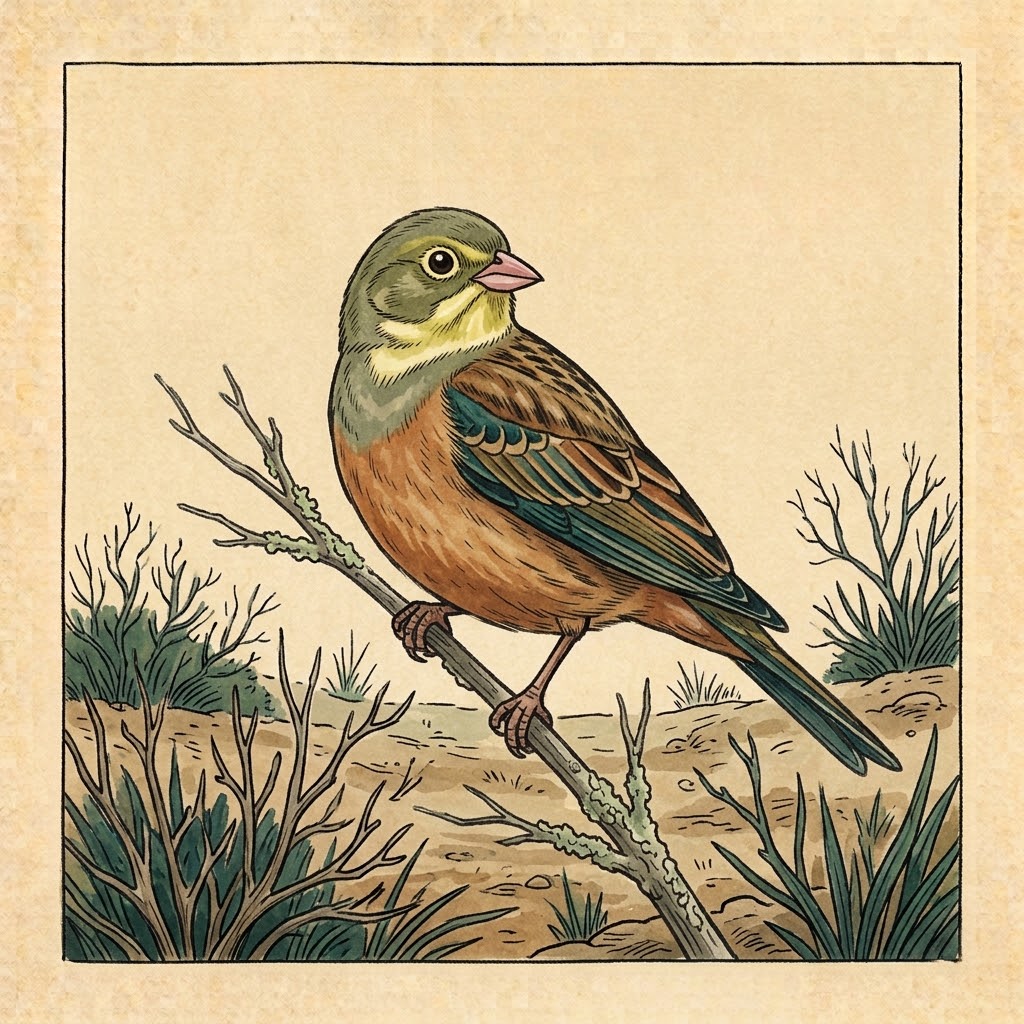
A modest bunting with an olive-grey head, a pale yellow throat and a pink bill, singing a simple, wistful song from a bush. The ortolan breeds in the dry, sunny regions of southern France and winters in Africa. In France it has become considerably rarer in just a few decades.
| Habitat | Dry, open landscapes with scattered shrubs and trees: vineyards, fields with hedges and open garrigue |
| Length | About 16 cm; around 20–25 grams |
| Present | From late April to September |
Card I of IV
Ecological profile
| Identification | Olive-grey head and breast band, pale yellow throat and eye ring, pink bill and a rusty-orange belly |
| Song | A short, somewhat wistful run of equal notes, with a lower final note |
| Diet | Seeds and, in the breeding season, mainly insects |
Where can you find them?
Difficulty: ●●●●● Difficult
In May and June the males sing from a bush or wire. If you know the song, they are easiest to find.
| Southern France | Dry slopes and vineyards in Provence, Languedoc and the Pyrénées-Orientales |
| Also | The Causses and the southern Alps |
| Tip | Go early in the morning and listen for birds singing from the tops of shrubs |
Did you know its scientific name hortulana means ‘of the garden’? The ortolan used to breed in gardens and orchards too, when they were still small-scale and varied.
Card II of IV
Behaviour & seasons
The ortolan is a true migrant. In late April it arrives from Africa, where it winters south of the Sahara. The female builds a nest on or just above the ground, hidden among grass and low shrubs. Both parents feed the chicks insects, such as grasshoppers and caterpillars. In August and September it heads south again, together with ortolans from northern and eastern Europe that fly over France.
| October – March | Winters in West Africa |
| Late April – May | Arrival; males sing to claim their territory |
| June – July | Breeding and feeding the chicks |
| August – September | Autumn migration to Africa |
When is the best time to see them?
| Jan | Feb | Mar | Apr | May | Jun | Jul | Aug | Sep | Oct | Nov | Dec |
| in Africa | arrival | singing · best time | autumn migration | in Africa | |||||||
■ Good chance ■ Fair chance ■ Difficult
Card III of IV
Threats & protection
Between 1997 and 2007 the number of ortolans in France fell by around 30 percent, and the decline is continuing. The main cause is the loss of small-scale farmland: hedges and shrubs are grubbed up, fields get bigger and more pesticides are used, so there are fewer insects. Where grazing stops, open land becomes overgrown with scrub. On top of that, illegal trapping during migration remains a problem.
Strictly protected: since 1999 the ortolan has been fully protected in France, and the European Birds Directive also bans catching, killing and selling it. A 2019 study showed that the ortolans migrating over south-west France come from vulnerable populations in northern and eastern Europe that cannot withstand any extra losses.
Card IV of IV
Stories & culture
The end of a controversial delicacy
For centuries the ortolan was considered one of the most expensive and exclusive dishes in France. Gourmets ate it with a napkin over their heads, a custom surrounded by many stories. It became a symbol of decadence, and for that very reason of the fight to save the bird. Since 1999 the ortolan has been protected and the dish banned. For conservationists it is now the symbol of all migratory birds under pressure from habitat loss and illegal trapping.
Frequently asked questions
Questions about the ortolan bunting
Is the ortolan protected?
Yes. Since 1999 it has been fully protected in France, and the European Birds Directive bans catching, killing and selling it.
Where can you see ortolans in France?
In dry, open areas in the south, such as Provence, Languedoc, the Causses and the Pyrénées-Orientales, from late April to August.
Why is the ortolan declining?
Mainly because of the loss of small-scale farmland with hedges and shrubs, fewer insects and illegal trapping during migration.
Habitat · France