Bird · Dehesa & farmland
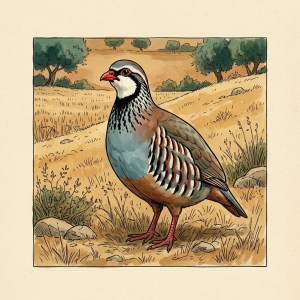
Alectoris rufa
● IUCN: near threatened · wild numbers declining
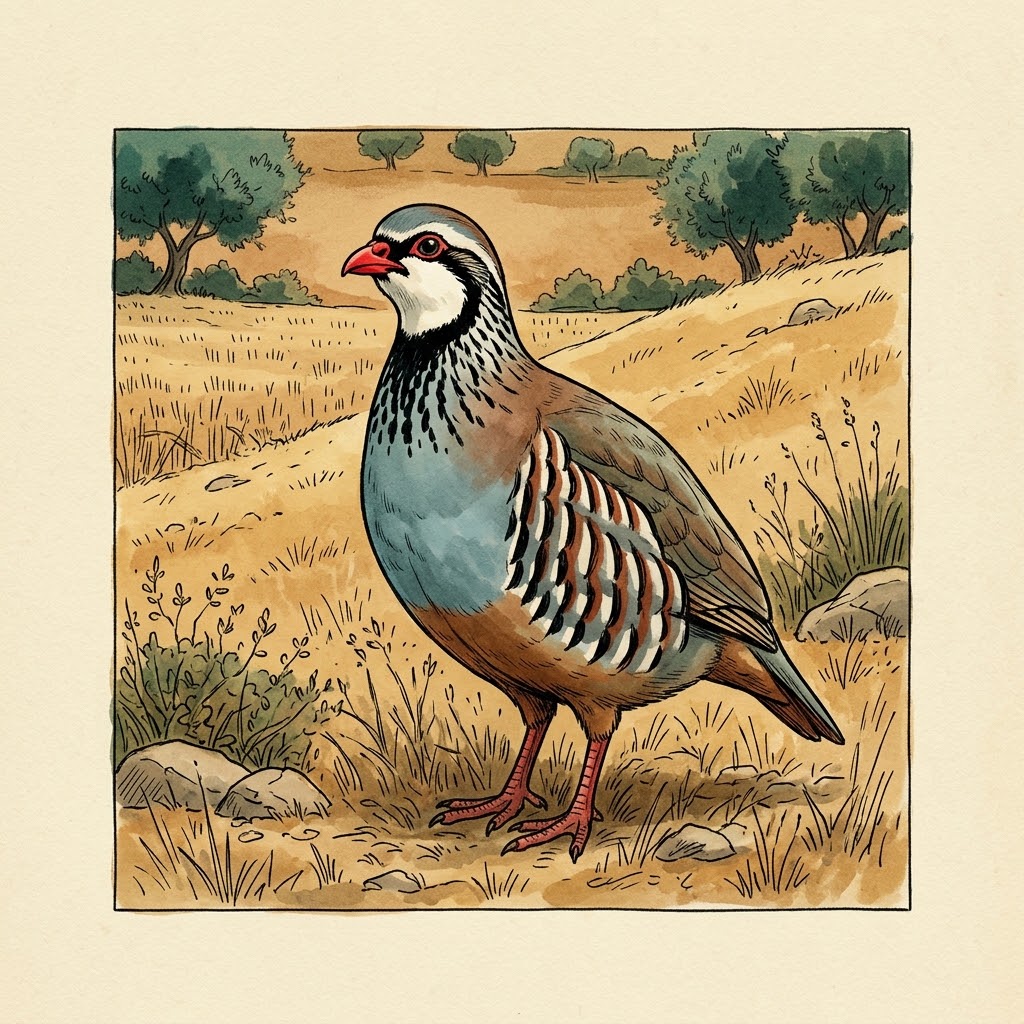
On a dry spring morning a rasping ‘chuck-chukar’ carries over the Castilian hills. That is the red-legged partridge, the bird with a red bill and red legs that is almost as familiar in Spain as the bull. It belongs to the countryside and the kitchen, but its wild numbers are under pressure.
| Habitat | Arable fields, stubble, vineyards and olive groves with scrub and field margins |
| Size | 32–35 cm; 400–550 grams |
| Active | By day, especially early morning and evening |
Card I of IV
Ecological passport
| Identification | Red bill and red legs, white throat with a black border breaking into black streaks, blue-grey breast, and flanks barred grey, rust, white and black |
| Don’t confuse with | The grey partridge of northern Europe, which has an orange-brown face, grey legs and no black necklace |
| Diet | Seeds, grain, buds and leaves; chicks eat mainly insects |
Where can you see them?
Difficulty: ●●●●● Fairly easy
Drive country lanes early in the morning; partridges often walk along the verge or call from a stone.
| Castile | The hills and fields around Toledo and the Campo de Montiel in Ciudad Real |
| Also good | The dehesas and steppes of Extremadura, such as La Serena |
| Tip | Listen for calling in March and April, when they are most active |
Did you know a female red-legged partridge sometimes has two nests at once? She incubates one and the male the other.
Card II of IV
Behaviour & season
In autumn and winter red-legged partridges live in small groups, called bandos in Spanish. At the end of winter these break up into pairs that defend their territory noisily. The female lays ten to fifteen eggs in a scrape under a bush. The chicks can walk within hours and follow their parents in search of insects.
| February – April | Pairing; males call from a stone or mound |
| May – June | Incubation and the first chicks |
| Summer | Families with young on the stubble fields |
| Autumn – winter | Groups of ten to twenty birds |
When is the best time to see them?
| Jan | Feb | Mar | Apr | May | Jun | Jul | Aug | Sep | Oct | Nov | Dec |
| winter | calling · best time | chicks & families | groups | ||||||||
■ Good chance ■ Fair chance ■ Difficult
Card III of IV
From field to plate
In Spain partridge is a classic game dish of autumn and winter. Much of the partridge sold by Spanish game dealers now comes from specialised farms; wild numbers have shrunk sharply because of intensive farming, pesticides and the loss of field margins. The meat is lean, mild in flavour and a little firmer than chicken.
Buy partridge from a poulterer or game dealer who can tell you where the meat comes from, and eat it in moderation: the wild red-legged partridge is having a hard enough time.
Seasons and preparation vary by region and year. Ask your poulterer what is fresh right now.
Card IV of IV
Recipe & tradition
Perdiz escabechada
| Partridge | Two dressed partridges, whole or halved |
| Escabeche | Plenty of olive oil, a whole head of garlic, onion, carrot, bay leaves, black peppercorns, white wine and wine vinegar |
| Method | Brown the partridges in the oil, then cook gently with the vegetables, wine and vinegar until tender, about an hour |
| To serve | Lukewarm or cold, with bread and a fresh salad; the flavour improves after a day’s rest |
Escabeche, preserving in oil and vinegar, is an old way of keeping meat and fish longer; the technique probably reached Spain through Arab cooking. Around Toledo, perdiz escabechada is the region’s best-known dish. Spanish fairy tales don’t end with ‘and they lived happily ever after’ but with y fueron felices y comieron perdices: and they were happy and ate partridges.
Frequently asked questions
Questions about the red-legged partridge
What is the difference between a red-legged and a grey partridge?
The red-legged partridge has a red bill, red legs and a white throat with a black border. The grey partridge has an orange-brown face and grey legs.
Where can you see red-legged partridges in Spain?
On farmland, in vineyards and olive groves across rural Spain, for example around Toledo, in the Campo de Montiel and in Extremadura.
What is perdiz escabechada?
Partridge cooked gently in olive oil, vinegar, wine, garlic and herbs. It is a traditional dish from the area around Toledo.
Habitat · Spain