Mammal · Dehesa & sierra
Genetta genetta
● IUCN: least concern · widespread in Spain
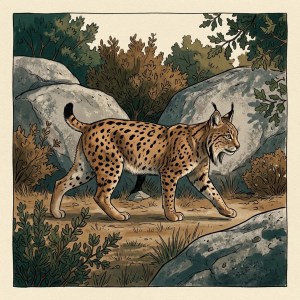
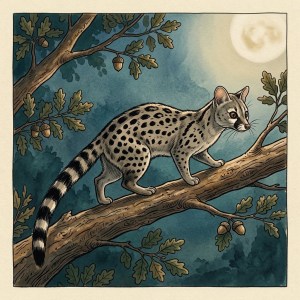
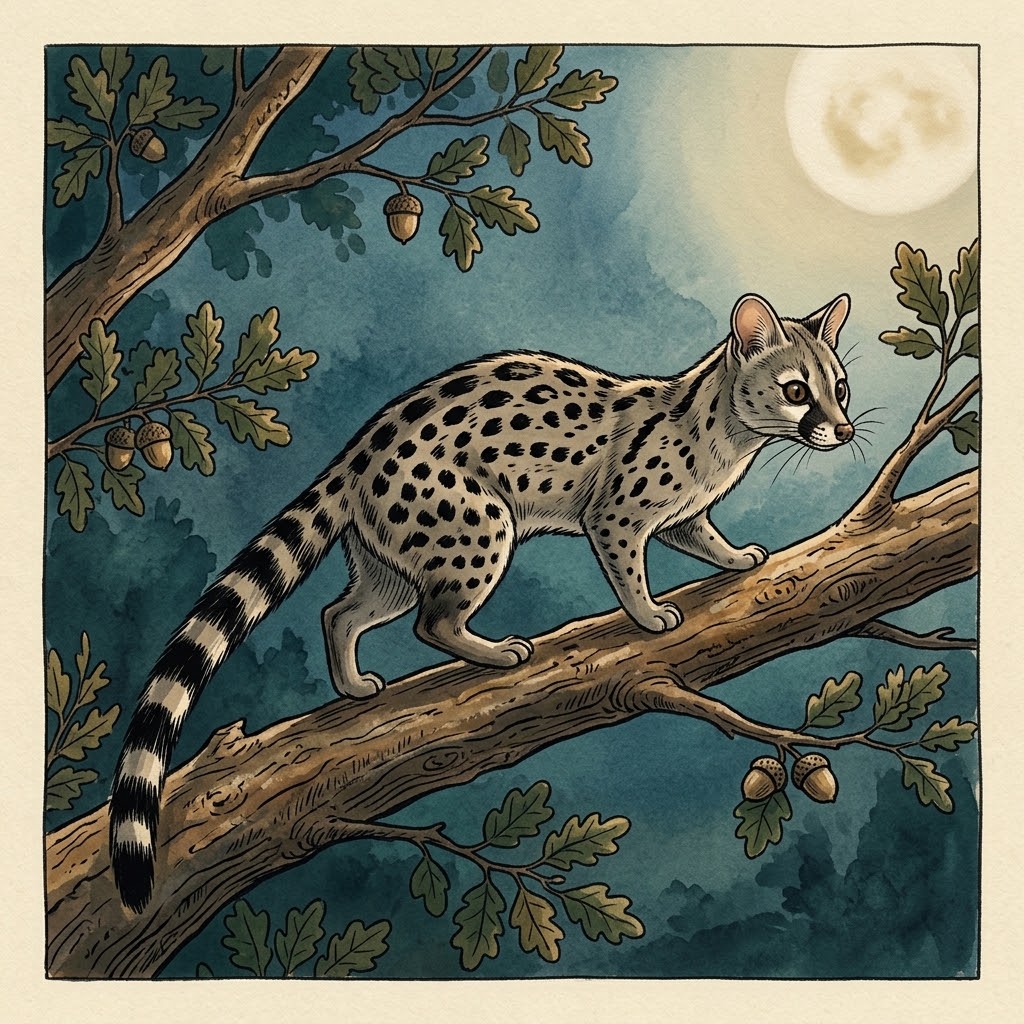
A slender body covered in black spots, a long ringed tail and big eyes that shine in the dark. The common genet looks like a small leopard, but it isn’t a cat. It lives across almost all of Spain, yet few people ever see one: it only comes out after dark.
| Habitat | Woods, dehesa, scrub and rocky slopes, often near water |
| Size | Body 40–55 cm, tail almost as long; 1.5–2.5 kg |
| Active | At night; by day it sleeps in a tree hollow or rock crevice |
Card I of IV
Ecological passport
| Identification | Slender grey-beige body with rows of black spots, a long tail with black and pale rings, a pointed snout and large eyes |
| Don’t confuse with | The wildcat, which is stockier and has a thick tail with a few black rings and a blunt black tip |
| Diet | Mainly wood mice and other rodents; also birds, lizards, insects and fruit |
Where can you see them?
Difficulty: ●●●●● Rare chance
You almost only see one by chance, in your headlights or by torchlight on a night walk.
| Everywhere | Across almost all of Spain, especially the dehesas and mountain woods of the south and west |
| Good chance | Night safaris in Monfragüe and the Sierra de Andújar |
| Tip | Look for ‘latrines’: regular spots on rocks or branches where genets leave their droppings together |
Did you know a genet uses its tail for balance? That lets it walk effortlessly along thin branches, almost like a tightrope walker.
Card II of IV
Behaviour & season
The genet is solitary and an excellent climber. At night it creeps through the trees and over rocks looking for mice and roosting birds. By day it rests in a tree hollow, an old nest or among boulders. Genets communicate mainly by scent: they leave their droppings together at fixed spots, some of which are used for years. Two or three young are born in spring.
| Winter | Mating season |
| April – May | Young born in a hollow |
| Summer | Young learn to hunt with their mother |
| Autumn | Lots of fruit on the menu; young animals look for their own range |
When is the best time to see them?
| Jan | Feb | Mar | Apr | May | Jun | Jul | Aug | Sep | Oct | Nov | Dec |
| always difficult · night only | warm nights · young animals | winter | |||||||||
■ Good chance ■ Fair chance ■ Difficult
Card III of IV
Role in the ecosystem
The genet is one of the most important mouse-catchers of Spain’s woodlands. A single animal eats hundreds of rodents a year, helping to prevent mouse plagues. In autumn it eats a lot of fruit, such as strawberry-tree berries, figs and olives. The seeds pass through undamaged and end up in its latrines, often high on a rock, so it helps plants spread.
Give them a chance: leave old trees, dry-stone walls and shrubs around your garden or holiday home. Genets shelter in them, and keep the mice away from you.
Card IV of IV
Stories & culture
An African in Europe
The genet is not a true cat but a member of the civet family, related to the mongooses, a group that lives mainly in Africa and Asia. DNA research shows that Europe’s genets descend from North African animals. They were probably brought over by people centuries ago, and then spread across the whole Iberian Peninsula and part of France. In Spanish it is called gineta.
Frequently asked questions
Questions about the common genet
Is a genet a cat?
No. It looks like a cat, but it belongs to the civet family, related to the mongooses.
Where does the genet live in Spain?
Across almost all of Spain, in woods, dehesa and scrub. You mainly see it at night, for example on a night safari in Monfragüe or the Sierra de Andújar.
Is a genet dangerous?
No. It is shy, about the size of a small cat and flees from people.
Habitat · Spain