Bird of prey · Dehesa & sierra
Aquila adalberti
● IUCN: vulnerable · EU Birds Directive Annex I
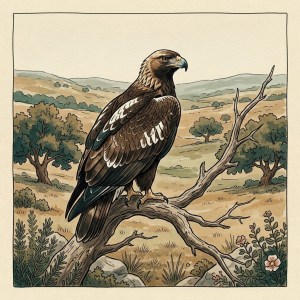
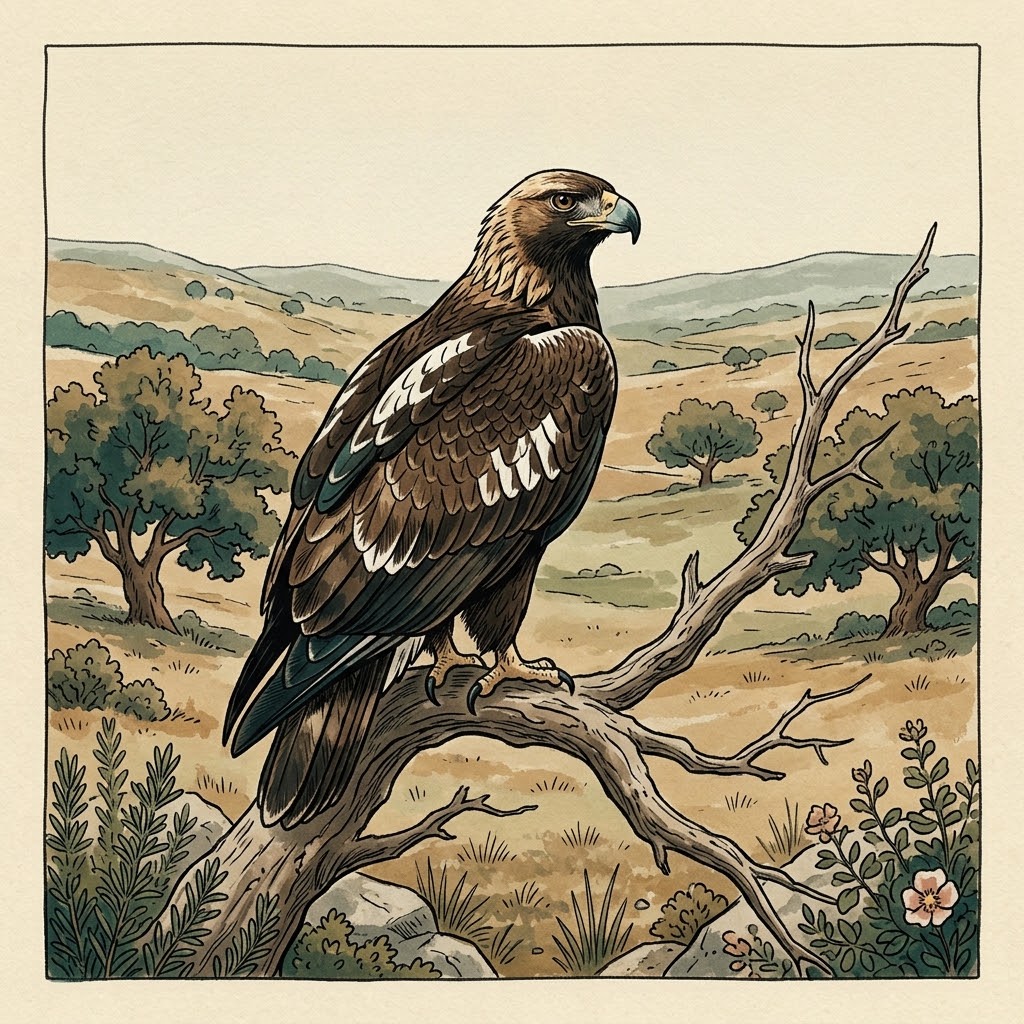
This eagle breeds nowhere in the world except the Iberian Peninsula. In 1974 only 39 pairs were counted. Half a century of protection later there are more than 800, and anyone who spots a large dark eagle with white shoulders in the dehesa is looking at one of Spain’s finest recovery stories.
| Habitat | Open dehesa and plains with scattered large trees and plenty of rabbits |
| Size | Length 75–85 cm, wingspan 1.8–2.2 m |
| Active | By day; often sits for long periods on a lookout |
Card I of IV
Ecological passport
| Identification | Adults dark brown with a striking white leading edge to the wing, white shoulder patches and a pale golden nape; young birds are tawny |
| Don’t confuse with | The golden eagle, which has no white shoulders and hunts more often in rocky mountains |
| Diet | Mainly rabbits; also partridges, pigeons, ducks and crows |
Where can you see them?
Difficulty: ●●●●● Moderate
With a telescope and some patience you will find it on its regular perch, usually a dead branch or a pylon.
| Extremadura | Monfragüe National Park and the dehesas around Trujillo |
| Also good | Doñana, the Sierra de Andújar, Cabañeros and the Monte de El Pardo near Madrid |
| Tip | Stay well away from nests, especially from February to June; disturbance can cost a brood |
Did you know a young imperial eagle only looks like an adult after five years? Its plumage gets a little darker every year.
Card II of IV
Behaviour & season
Imperial eagles live in the same territory all year and pair for life. They build their large nest at the top of a tree, often a cork oak or pine, rather than on cliffs like the golden eagle. In winter pairs put on impressive display flights, diving and touching talons. Usually two or three young are raised.
| December – February | Display flights and nest building |
| March – April | Incubating two or three eggs |
| May – July | Young in the nest; they fledge in summer |
| Autumn | Young eagles wander, sometimes as far as Morocco |
When is the best time to see them?
| Jan | Feb | Mar | Apr | May | Jun | Jul | Aug | Sep | Oct | Nov | Dec |
| display · best time | breeding · keep distance | heat | autumn | display | |||||||
■ Good chance ■ Fair chance ■ Difficult
Card III of IV
Role in the ecosystem
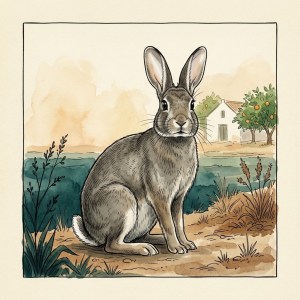
Like the Iberian lynx, the imperial eagle lives mainly on rabbits, and like the lynx it suffered badly from the rabbit diseases. As a predator at the top of the food chain it is a gauge of a healthy dehesa: where imperial eagles breed there is enough prey, old trees and peace.
Danger from power lines: electrocution on pylons is the main non-natural cause of death. Since 2008, Spanish law has required power lines to be made safe for birds, and that is helping. Poison baits also remain a problem.
Card IV of IV
Stories & culture
An eagle named after a prince
The scientific name adalberti honours Prince Adalbert of Bavaria, who travelled through Spain in the nineteenth century. For a long time the bird was seen as a subspecies of the eastern imperial eagle; only later was it recognised as a species of its own. In the 1970s the famous Spanish wildlife filmmaker Félix Rodríguez de la Fuente warned on television that the eagle was close to extinction, which helped get protection going. In 1974 there were 39 pairs; by 2022 there were at least 841, almost all in Spain.
Frequently asked questions
Questions about the Spanish imperial eagle
How many Spanish imperial eagles are there?
The 2021–2022 census found at least 841 breeding pairs: 821 in Spain and about 20 in Portugal.
Where can you see a Spanish imperial eagle?
In Monfragüe, Doñana, the Sierra de Andújar and the Monte de El Pardo near Madrid. It often perches on a dead branch or pylon overlooking open ground.
How do you recognise a Spanish imperial eagle?
By its dark brown plumage with a white leading edge to the wings and white shoulder patches. The nape is pale golden.
Habitat · Spain