Bird of prey · Dehesa & sierra
Aegypius monachus
● IUCN: near threatened · EU Birds Directive Annex I
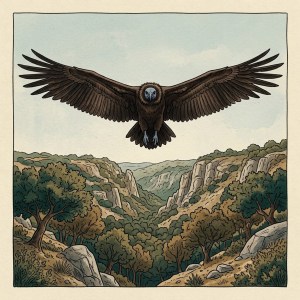
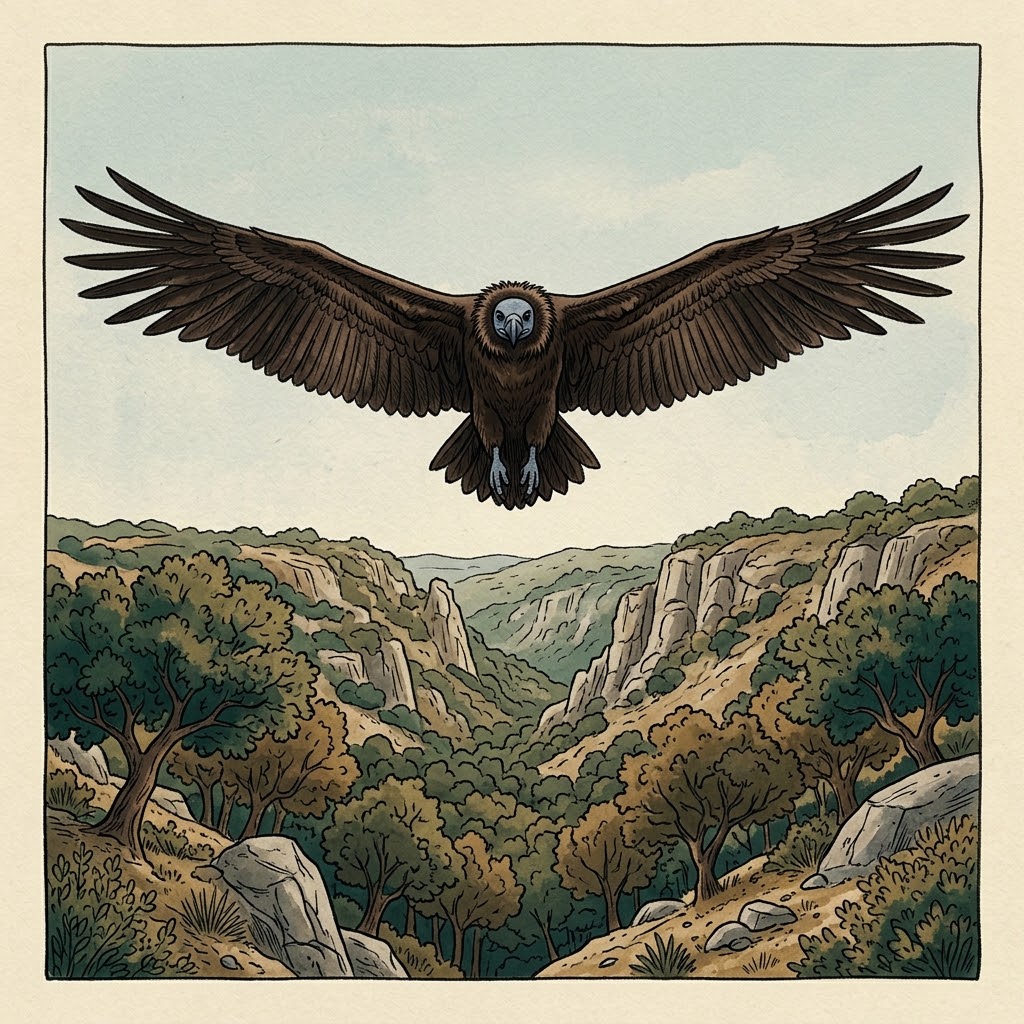
With a wingspan of almost three metres, the cinereous vulture is Europe’s largest bird of prey. From a distance it looks like a flying door. Spain is its stronghold: the great majority of Europe’s cinereous vultures breed here, and Monfragüe in Extremadura is one of the best places to see them.
| Habitat | Dehesa, wooded hills and mountain slopes with large old trees |
| Size | Wingspan 2.5–2.9 m; weight 7–12 kg |
| Active | By day, especially once the sun warms the air |
Card I of IV
Ecological passport
| Identification | Very large and dark chocolate brown, with a bare blue-grey head and a ruff of feathers on the neck; broad, rectangular wings with spread ‘fingers’ |
| Don’t confuse with | The griffon vulture, which is paler sandy brown, has a white downy ruff and nests in colonies on cliffs |
| Diet | Carrion: dead sheep, deer, rabbits and boar; it mainly eats the tough parts such as skin and tendons |
Where can you see them?
Difficulty: ●●●●● Fairly easy
On a sunny day in Monfragüe you are almost certain to see cinereous vultures, often together with griffons.
| Extremadura | Monfragüe National Park: the Portilla del Tiétar viewpoint and Monfragüe castle |
| Also good | Sierra de Andújar, Sierra de San Pedro and the Sierra de Guadarrama near Madrid |
| Tip | Arrive mid-morning, when warm air starts rising and the vultures take to the sky |
Did you know a cinereous vulture’s nest can grow to two metres across? A pair uses the same nest for years and keeps adding to it.
Card II of IV
Behaviour & season
Unlike the griffon vulture, the cinereous vulture does not nest on cliffs but at the top of a tree: a cork oak, holm oak or pine on a quiet slope. Pairs stay together for life. They lay one egg a year and look after the chick together for almost six months. By day they soar for hours on rising warm air, scanning the landscape for carrion.
| January – February | Display flights and nest building |
| February – April | The single egg is incubated for almost two months |
| April – September | The chick grows up in the nest |
| Autumn – winter | Young vultures wander widely, sometimes hundreds of kilometres |
When is the best time to see them?
| Jan | Feb | Mar | Apr | May | Jun | Jul | Aug | Sep | Oct | Nov | Dec |
| winter | breeding · best time | heat · go early | autumn & winter | ||||||||
■ Good chance ■ Fair chance ■ Difficult
Card III of IV
Role in the ecosystem
Vultures are the landscape’s clean-up crew. They clear away dead animals before they rot and spread disease. At a carcass the species work together: the cinereous vulture’s powerful bill tears open the tough hide, after which the griffons can reach the soft meat. Where vultures disappear, feral dogs and rats take their place.
From near-loss to stronghold: in the 1970s only a few hundred pairs were left in Spain. Thanks to protection of nest trees and a ban on poison baits, numbers have since grown many times over. Poison, power lines and wind turbines remain a threat.
Card IV of IV
Stories & culture
A monk in the sky
Its Dutch and scientific names refer to a monk: the ruff of feathers around the bare head looks like a monk’s hood. In Spanish it is the buitre negro, the black vulture. Monfragüe became a national park in 2007, partly because of its vultures, and the Salto del Gitano cliff opposite the castle is one of Spain’s best-known birdwatching spots. Spanish cinereous vultures have also been used to bring the species back to Mallorca and France.
Frequently asked questions
Questions about the cinereous vulture
What is the difference between a cinereous and a griffon vulture?
The cinereous vulture is larger and dark brown, with a bare blue-grey head, and nests in trees. The griffon is sandy brown, has a white ruff and nests on cliffs.
Where can you see cinereous vultures in Spain?
Most easily in Monfragüe National Park in Extremadura. They are also regularly seen in the Sierra de Andújar and the Sierra de Guadarrama.
Is the cinereous vulture Europe’s largest bird?
It is Europe’s largest bird of prey, with a wingspan of up to almost three metres. Only the bearded vulture comes close in wingspan.
Heading out? Read our guide vulture and bird watching in Monfragüe, with the best viewpoints and times.
Habitat · Spain